
Your office closes at five. Your callers do not stop shopping for cover at five. The gap between those two facts is where brokerages quietly leak new business every week.
This is how an AI voice agent for insurance brokers closes that gap. After-hours intake, renewals and first-notice-of-claim triage, all under NZ and AU privacy rules.
What does an AI voice agent do for an insurance brokerage?
An AI voice agent for insurance brokers answers every call, day or night, qualifies the enquiry and routes it to the right adviser. It captures the caller's details, the cover they want and the urgency. Then it books a callback or escalates a claim.
Most brokerages run lean. Two or three advisers, one front-desk person, a phone that rings while everyone is on another call. A missed call is a missed quote.
The agent picks up on the first ring, every time. It does not take lunch. It works the hours your callers actually call.
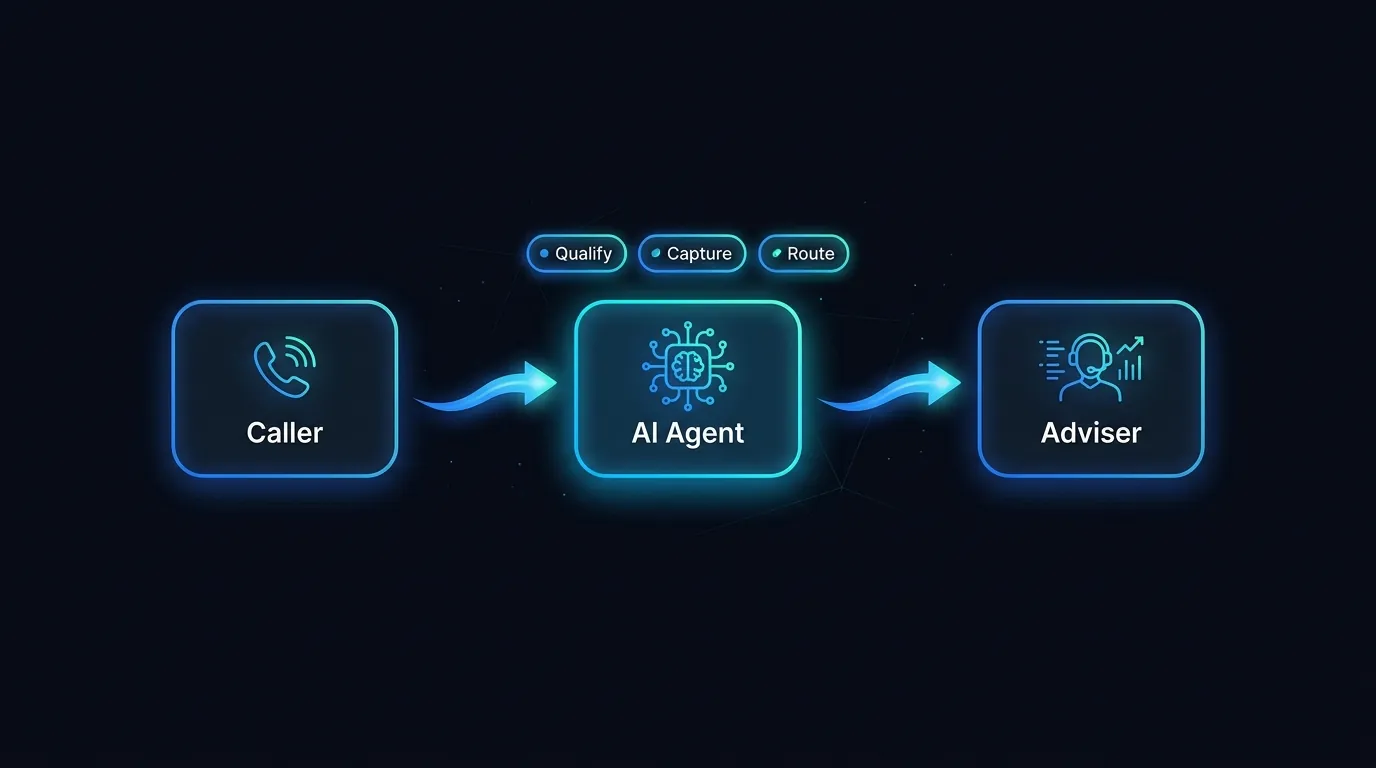
The agent answers, qualifies and routes the enquiry while your office is dark.
Why do brokers lose enquiries after hours?
Brokers lose enquiries after hours because the people shopping for cover ring outside business hours. Someone settles a house at 6pm and needs landlord cover by morning. Your office is dark, so the call goes to voicemail and the caller rings the next broker.
Think about when people actually deal with insurance. After a near-miss. After the bank emails about a mortgage.
We tested call patterns across NZ and AU brokerages. A meaningful share of new-business calls arrive evenings and weekends. Every one of those that hits voicemail is a coin flip on whether you ever hear from them again.
The agent removes the coin flip. It answers, it qualifies, it books the follow-up while the caller is still motivated. Our guide to following up hot leads fast shows why those first minutes decide the outcome.
How does it qualify and route a new enquiry?
It asks a short set of questions and captures the answers as a structured record. Then it routes the lead to the right adviser by line of business. Car, home, commercial, life. The caller never sits on hold.
Here is a real scene. A caller rings at 7pm wanting cover for a new van. The agent confirms the vehicle, the use, the start date and the best callback time.
It tags the enquiry as commercial motor. It drops the record into your CRM. Your commercial adviser opens the day with the quote half-built.
The agent discloses it is an AI on every call. Callers know who they are talking to. In our experience that honesty raises trust rather than lowering it.
Routing matters because a misrouted lead is a slow lead. A life enquiry sitting in the car-insurance queue goes cold. The agent reads the line of business from the conversation and sends it where it belongs.
Stop losing the 7pm quote.
See how an AI voice agent for NZ insurance brokers turns after-hours calls into booked follow-ups.
How does it handle renewals and a first notice of claim?
For renewals, the agent runs outbound reminder calls and confirms whether the client wants to keep, change or cancel cover. For a first notice of claim, it triages the call, captures the facts and escalates anything urgent to a human straight away. Routine renewals get handled. Real distress reaches a person.
Renewals are quiet revenue. A client who forgets to renew is a client who lapses or shops around. An outbound reminder call costs you about a dollar or two for a one to two minute conversation.
First notice of claim is more sensitive. Someone has had a prang or a break-in. The agent takes the basics calmly. Date, what happened, policy number, contact details.
A car written off on the motorway is a now call. A cracked windscreen is a tomorrow call. The agent knows the difference and acts on it. We cover that human handoff line in our piece on why voice AI agents still need humans.
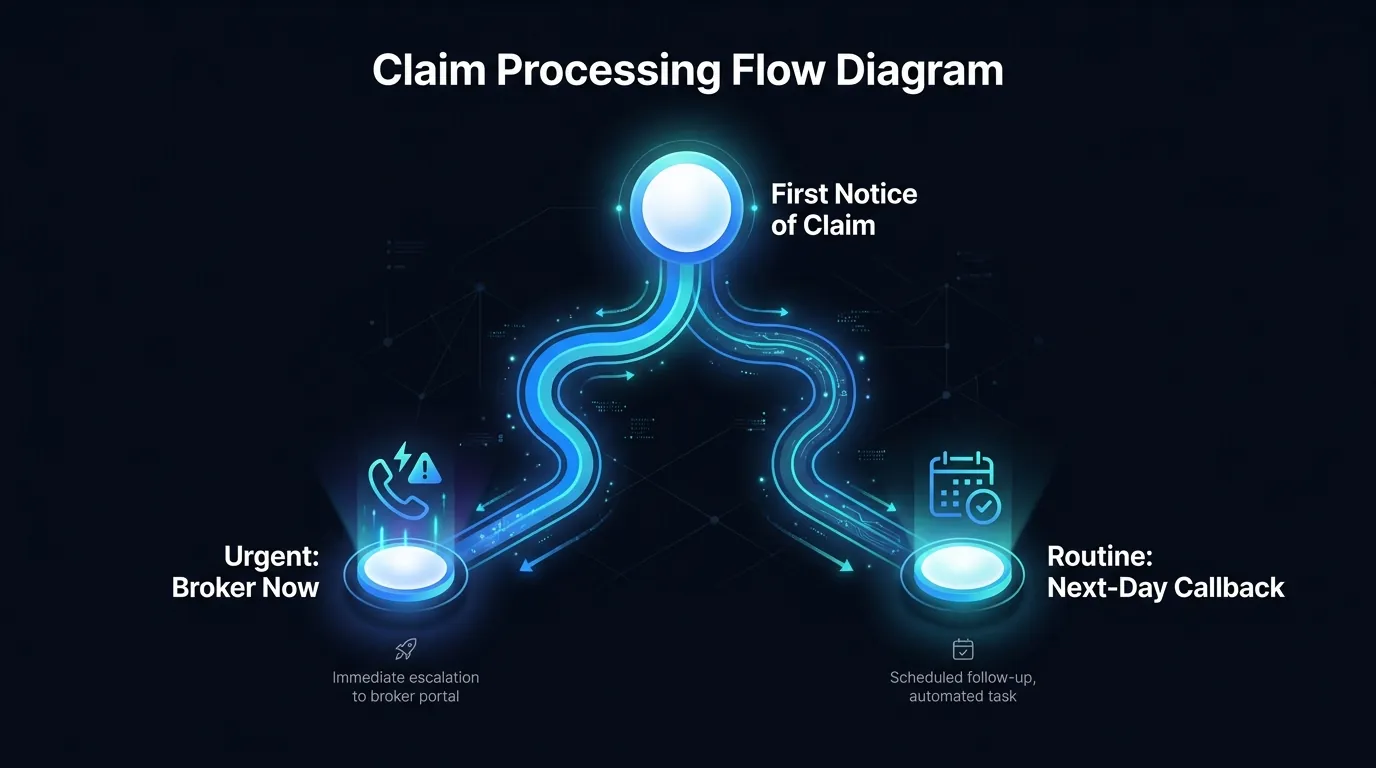
A serious claim reaches a broker now; a windscreen chip gets a next-day callback.
How does it keep client financial data private?
Your portal, transcripts and structured client records live on our servers in Sydney. Live call audio is processed offshore by our voice infrastructure partner under documented arrangements. We never tell you all data stays in Australia, because that would not be true. We tell you exactly where each part sits.
Insurance brokers hold sensitive information. Income, assets, health details, claim histories. Both privacy regimes take that seriously.
In New Zealand you sit under the Privacy Act 2020 and the Office of the Privacy Commissioner. In Australia you sit under the Privacy Act 1988, the 13 Australian Privacy Principles and the OAIC. A reportable breach goes through the Notifiable Data Breaches scheme.
Consent is built in. The agent discloses it is an AI and that the call is recorded. If a client asks you to remove their data, we can delete their records promptly on request.
We go deeper on the NZ side in our guide to the NZ Privacy Act 2020 and AI voice agent compliance.
When should a call reach a broker?
A call should reach a broker the moment it stops being routine. A serious claim, a complex commercial risk, a frustrated client, a high-value new opportunity. The agent handles the ordinary volume and lifts the human into the calls that need judgement.
The point is not to replace your advisers. The point is to protect their time. A broker spending the morning on voicemail is a broker not writing new business.
Set the escalation rules to your appetite. Some brokerages want every life enquiry to reach a person. Others only want claims above a threshold escalated live.
A frustrated caller is always a human call. The agent reads tone and hands off when someone needs reassurance a script cannot give. That balance, automation for volume and humans for nuance, is the whole game.
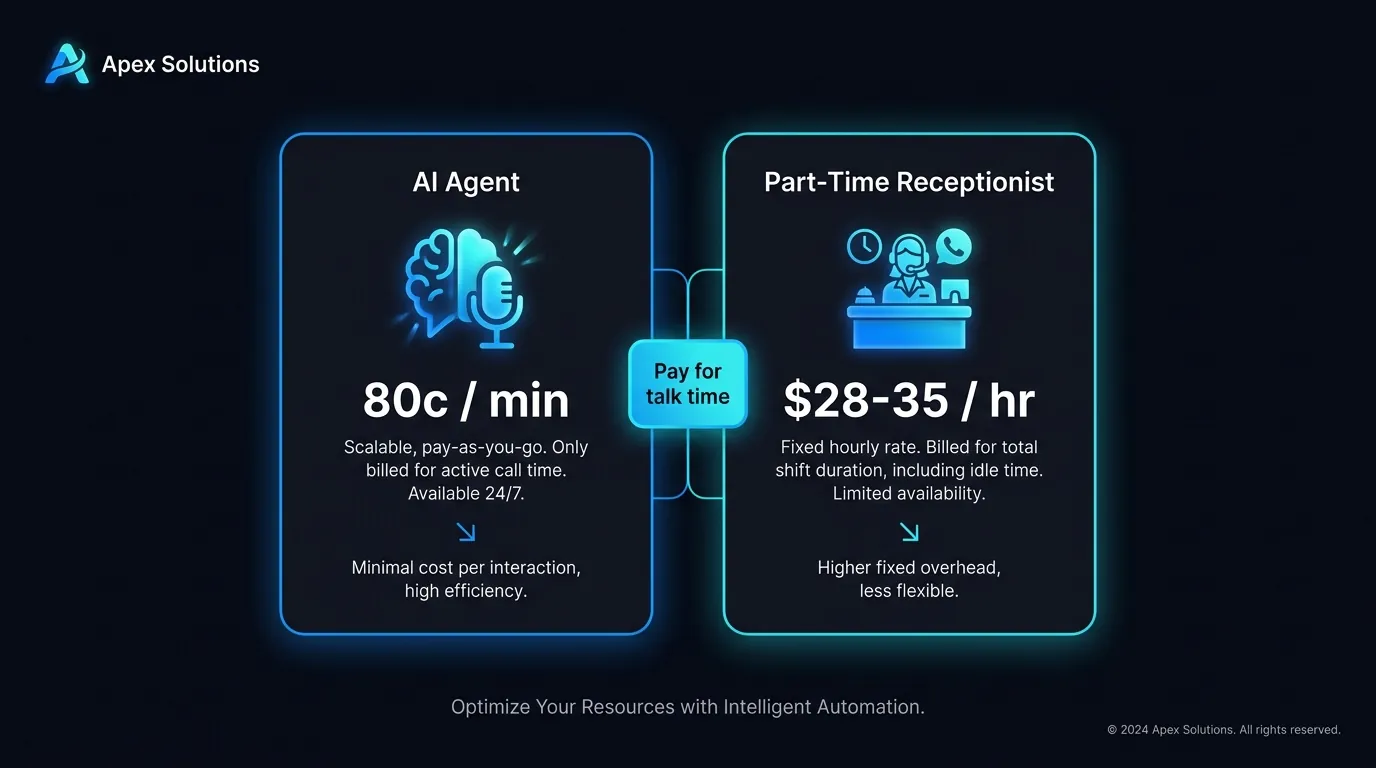
You pay for talk time, not idle salary, and you cover the hours staff never will.
What does it cost a NZ or AU brokerage?
It costs about 80 cents a minute, billed by the second, in NZD or AUD. An average answered call runs about 30 seconds, so roughly 40 cents. A one to two minute renewal or enquiry call lands around one to two dollars. A 200-dial renewal campaign costs about 100 dollars.
Compare that to a part-time receptionist at about 28 to 35 dollars an hour before KiwiSaver or super, ACC and holiday pay. The agent covers nights and weekends those staff never will.
Real numbers from our other clients show the shape of the return. A Sydney sales agent produced 141 qualified leads in 90 days at 32.74 dollars per lead. A Christchurch developer booked viewings at 7.12 dollars each.
You only pay for talk time. No idle salary. No call you missed because everyone was busy.
Run the numbers for your brokerage.
Book a walkthrough of the AI voice agent for AU insurance brokers, or see how it works as a NZ inbound receptionist.
Frequently Asked Questions
Does the AI voice agent tell callers it is an AI?
Yes, on every call. The agent discloses it is an AI and that the call is recorded before it collects any details. This meets disclosure expectations under both the NZ Privacy Act 2020 and the Australian Privacy Principles. In our experience callers trust the agent more, not less, when it is upfront about what it is.
Can it work with my existing CRM and broking system?
Yes. The agent drops structured records into your CRM so advisers open the day with a tidy brief instead of a voicemail. We have written about a full CRM-connected setup in our piece on an ActiveCampaign AI voice agent for an insurance broker. The agent fits around your existing tools.
What happens during a first notice of claim?
The agent triages the call. It captures the date, what happened, the policy number and contact details, calmly and in plain English. If the claim is urgent, like a car written off on the motorway, it escalates to a broker straight away. Routine matters, like a cracked windscreen, get booked for a next-day callback.
Where is my clients' data stored?
Your portal, transcripts and structured client records sit on our servers in Sydney. Live call audio is processed offshore by our voice infrastructure partner under documented arrangements. We never claim all data stays in Australia. If a client asks, we can delete their records promptly on request, which supports your obligations under the OPC and the OAIC.
How much does it cost to run renewal reminder calls?
About 80 cents a minute, billed by the second. A one to two minute renewal call lands around one to two dollars. A 200-dial renewal campaign costs about 100 dollars. Set against a lapsed policy or a part-time receptionist at 28 to 35 dollars an hour, the maths usually favours the agent.
Will it replace my brokers?
No. The agent handles routine volume, after-hours enquiries and renewal reminders. It lifts your brokers into the calls that need judgement, like serious claims and complex commercial risk. A frustrated caller always reaches a human. The aim is to protect adviser time, not remove the people clients trust. See our note on AI receptionist appointment booking for how the two work together.
See our approach to voice AI security and compliance.
Leonardo Garcia-Curtis
Founder & CEO at Waboom AI. Building voice AI agents that convert.
Ready to Build Your AI Voice Agent?
Let's discuss how Waboom AI can help automate your customer conversations.
Book a Free Demo

