
An AI voice agent for physiotherapists answers every booking and reschedule call while your therapists stay hands-on with patients. It books appointments, moves them, sends reminders and only passes a call to a human when it should. The front desk stops missing calls. Your therapists stop interrupting treatment to grab the phone.
We build these agents for physio and allied health clinics across New Zealand and Australia. This article covers the basics. What the agent does. Why the desk misses calls. How it books, cuts no-shows, protects patient data, knows when to reach a person, and what it costs.
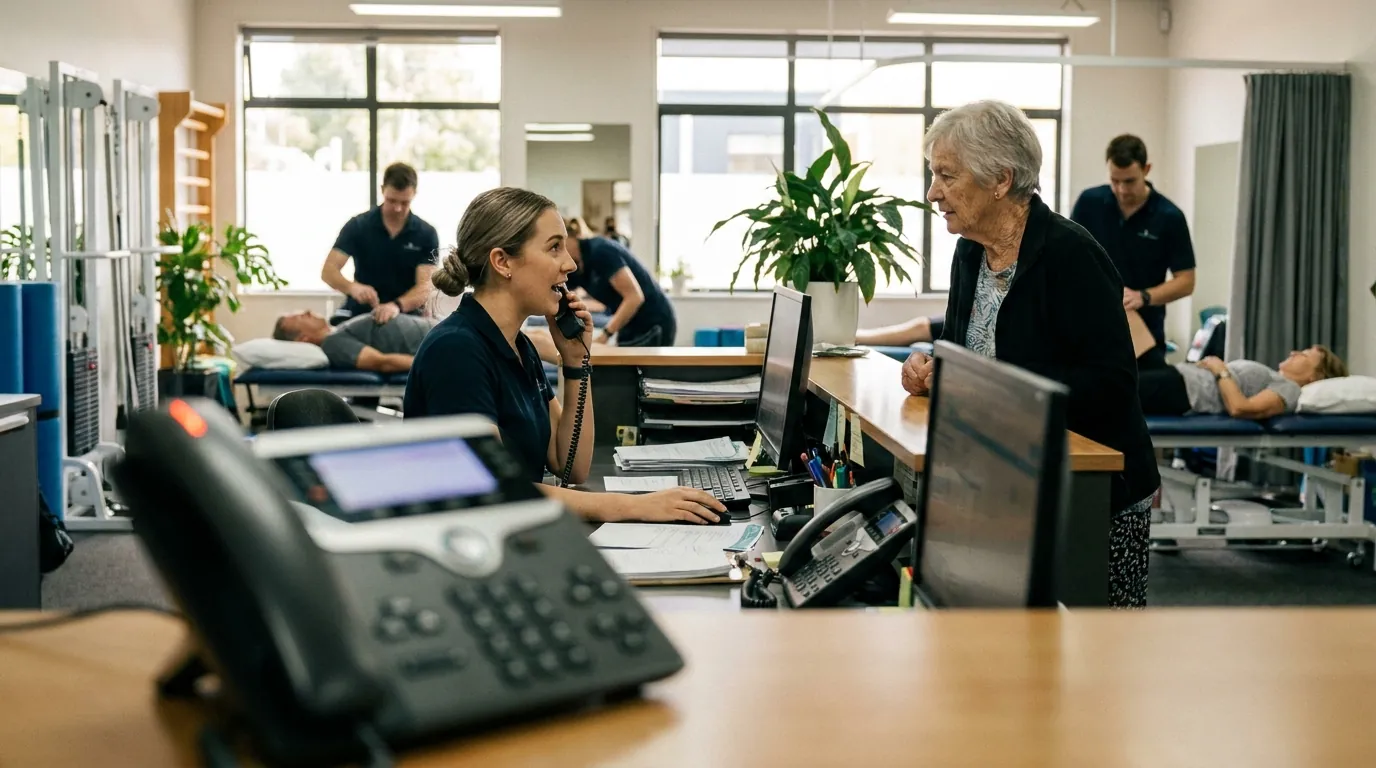
Peak hour at a physio clinic is exactly when the desk cannot get to the phone.
What does an AI voice agent do for a physiotherapy clinic?
It picks up the phone, books and moves appointments, answers common questions and texts confirmations. It works every hour your clinic is open and every hour it is not. The agent tells callers it is an AI at the start of the call.
Think of a Tuesday at 4pm. Three therapists are mid-treatment. The phone rings four times in ten minutes. A new patient wants a Thursday slot. A current patient needs to move Friday. Someone asks about ACC cover. The agent handles all four at once without anyone leaving a treatment room.
The agent knows your schedule, your services and your fees. It speaks in full sentences and waits for the caller to finish. It does not put people on hold. It does not lose the booking because the desk was busy.
This is the same pattern we run for medical practices. You can see it applied to general clinics in our piece on the AI receptionist for medical clinics in NZ.
Why does the physio front desk miss calls?
The desk misses calls because one person cannot treat patients, greet walk-ins and answer the phone at the same time. Clinics lose bookings in the gaps. Most missed calls happen at peak hours and after close, when nobody is there to pick up.
Picture the reception at 8:45am. The first patients are arriving. The phone rings while your receptionist is checking someone in and printing an ACC form. The caller waits, then hangs up. That caller often books with the next clinic on their search.
After hours is worse. People injure themselves on weekends and call on Sunday night. If nobody answers, the booking is gone by Monday. A clinic that misses ten calls a week at an average new-patient value can lose thousands a month in treatment revenue.
The agent removes the gap. It answers on the first ring at 8:45am, at 9pm, and on Sunday. Nobody waits on hold. Nobody hangs up.
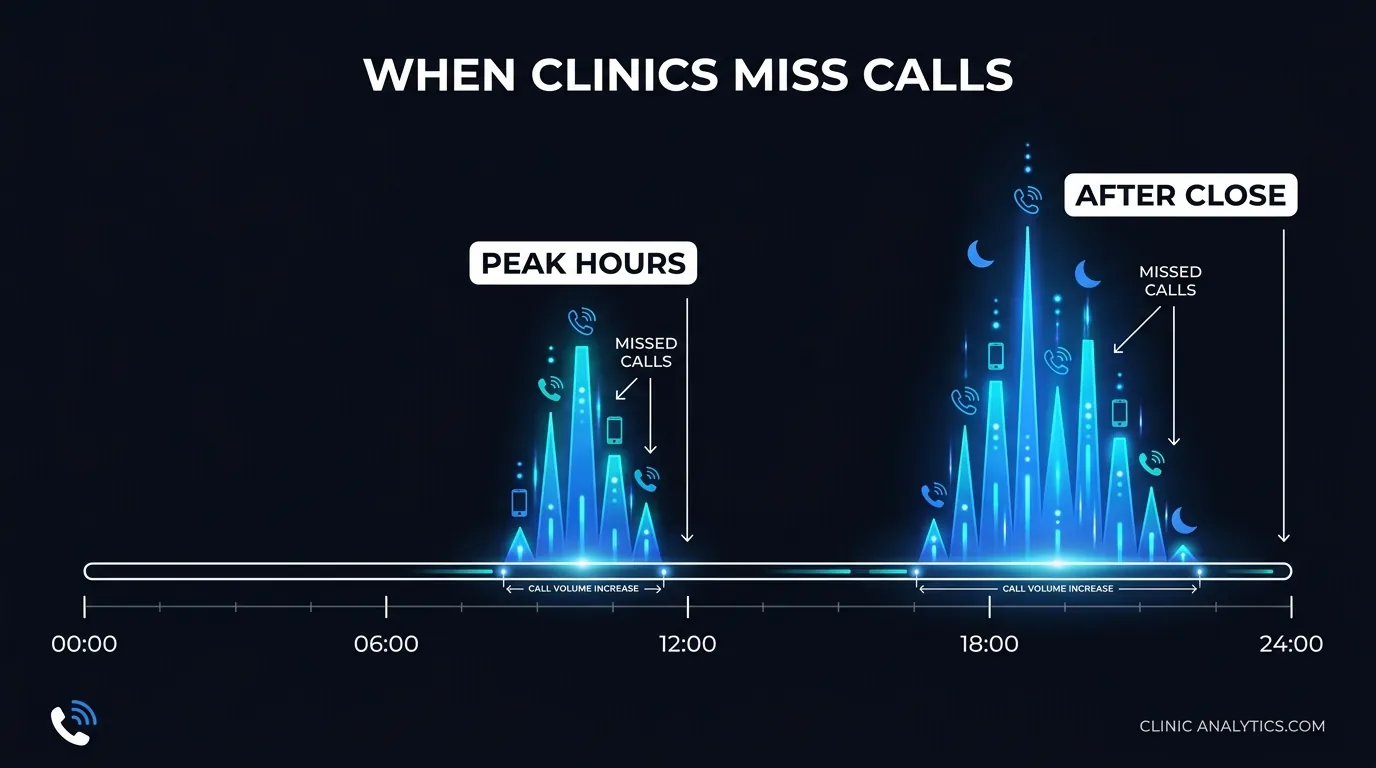
Missed calls cluster at peak hours and after close, the exact times bookings are won or lost.
Stop losing bookings in the gaps.
See how we set up phone answering for clinics in our healthcare voice agent overview.
How does it book and reschedule appointments?
The agent reads your live calendar, offers real open slots and writes the booking straight in. To reschedule, it finds the existing appointment, cancels it and books the new time in one call. The caller gets a text confirmation before they hang up.
Here is the flow on a reschedule. A patient says they cannot make Friday at 2pm. The agent confirms who they are. It finds the Friday slot, reads back two or three alternatives, and books the one they pick. Then it frees the Friday slot so another patient can take it.
It handles new bookings the same way. It asks the service, checks duration and matches a therapist with an opening. For ACC versus private, it captures the right details up front. Your desk is not chasing claim numbers later.
We cover the booking mechanics in depth in our guide on how an AI agent handles appointment booking. The short version: the booking lands in your calendar in real time, not in a voicemail someone transcribes tomorrow.
How does it cut no-shows with reminders?
The agent sends timed text and voice reminders before each appointment and lets patients confirm, move or cancel by reply. No-shows drop because patients get a nudge and an easy way to act on it. A freed slot can be offered to someone on a waitlist.
Physio no-shows are expensive. A booked hour that nobody attends is an hour a therapist cannot bill. Send a reminder the day before and the morning of, and a chunk of those empty hours fill back up.
The reminder is not a dead-end. If a patient replies that they need to move, the agent reschedules them on the spot. If they cancel, the slot reopens and the agent can call the next person waiting. The desk does none of this by hand.
A reminder-and-rebook call runs 1 to 2 minutes, so about 1 to 2 dollars. It saves a billable physio hour. The maths is not close.
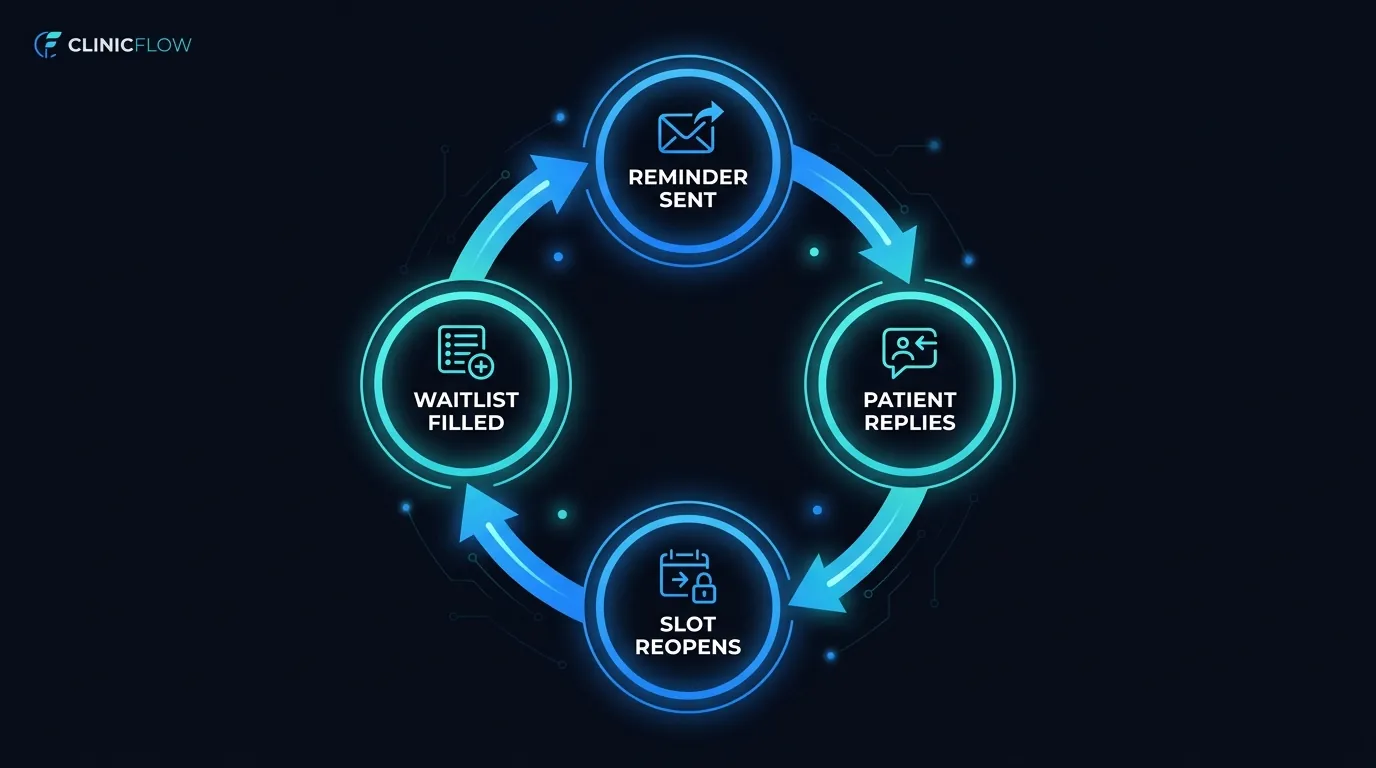
Every reminder is a two-way loop, so a freed slot reopens instead of sitting empty.
How does it keep patient data private?
Patient data is handled under clear rules and stored on our servers in Sydney. Your portal, transcripts and structured booking records sit in Sydney. Live call audio is processed offshore by our voice infrastructure partner under documented arrangements. We do not claim all data stays in Australia, because that would not be honest.
Health information is sensitive. In New Zealand the agent operates under the Privacy Act 2020 and the Health Information Privacy Code, overseen by the Office of the Privacy Commissioner. In Australia it operates under the Privacy Act 1988 and the 13 Australian Privacy Principles, the APPs, overseen by the OAIC.
In plain terms, that means three things for your clinic. You know where records live. You control who can see them. Every call is logged and disclosed as AI, so there are no surprises for your patients.
We go deeper on the New Zealand side in our write-up on Privacy Act 2020 compliance for voice agents. If you handle health data, read it before you sign with anyone.
When should a call reach a therapist?
A call should reach a human when it leaves routine ground. Clinical advice, a distressed caller, a complaint, or anything the agent is unsure about gets handed to your team straight away. The agent is built to route these, not to guess at them.
The agent is brilliant at bookings, reschedules, hours, fees and directions. It is not your physiotherapist. If a caller describes worsening symptoms or asks whether they should keep exercising an injury, that is a clinical question. The agent passes it to a person.
You set the rules. Maybe new acute injuries always reach a therapist. Maybe complaints go straight to the practice manager. The agent follows your escalation map every time, without forgetting under pressure.
We wrote about why voice agents still need humans for exactly this reason. The agent carries the routine volume so your people are free for the calls that need a human.
What does it cost a NZ or AU clinic?
You pay for the seconds the agent talks, at about 80 cents a minute in NZD or AUD, billed by the second. An average answered booking call runs about 30 seconds, so roughly 40 cents. A longer reschedule with reminders runs 1 to 2 minutes, so about 1 to 2 dollars.
Compare that to a part-time receptionist at about 28 to 35 dollars an hour before KiwiSaver or super, ACC and holiday pay. The agent does not call in sick, does not take lunch, and answers at 9pm on a Sunday.
A clinic taking 200 booking and reminder calls a month spends roughly 100 dollars on agent time. One recovered no-show or one captured after-hours new patient often covers the whole month. We break the numbers down further in our guide on what an AI receptionist costs.
The point is not that the agent is cheap. The point is that it answers the calls your desk drops, and those calls are worth more than the agent costs.
Ready to stop missing physio bookings?
Hear an agent answer a real inbound call on our inbound voice agent page, then talk to us about your clinic.
Frequently Asked Questions
Does the AI voice agent for physiotherapists tell callers it is an AI?
Yes. The agent discloses that it is an AI at the start of every call. This is built in, not optional. Patients know they are speaking with an assistant, and the call is logged. Disclosure keeps you onside with privacy expectations in both New Zealand and Australia and builds trust with your patients.
Can it handle ACC bookings and private appointments differently?
Yes. The agent captures the details each booking type needs, so ACC claims and private appointments are recorded correctly from the first call. It asks the right questions up front, including claim numbers where relevant. Your desk stops chasing missing information later, and your billing is cleaner from the start.
Will it work with our existing practice management calendar?
In most cases, yes. The agent reads live availability, books and reschedules straight into your calendar, then sends the patient a confirmation. We scope your specific setup during onboarding. If a direct connection is not possible, we set up a workflow that still lands every booking in your system in real time.
What happens to a call the agent cannot handle?
It routes to a human. Clinical questions, distressed callers, complaints and anything the agent is unsure about go to your team based on rules you set. The agent never improvises clinical advice. It carries the routine booking volume and hands off the calls that genuinely need a person.
How quickly can a physio clinic go live?
Most clinics are live within a couple of weeks. We map your services, fees, hours and escalation rules. We connect your calendar. We test the agent on real call scenarios before it answers a single patient. You sign off on how it sounds and behaves first. Nothing goes live without your approval.
Where is our patient data stored?
Your portal, transcripts and structured booking records are stored on our servers in Sydney. Live call audio is processed offshore under documented arrangements with our voice infrastructure partner. We are honest about this split rather than claiming everything stays in Australia. You always know where records live and who can access them.
For practices ready to fix this, see Waboom's medical answering service.
Leonardo Garcia-Curtis
Founder & CEO at Waboom AI. Building voice AI agents that convert.
Ready to Build Your AI Voice Agent?
Let's discuss how Waboom AI can help automate your customer conversations.
Book a Free Demo

