
What is conversational AI? It's software that understands spoken or typed language, works out what the person means, and replies in natural language. On a phone call it listens, thinks, and talks back like a person. No menus, no scripts, no buttons.
Most people meet conversational AI without naming it. You ring a clinic after hours and a calm voice answers. It asks why you're calling, checks the diary, and books you in.
That voice is conversational AI. It's not a recording and it's not a phone tree. The term covers anything that holds a real back-and-forth in human language.
At Waboom AI we build the spoken kind. An agent that answers your phone, talks to your customers, and gets things done.

Conversational AI listens, thinks, and speaks back in one fast loop.
What is conversational AI?
Conversational AI is software that understands human language, works out intent, and responds naturally in words. On a phone it listens to a live voice and talks back, no buttons involved. The same idea powers typed chat too, but the voice version is what answers your phone.
Think of it as a brain plus ears and a mouth. It catches what the caller says, decides what to do, and replies out loud. It can book a job, take a message, or qualify a lead while you're asleep.
The key word is conversational. The caller just talks, the way they'd talk to a person. No learning a system, no waiting for a list of options. For the deeper mechanics, read our guide on what an AI voice agent actually is.
How is conversational AI different from a chatbot?
A chatbot lives on a screen and waits for typing. Conversational AI on a phone listens to a live voice, handles interruptions, and replies out loud in under a second. Same brain, different body. One reads, the other hears and speaks.
A website chatbot is fine when someone sits at a keyboard. But most enquiries in New Zealand and Australia still come by phone. People driving, on a worksite, or holding a screaming toddler. They can't type. They want to talk.
Voice is harder than text. The agent has to catch words over road noise, decode a mumbled street name, and not talk over the caller. Our platform does the listening, the thinking, and the speaking in one smooth flow.
How is it different from an old phone menu (IVR)?
An old phone menu, the press-1-for-sales kind, is a fixed tree. It only knows the buttons you programmed. Conversational AI has no menu at all. The caller just talks, and the agent works out what they need and acts on it.
The press-1 system is called an IVR. It was built in the nineties and it shows. Callers hate it. They mash zero to reach a human, they give up, and you lose the booking before anyone answers.
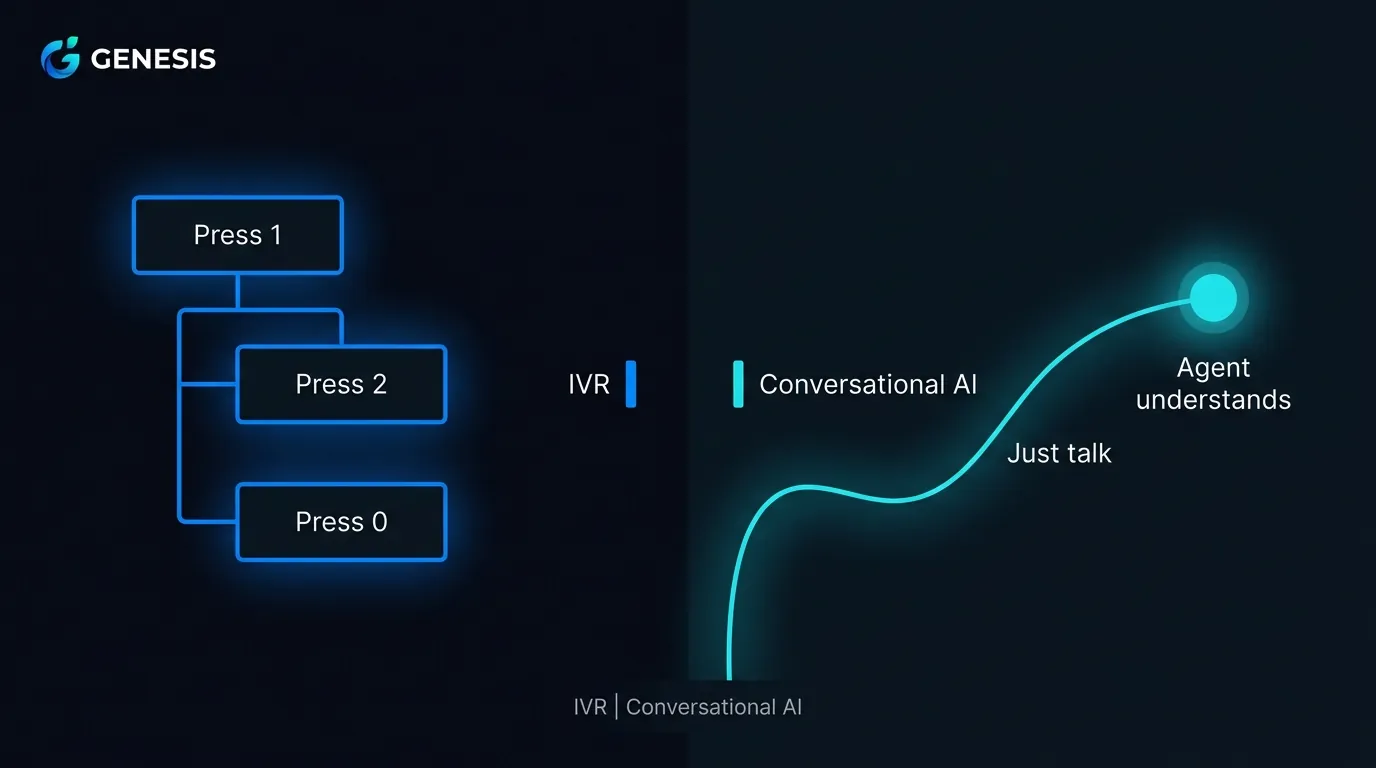
An IVR forces callers down a fixed tree; conversational AI just understands the sentence.
Conversational AI flips that. There's no list to memorise. A caller can say I think I left my wallet at your bar last night, and the agent understands and helps.
No button maps to that sentence. We wrote a full IVR versus AI voice agent comparison, and a piece on how our agents navigate other companies' IVR menus when they call out.
Want to hear one answer the way your customers do?
See live demos and setups for your trade on our AI voice agents hub.
How does conversational AI work on a phone call?
Three steps happen in a loop. The agent turns speech into text, decides what to say using your business rules, then speaks the reply out loud. The whole loop takes under a second. It feels like a normal chat.
Here's the loop in plain terms. First, listening. The caller speaks and the agent transcribes the words in real time. It knows when a sentence has finished and when the caller is just pausing.
Second, thinking. The agent reads the transcript, checks your rules, your diary, your prices, and decides the next thing to say. It can look up a booking or write one.
Third, speaking. It turns that decision into a natural voice and plays it back. That loop runs every turn of the conversation.
The agent remembers what was said earlier in the call. So if the caller mentioned a Saturday, it doesn't ask again. For a deeper walk-through, read how an AI voice agent works on a call.
Where do New Zealand and Australia businesses use it?
Mostly to answer the phone and to make outbound calls. A clinic that never misses an after-hours booking. A trades firm that captures every job lead. A sales team that lets the agent dial and qualify before a human steps in.
The numbers make the case. An answered call averages about 30 seconds, which costs about 48c. A one to two minute call runs about 95c to $1.90. We bill from 77c to 95c a minute depending on plan in NZD or AUD, charged by the second.
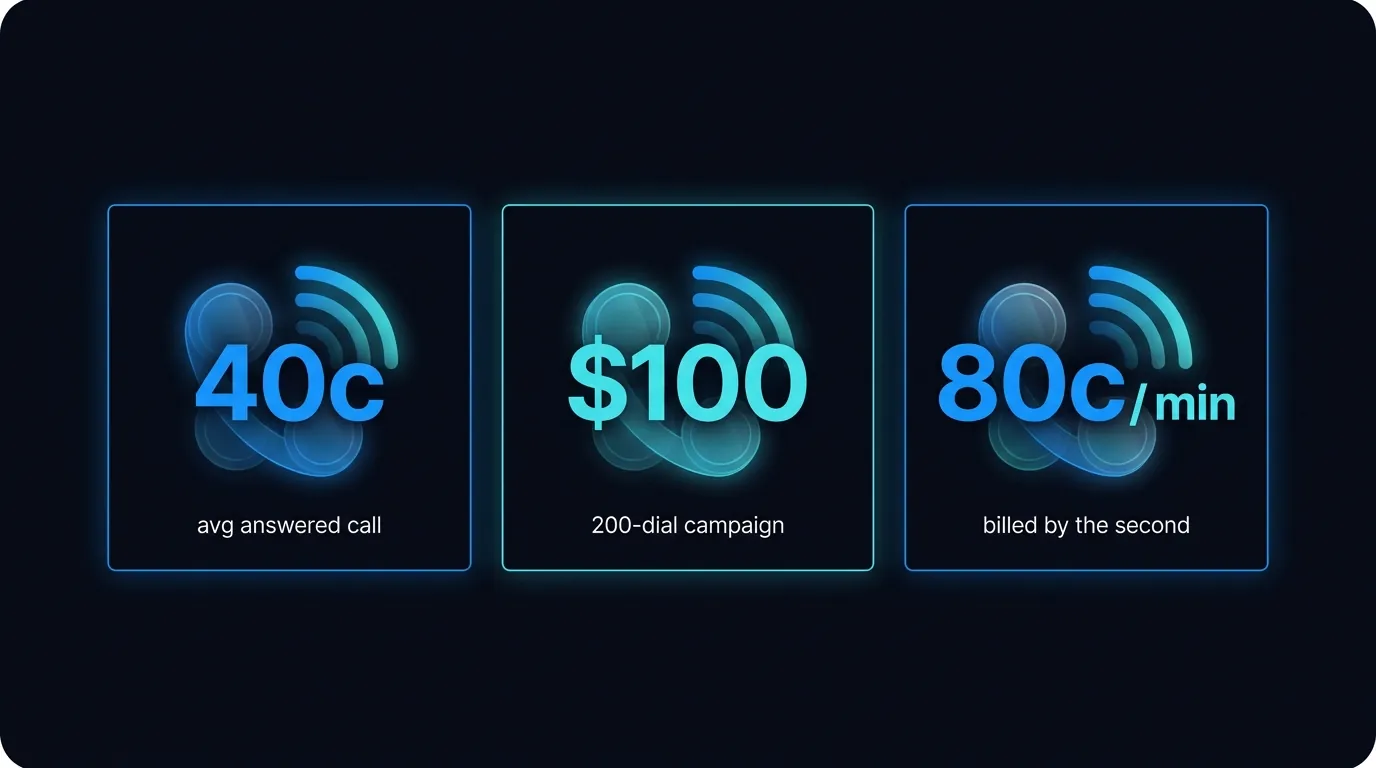
Real numbers from NZ and AU campaigns we run.
Outbound works too. A 200-dial campaign costs about $125. Connect rates sit between 47 and 65 percent, and about 20 to 25 percent of dials turn into a real one-minute conversation.
A Sydney agent produced 141 vendor leads in 90 days at 32.74 dollars each. A Christchurch developer booked viewings at 7.12 dollars apiece. Compare that to a part-time receptionist at about 28 to 35 dollars an hour before KiwiSaver or super, ACC and holiday pay.
The agent answers every call at once, all night, for the price of a coffee a shift. See the full range on our AI voice agents page.
Is it accurate and safe enough to trust?
Yes, when it's set up right. The agent works from your facts, not from guesses, so it quotes your real prices and your real hours. It discloses it's an AI on every call. And your records sit on our Sydney servers.
The honest worry is making things up. A loose agent can invent a price or a policy. We stop that by grounding the agent in your approved information and blocking it from improvising on anything it doesn't know. We wrote a whole guide on how we stop AI voice agent hallucination.
On privacy, here's the straight version. Your portal, transcripts, and structured records live on our Sydney servers. The live audio is processed offshore under documented arrangements with our voice infrastructure partner. We don't claim all data stays in Australia, because that wouldn't be true.
You stay compliant either side of the Tasman. In New Zealand that means the Privacy Act 2020 and the Office of the Privacy Commissioner. In Australia it means the Privacy Act 1988, the 13 Australian Privacy Principles, and the OAIC.
How do you get started?
You give us your hours, services, prices, and your most common questions. We build an agent on that, test it with you, then connect it. Most clients are live within a week.
There's no hardware and no new phone system. The agent sits in front of your existing number or runs a fresh one. You listen to test calls, tweak the wording, and switch it on when you're happy.
Start small. Point it at after-hours calls first, or at one outbound list. Watch the recordings and the bookings for a fortnight, then widen it once you trust it.
Ready to see conversational AI on your number?
Browse setups that fit your trade and book a demo on the AI voice agents hub.
Frequently Asked Questions
Is conversational AI the same as a voice assistant on my phone?
Not quite. A phone assistant handles your own commands, like setting a timer. Conversational AI for business answers your customers, follows your rules, books jobs, and works your diary. It's built around one business and one set of tasks, not general personal use.
Will callers know they're talking to a machine?
Yes. The agent discloses it's an AI at the start of every call. That's both the honest thing and the legal thing across New Zealand and Australia. In practice most callers don't mind once the agent actually solves their problem fast.
What does a typical call cost?
About 48c for an answered call that averages 30 seconds. A one to two minute call runs about 95c to $1.90. We bill from 77c to 95c a minute depending on plan, charged by the second, so you only pay for the talking time, not idle ringing.
Can it handle a strong Kiwi or Aussie accent?
Yes. The agent is tuned for New Zealand and Australian speech, including fast talkers and background noise from worksites or cafes. If it ever mishears, it asks the caller to repeat rather than guessing, which keeps your bookings accurate.
What happens if the agent doesn't know the answer?
It says so and takes a message or transfers to a human. We block the agent from improvising on anything outside your approved information. That stops made-up prices and policies, which is the main risk with any conversational AI.
How is my customers' data protected?
Your portal, transcripts, and structured records sit on our Sydney servers. Live audio is processed offshore under documented arrangements with our voice infrastructure partner. You stay aligned with the NZ Privacy Act 2020 and the Australian Privacy Act 1988 and its 13 Privacy Principles.
Leonardo Garcia-Curtis
Founder & CEO at Waboom AI. Building voice AI agents that convert.
Ready to Build Your AI Voice Agent?
Let's discuss how Waboom AI can help automate your customer conversations.
Book a Free Demo

