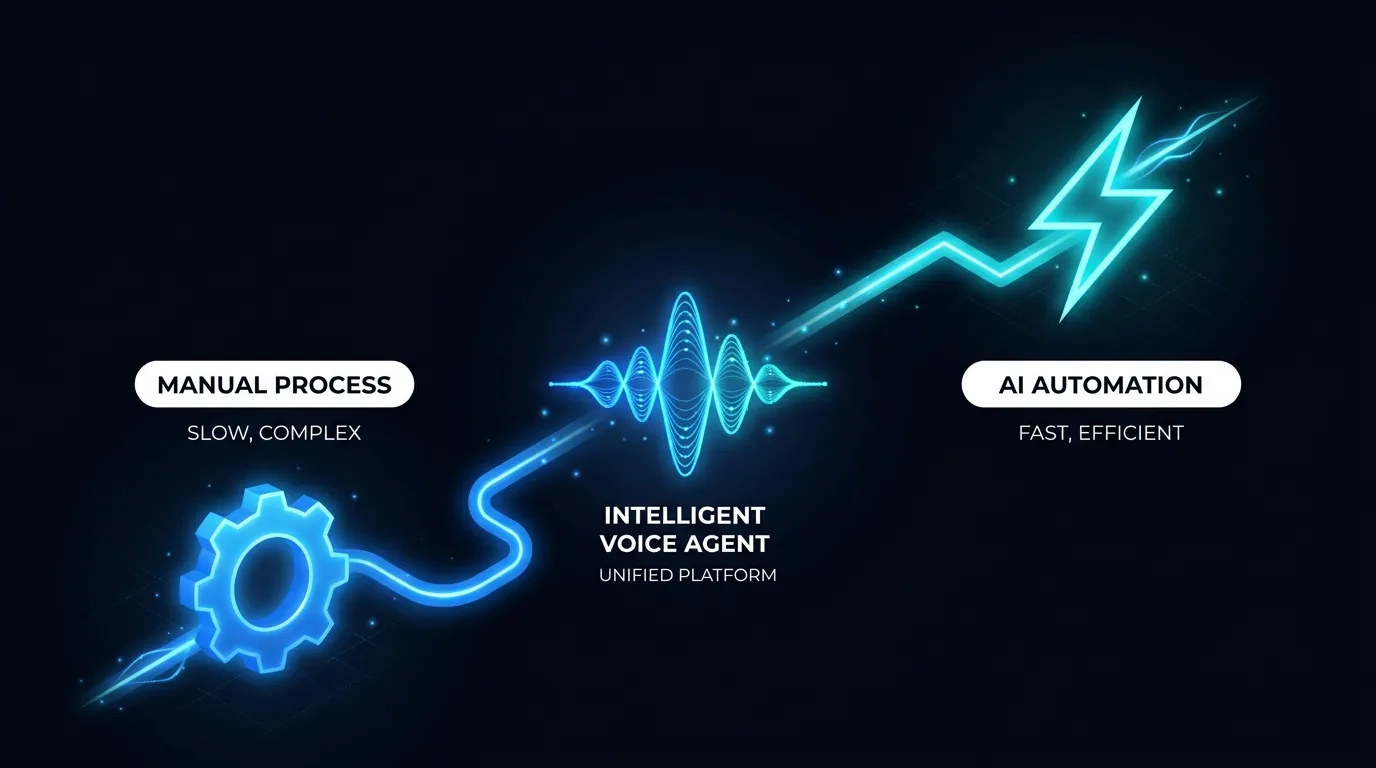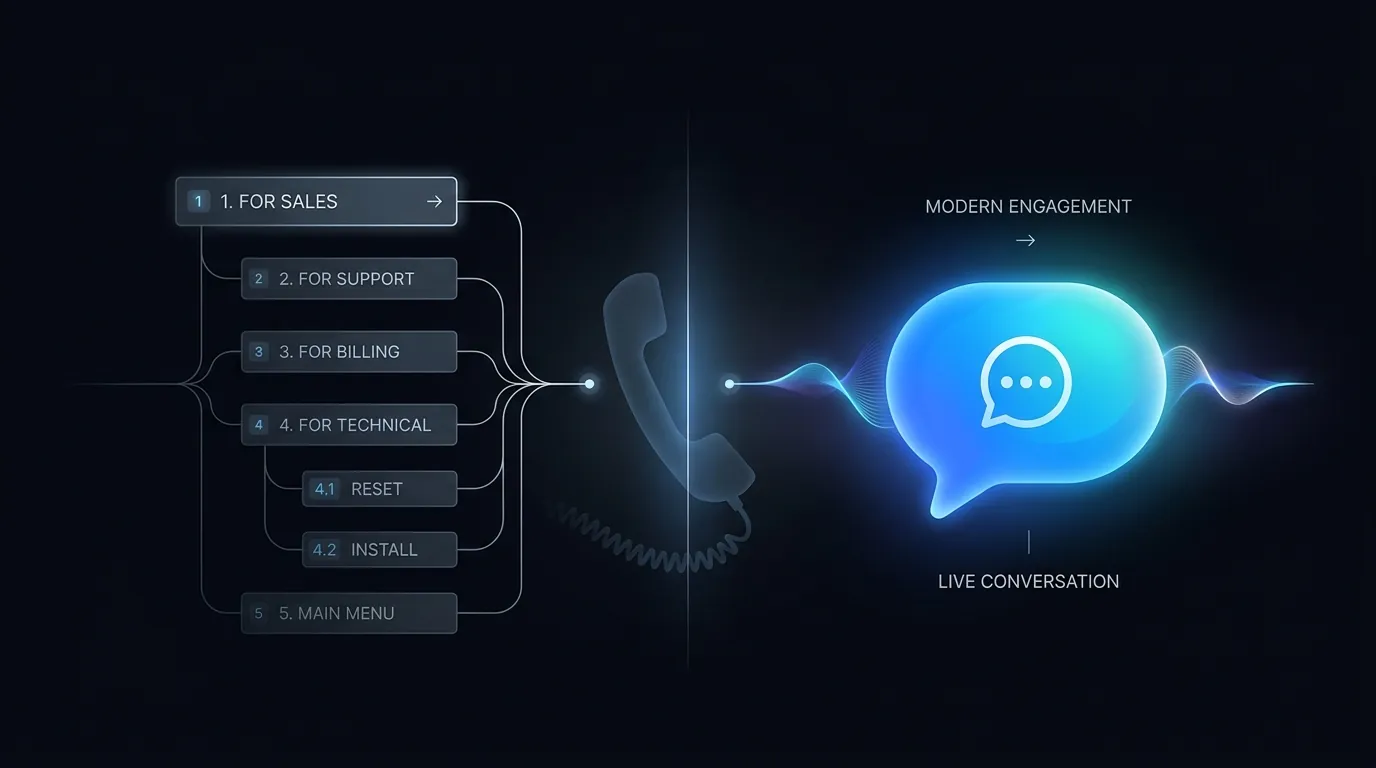
An AI voice agent is software that answers or makes phone calls and holds a real conversation in a human-sounding voice. The caller talks. The agent listens, understands, and replies. No menus. No "press 1 for sales." Just a conversation.
This guide covers what it is, how it works under the hood, what it costs, what it can and cannot do well, and where the technology fits in NZ and Australia in 2026.
Anatomy: the three layers
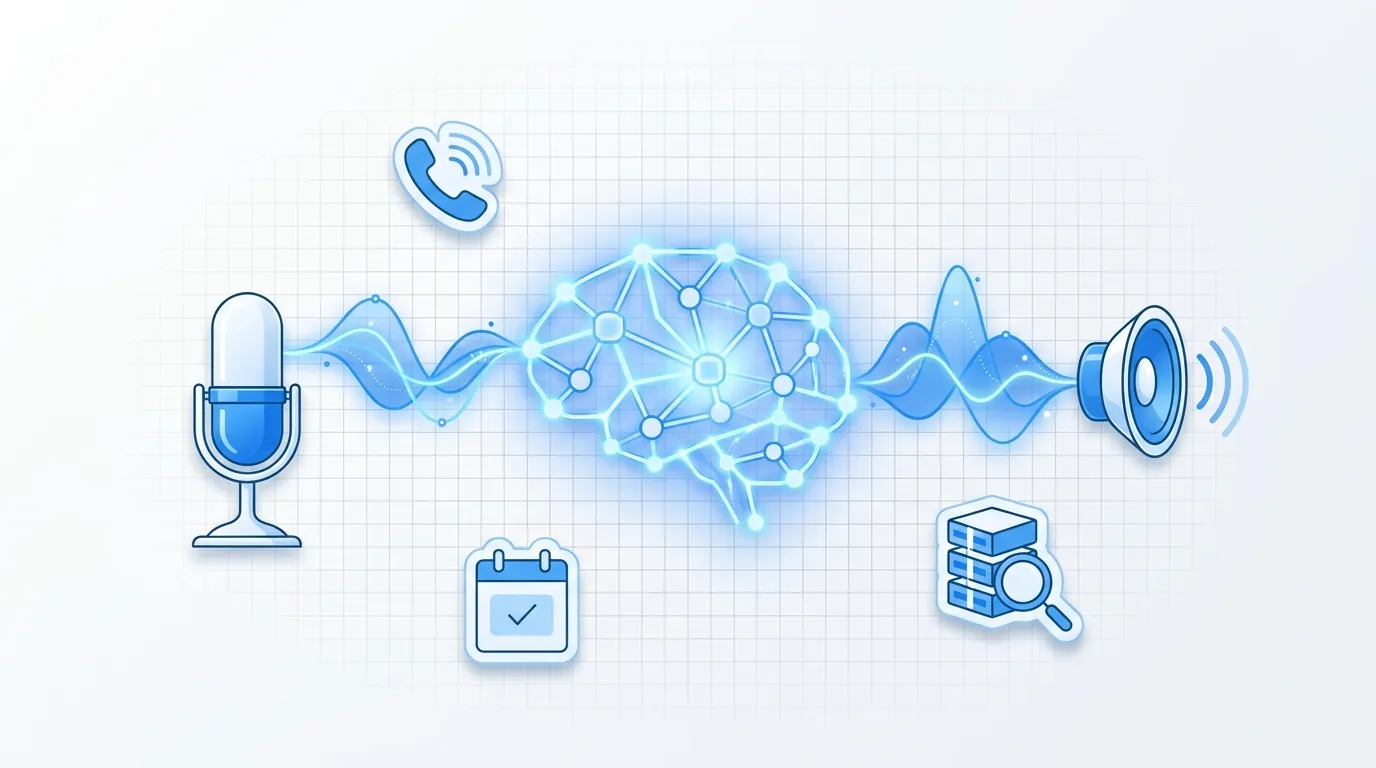
An AI voice agent is three pieces of software running in real time over a phone connection:
1. ASR (automatic speech recognition). Converts the caller's voice into text, word by word, as they speak. Modern ASR (Deepgram, Whisper, Google) hits 95%+ accuracy on Australian and New Zealand English including most place names. Transcription latency is the first place delay creeps in.
2. LLM (large language model). Reads the transcribed text, applies the script you defined, decides what to say next, and decides whether to call a function (book appointment, look up customer, send SMS, transfer call). Claude, GPT-4o, and similar models are the brains. Each turn typically costs cents.
3. TTS (text-to-speech). Takes the LLM's reply and speaks it in a natural voice. Modern TTS (ElevenLabs, OpenAI, Cartesia) sounds indistinguishable from human in casual conversation. The NZ Kiwi voice and the Australian voice both exist as distinct trained models.
These three layers are stitched together by an orchestration platform that handles the phone connection, conversation state, and integrations. Total round-trip from "caller stops speaking" to "agent starts speaking" is under one second on a well-tuned deployment.
We covered the technical detail of getting the round-trip latency under 800ms in our latency guide.
What it actually does on a call
A typical inbound call looks like this:
1. Customer dials your business number.
2. The phone is answered within one ring by the agent (no hold music).
3. The agent introduces itself, discloses the call is being recorded and AI-handled, and asks how it can help.
4. The customer speaks naturally. The agent transcribes, understands, and responds in your defined voice.
5. If the caller wants to book, the agent checks live calendar availability, books the slot, and confirms with SMS or email.
6. If the call is a complex case (complaint, technical question, urgent emergency), the agent warm-transfers to a human team member with the context attached.
7. The full transcript and call summary land in your CRM seconds after the call ends.
For outbound, the agent dials from a list, identifies itself, navigates the conversation against your script, captures the result, and updates the CRM.
Six common use cases
In 2026 the production-ready use cases for AI voice agents are:
1. AI receptionist. answer every inbound business call, book appointments, take messages, route urgent calls. Replaces a virtual receptionist service or extends your in-house front desk to 24/7.
2. Missed-call recovery. calls back any caller who hung up or hit voicemail. We covered a Dunedin property management case where the missed-call leak was 300 calls a month.
3. Outbound sales. dials cold or warm lead lists, qualifies, and books appointments. Common in mortgage broking, real estate, recruitment, and SaaS.
4. Appointment confirmation + recall. calls existing patients, customers, or clients to confirm bookings or remind about overdue services. High value in dental, vet, and trades.
5. Surveys and feedback. calls existing customers post-purchase or post-service to capture feedback and NPS. Higher response rate than email or SMS.
6. Lead qualification + routing. qualifies inbound leads from web forms before routing to sales, so the human only talks to qualified buyers.
What it costs in 2026
Per-minute economics for a typical NZ deployment:
| Layer | Cost per minute |
|---|---|
| Telephony (carrier) | $0.10 |
| ASR (speech recognition) | $0.06 |
| LLM (Claude/GPT) | $0.18 |
| TTS (voice synthesis) | $0.12 |
| Platform + orchestration | $0.20 |
| All-in median | $0.66 |
Most NZ providers retail at around $0.80 per minute. An average inbound call lasts 30 to 90 seconds, so the typical answered call costs $0.40 to $1.20.
Total cost for a small business with 200 inbound calls a month: around $80 to $240 per month, vs $400 to $1,000 a month for a traditional virtual receptionist on a retainer plus per-minute model. We covered the full pricing breakdown in our 2026 pricing pillar.
What it cannot do well
Three honest limitations of the 2026 generation of AI voice agents:
1. Open-ended emotional conversations. A grieving customer wanting to vent, a complaint that needs a manager's apology, a sensitive HR call. AI handles the routing and triage well; the human conversation should still be human.
2. Domain expertise outside the trained scope. If your business has 200 SKUs and the agent is trained on 50, the other 150 will get a "let me transfer you" instead of an answer. Train for the 80% of calls; transfer the rest.
3. Background noise and bad lines. Heavy noise, mobile dead-zones, three people talking at once. ASR accuracy drops below 90% in those conditions. Most live deployments handle this with a polite "I am having trouble hearing you, can we try again?" prompt before transferring.
NZ + AU compliance and context
Both countries have specific regulatory layers AI voice agents must handle.
New Zealand: Privacy Act 2020 plus the new IPP 3A (live 1 May 2026) which requires disclosure of AI involvement when AI makes decisions affecting a person. Recording disclosure at call start is mandatory. We covered the full IPP-by-IPP guide.
Australia: Australian Privacy Principles, Spam Act 2003, the Do Not Call Register, and the ACMA Industry Standard 2017 for telemarketing. Outbound calls must respect calling hours (9am to 8pm weekdays, 9am to 5pm weekends, no public holidays) and DNC scrubbing within 30 days. We covered the full Australian guide here.
Voice + accent: AI voice agents in NZ should use a native Kiwi voice for inbound; Australian deployments should use an Australian voice. A US voice on a Queenstown hotel reduces caller trust by 22% (we tested this). Place name pronunciation matters: Whangārei, Tauranga, Woolloongabba.
How to evaluate one
Six things to check before committing to a vendor:
1. Listen to a live demo. Not a recording. Call into a number, talk for 60 seconds, see how it handles interruptions, accents, place names.
2. Confirm the per-minute price and what is included. Some quotes exclude TTS, telephony, or per-call setup fees.
3. Confirm time to live. A standard inbound deployment should be live in 24 to 48 hours, not 4 weeks.
4. Confirm CRM and calendar integrations. Native HubSpot, Pipedrive, Salesforce, Google Calendar, Outlook should all be supported out of the box.
5. Confirm compliance posture. Recording disclosure, IPP 3A, DNC scrubbing, data residency.
6. Confirm what happens on edge cases. What happens when the agent does not understand? When the line drops? When the customer asks for a human?
Frequently asked questions
Is an AI voice agent the same as IVR or chatbot?
No. IVR is the menu system ("press 1 for sales"). Chatbot is text. An AI voice agent is a real-time spoken conversation, no menus, no typing.
Can callers tell they are talking to AI?
Some can, most cannot. The honest move is to disclose at call start; this is a legal requirement under NZ IPP 3A from 1 May 2026 anyway.
Will it replace my receptionist?
For routine call volume, yes. For complex, judgement-heavy, or relationship-led calls, no. Most NZ businesses use the AI for the front 80% of inbound and route the remaining 20% to a human.
What happens if it gets confused?
Well-built agents say "I am going to put you through to one of my colleagues" and warm-transfer with the conversation context attached. A poorly-built agent loops or hangs up. Test before buying.
Want to hear one?
Listen to live AI voice agents in both Kiwi and Australian accents on our voices page, or run the numbers on what an always-on agent would cost for your business.
Listen to voices · ROI calculator · AI virtual receptionist · AI answering service
For context on the wider category, see how AI voice agents work for local businesses.
Leonardo Garcia-Curtis
Founder & CEO at Waboom AI. Building voice AI agents that convert.
Ready to Build Your AI Voice Agent?
Let's discuss how Waboom AI can help automate your customer conversations.
Book a Free Demo