
7 min read · Outbound AI · 20 November 2026
Imagine you run a café. Your phone rings mid-shift.

You've just told it you're opening a second café. That's a big moment for you, and it changes what you might need from your broker. But the agent heard "I remember" and moved to the next rule in its prompt: offer an appointment. You could have left out the second café entirely and heard exactly the same reply.
That isn't how we build ours. We give our outbound AI sales agents room to stay with what you've just said.

The timing comes from your moving plans. The reason for the callback comes from you. And when the broker rings, they open with the question you actually wanted answered.
That small moment does a lot of work. Reflecting back what someone has just told you, before asking for anything, tells them they were heard. It builds on what psychologists call labelling: research from UCLA (Lieberman and colleagues, 2007) found that putting a feeling into words calms the brain's threat response.
It's the kind of follow-up we design for insurance brokers in New Zealand and Australia.
Our outbound AI agents earn the first ten seconds with honesty
When an unexpected call comes in during a busy shift, you decide in seconds whether to give it any time.
A quote follow-up has a natural opening. Our agents say they're AI, name the business they're calling for and remind the person which enquiry prompted the call. "You asked about cover for your café" gives you a fair chance to place the call before anyone asks for your time.
On a cold call there's no earlier conversation to pick up, so honesty has to do the work. Gong's analysis of more than 300 million cold calls found that openers which admitted it was a cold call and asked permission to explain kept the conversation going 11.18% of the time. Opening with small talk ("How's your day going?") managed 7.6%. Asking "Did I catch you at a bad time?" managed just 2.15%.
What you say once someone agrees to listen matters too. In separate Gong research, pitches that described a problem the listener could recognise worked 16% of the time, against 5.5% for pitches built on buzzwords.
People feel a loss more sharply than an equal gain (Kahneman and Tversky). An uninsured coffee machine in the back of a van is a loss you can picture. "Better cover" isn't.
When we write an opening, we ask one question: could the person picking up explain, in their own words, why we called them?
We also have our agents say why they're asking. Ellen Langer's photocopier study in 1978 found that people agreed far more often when a request came with a reason, even a thin one. So the agent doesn't just ask whether the broker can call. It says, "So the broker can have the right answer ready, would a call before Friday suit you?"
They ask for a small yes before a big one
Asking a stranger for a meeting in the first minute is a big ask. Asking for 30 seconds isn't. Psychologists call this the foot-in-the-door effect. In a classic 1966 study, Freedman and Fraser found that people who agreed to a small request were far more likely to agree to a bigger one later.
So our agents build up in small steps:
Each yes is easy to give, and each one is the person's own choice.
They hear a first "no" as a reflex, and a second as final
Most first refusals on a call aren't a decision. They're a reflex to being interrupted. Gong's data shows that the calls which end in a booking usually get through a couple of objections first.
So our agents treat a first "not interested" with one warm line and one honest question about what's going on. A second no ends the call politely. And a request to stop calling is honoured on the spot, every time, with no rebuttal.
They ask one question, then actually listen
Nothing gives a robot away faster than a list of questions fired off in one breath. Our agents ask one thing, then stop and listen. They react to the answer before moving on, and they never ask for something you've already told them.
It sounds simple. It's also the difference between a conversation and a survey.
They let people choose, so every yes is real

Anyone who's agreed to a meeting just to get off the phone knows how little that booking is worth. When people feel their freedom to choose is being squeezed, they tend to push back. Psychologists call this reactance. A review of 42 studies by Christopher Carpenter found that telling people plainly the choice is theirs, and they can say no, often made them more willing to agree.
On our calls, a yes to "Can I explain why I'm calling?" earns the agent a brief explanation, nothing more. A meeting is a separate decision. If the café owner says, "We've sorted the cover," the agent thanks them and finishes there. If they say, "Could the broker ring me on Thursday? We're moving the coffee machine on Friday," there's a time, a reason and a question worth passing on.
They book while it's fresh and hand over the whole story
When someone does want to talk, timing matters. In Gong's data, meetings booked within two weeks went ahead about 53% of the time. Book four or more weeks out and that dropped to 32%. So when a meeting makes sense, our agents offer a specific time in the next fortnight, not "sometime next month".
The handover also has to carry the right detail. On a campaign for Shannon, a Sydney real estate agent, the people picking up were homeowners. A homeowner happy to speak to Shannon today and one who says "try me in six months" have agreed to two very different things.
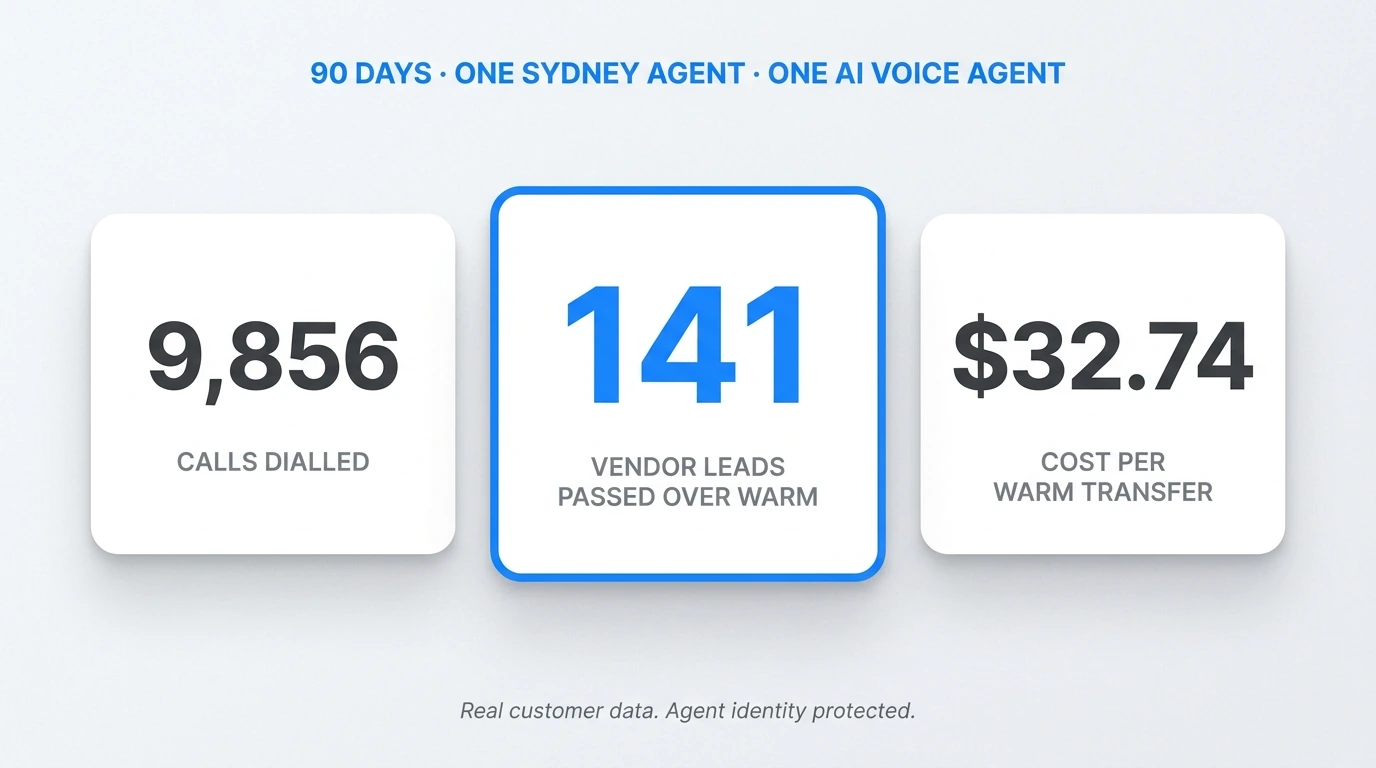
Over 90 days, our outbound agent had 1,997 conversations lasting at least 30 seconds and live-transferred 141 interested sellers to Shannon. Another 52 asked for a personal callback or a check-in in six months. Shannon spent her time with people who wanted to talk now, and followed up with the rest when they'd asked her to. Read the full case study.
Results like that come from testing. We test these moments against real conversations before an agent goes live, and keep reviewing them once it's running: what happened when someone interrupted, changed the subject or said no. And we check exactly what reaches the person who takes over.
In the café example, "Call Thursday" only tells the broker when to ring.
"Call Thursday about cover for the coffee machine while it's being moved to the new café on Friday" tells them why the owner wants to talk, what to have ready and what's at stake.
So the broker opens with the answer, not "So, what can I do for you?" The call picks up warm, the owner feels looked after, and the broker is one conversation away from covering two cafés instead of one.
Frequently asked questions
How do Waboom AI outbound agents know what to say on a cold call?
Every agent works from two things. A set of call rules built from proven cold-call research and psychology: honest openers, small yeses, one question at a time, and when to stop. And a knowledge base with your business facts, so it answers from what you've approved rather than guessing.
Do your agents read from a script?
No. Each agent has a call plan with a clear goal and stages to move through, but it follows the person's answers rather than reading lines. If someone mentions a second café, the agent stays with that before moving on, which is exactly what a script can't do.
How does the agent adapt when a call goes off track?
It answers the question first, then picks up where it left off. If someone interrupts, changes the subject or asks something unexpected, the agent responds to what they said, asks one question and steers back towards the goal. It never restarts the call or repeats itself word for word.
How does the agent stay focused on the goal of the call?
Each campaign has one goal, such as booking a meeting, live-transferring a keen prospect or arranging a callback. The conversation can flow, but every stage moves towards that goal, and the agent asks for it once the person is interested rather than at a fixed point in the call.
What happens if someone says they're not interested?
A first "not interested" gets one warm line and one honest question, because it's often a reflex to being interrupted. A second no ends the call politely. Any request to stop calling is honoured on the spot and the number is removed, with no rebuttal.
Will people know they're talking to an AI?
Yes. Our agents say they're an AI assistant every time they introduce themselves, and answer honestly if someone asks. In our experience, being upfront works for the call, not against it.
How do you stop the agent making things up?
The agent only states facts that are in its knowledge base. If it doesn't know, it says so and offers the person a callback from your team. We test each agent against real conversations before it goes live, including people who interrupt, push back or ask things it can't answer.
Can the agent book meetings or put people through to my team?
Yes. Depending on how your team works, the agent can book a time in the next fortnight, live-transfer an interested prospect while they're on the line, or arrange a callback at the time they choose. Your team gets the reason for the call along with it, so they pick up where the agent left off.
Hear an outbound AI agent for yourself
You can talk to our outbound agents on the campaign pages for New Zealand and Australia. Interrupt it. Tell it something has changed since your first enquiry. Listen to the question it asks next.
If you have a list of old quotes or enquiries you'd like to follow up, bring one typical conversation to a demo, and we'll walk through how an agent would handle it for your business. Book a demo.
Less Busy. More Life.
Leonardo Garcia-Curtis
Founder & CEO at Waboom AI. Building voice AI agents that convert.
Ready to Build Your AI Voice Agent?
Let's discuss how Waboom AI can help automate your customer conversations.
Book a Free Demo

