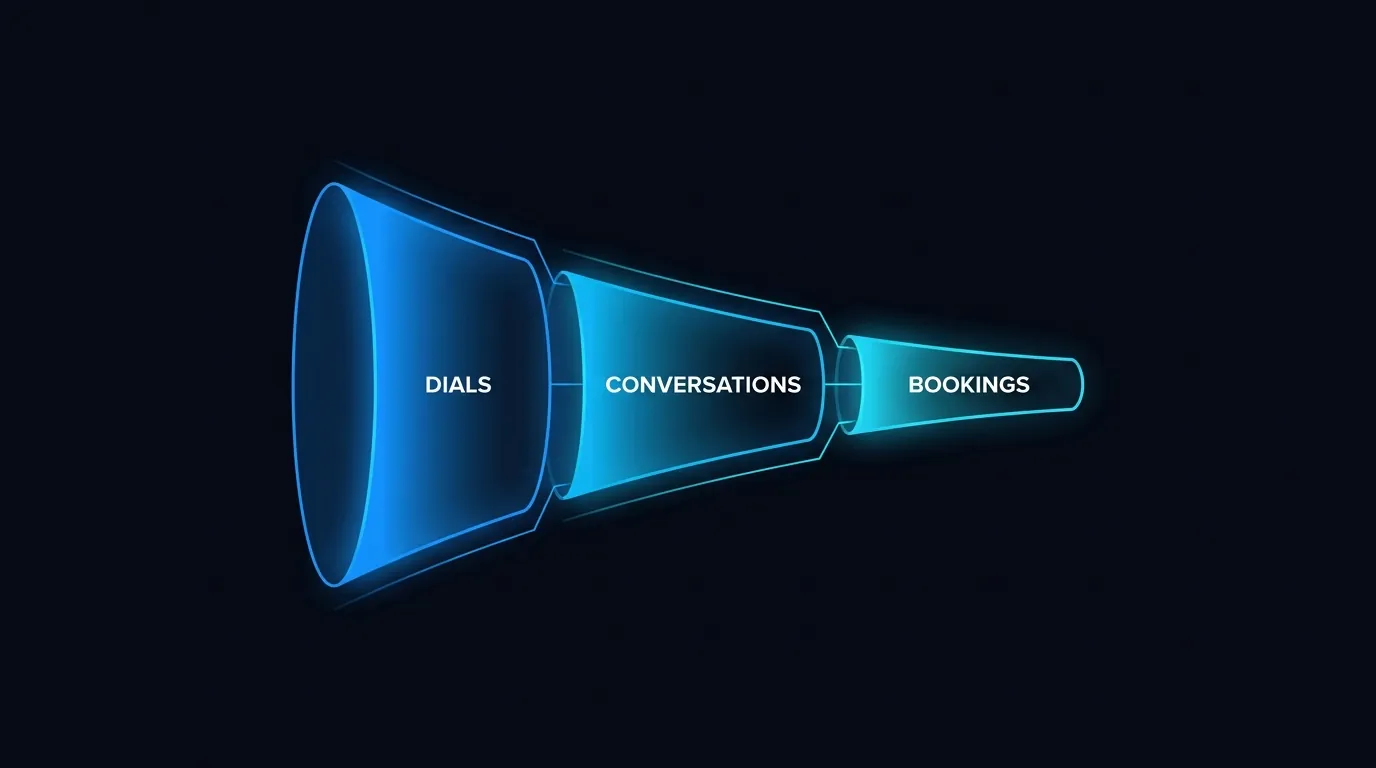
Your top SDR makes 80 dials a day, has 22 conversations, and books 4 meetings. They cost you $95,000 plus super, plus a desk, plus three weeks of onboarding before they could pick up the phone unsupervised.
An AI sales agent makes 1,000+ dials a day at a higher hit rate, costs you under $2,000 a month in active call time, and went live in hours.
The catch is that the human SDR can read a room. The AI cannot. Not yet, anyway. Pick the wrong work for the wrong tool and you torch your number list and your reputation.
Here is the honest version of what an AI sales agent is, what it does well, and where it still loses.
Contents
What an AI sales agent actually is
An AI sales agent is software that runs an outbound sales call from open to close. It picks up the dial, identifies the prospect, opens with your script, qualifies against your criteria, handles common objections, and books a meeting in your calendar.
It is not a chatbot. Chatbots wait for a human to start. AI sales agents start the conversation.
It is not a robocall. Robocalls play a recording. AI sales agents hold a real two-way conversation in a natural voice.
It is not an autodialer with a script reader. An autodialer connects a human to a list. The AI sales agent IS the human side of the call.
The technology stack is the same as an AI receptionist. We covered that breakdown in our companion piece on what an AI receptionist is. The difference is direction. Receptionists answer. Sales agents call.
Real numbers from the field
We run outbound campaigns at Waboom every day. Here is what the numbers look like at scale, drawn from active 2026 campaigns and verified across our portal data.
| Metric | Typical range | Notes |
|---|---|---|
| Cost per active minute | $0.80 | Telephony plus model plus voice synthesis |
| Average call length | 30 seconds | Most calls end inside the qualifying questions |
| Connect rate | 47-65% | Cleaner lists run higher. Burned numbers run lower |
| Success tag rate | 20-25% | Of connected calls, the share flagged as a positive outcome |
| Hot transfer rate | 8-15% | Of connected calls, the share warm-transferred to a human |
| Daily call volume per agent | 1,000+ (scalable) | Limited by your dial budget, not the technology |
These are the numbers our portal clients run. Your numbers will sit in this range if your list is clean and your script is tight. Both can throw you off. We covered why AI diallers burn phone numbers in a separate teardown if you want the operational detail.
How an AI sales agent works end to end
Five stages.
One. The list. A clean list of prospects with phone, name, company, and any context the script needs. Lists from public databases run dirty and burn fast. We pull from Lusha, Apollo, and verified Pipedrive data.
Two. The dial. A telephony provider (we use Twilio in Australia) places the call from a registered, warmed number. The call goes through normal carrier routing. There is no robocall flag if your number is clean.
Three. The conversation. The agent opens with your script. The prospect speaks. Speech to text transcribes the audio in real time. A model like GPT-4.1-mini or Claude Haiku 4.5 decides what to say back. The reply gets spoken in your chosen voice. Total turn time stays under 800ms or the conversation feels off.
Four. The action. When the agent qualifies the prospect, it can call functions. Book a meeting in HubSpot. Drop a deal in Pipedrive. Send a confirmation SMS. Page Slack. The actions you wire are the actions you get.
Five. The handoff. Anything off-script triggers a warm transfer to your team. The human picks up an in-context call instead of a cold one, with a summary already typed in their CRM.
Industries where it actually wins
We run AI sales agents across four industries with confidence. Each has the same pattern: high outbound volume, structured qualification, and a long enough sales cycle that the upfront human cost stings.
Mortgage broking. Outbound to homeowners coming up to fixed-term rollover. The agent confirms current rate, current bank, and renewal window. Hot leads transfer to a broker. We process thousands of these calls a month for AU and NZ broker networks. The script is tight, the qualification is binary, and the human cost is high enough that AI lands.
Insurance renewals. Outbound on commercial policies coming to renewal. The agent confirms the broker contact wants to discuss the upcoming renewal and books a 15 minute call.
SaaS demo qualification. Outbound on inbound demo requests that have gone cold for 30 days. The agent confirms the prospect still has the problem and rebooks. We see 18-24% of dead demos rebook.
Real estate prospecting. Outbound on past appraisal leads who have not listed. We covered this in detail in our 44,000 dormant leads case study: 800 dials, 42 booked meetings, the kind of result that pays for itself in week one.
We deliberately do not list "AI sales agent for everything". It is a tool. Use it where the script holds and the volume justifies it.
Australian compliance: Spam Act and DNC
If you make outbound sales calls in Australia, three things matter.
Spam Act 2003. This is mostly an electronic-message Act. Voice calls are governed under different instruments. But the principle bleeds across: do not contact people who have asked you to stop, and identify yourself when asked.
Do Not Call Register (DNC). A federal scheme run by ACMA. You must scrub your list against the DNC Register before dialling unless one of the limited exceptions applies (existing customer relationship, charity, government, and a few others). Penalties are real. We have seen settlements above six figures.
Calling hours. ACMA's Telemarketing and Research Industry Standard sets weekday hours of 9am to 8pm and weekend hours of 9am to 5pm Saturday. No calls on Sunday. No calls on national public holidays.
Your AI sales agent must enforce all three at the infrastructure level, not the agent prompt level. Prompt enforcement leaks. We build calling hours into the dialler so a single 8:01pm call cannot happen. The agent prompt has a fallback if a prospect asks how their number was obtained or asks to be removed: identify, confirm, and trigger the suppression flow.
For the full breakdown including New Zealand's Information Privacy Principles, see building compliant AI voice agents for New Zealand and Australia.
AI sales agent vs human SDR vs traditional dialler
| AI sales agent | Human SDR | Traditional dialler | |
|---|---|---|---|
| Daily dial volume | 1,000+ (scalable) | 60-100 | 200-400 (with humans) |
| Cost per booked meeting | $10-$40 | $120-$400 | $60-$180 |
| Empathy and nuance | Limited | Strong | Limited |
| Time to live | Hours | 3-6 weeks | 2 weeks |
| Compliance enforcement | Built in (calling hours, DNC, suppression) | Depends on training | Up to the operator |
| Best fit | Tight script, high volume, structured qualification | Complex deals, premium accounts, relationship sale | Mid volume, mid complexity |
Where AI sales agents still fail
A short list.
A good AI sales agent knows where it ends. The handoff is a feature, not a bug.
Cost and ROI
The maths is straightforward.
A campaign of 1,000 dials a day, 5 days a week, lands roughly 220 connected conversations a day with around 50 flagged as a positive outcome. Active call time runs around 25 hours a week. At $0.80 per active minute, that works out to roughly $1,200 a week. Or roughly $5,000 a month for one running agent.
A human SDR team matching that dial volume would need 5+ staff. That is at least $475,000 a year in fully loaded cost. Same dial count at roughly 10x lower spend.
The catch is that the human team plays a different role. They handle the qualified leads, build the relationships, and close the deals. AI does the dialling at the top of the funnel. Humans do the closing at the bottom.
For pricing on the Waboom platform: see our voice agent pricing page.
Frequently asked questions
Will prospects know they are talking to AI?
Some will, most will not on a tuned platform. We tell agents to identify when asked directly. Most callers do not ask. The ones who do appreciate the honesty.
How quickly can a campaign go live?
Hours from sign-off if your list and script are ready. List import and voice selection in the morning. Script tuning by midday. Live calls before close of business. Most clients see their first booked meeting on day one.
What is the typical campaign lifespan?
A clean list runs hot for 4-8 weeks before saturation. Then we cycle in fresh leads. Same number, fresh data.
Can it integrate with HubSpot, Pipedrive, Salesforce?
Yes. All three are out of the box on Waboom. Custom CRMs we wire on request.
Is it legal in Australia?
Yes, with proper DNC scrubbing, calling hour enforcement, and identification on request. The full breakdown is in our compliance guide.
Do I need a separate phone number?
Yes. We register and warm dedicated outbound numbers for each campaign. Sharing numbers across campaigns burns reputation.
Can it leave voicemails?
Yes. We tune voicemail drop messages per campaign. Voicemail conversion sits around 1-3%, lower than live answer but worth capturing.
What happens to a hot lead while the agent is calling someone else?
Warm transfers happen in real time. The agent pulls a human off whatever they were doing and connects them mid-call. If no human is available, the agent books a meeting at the prospect's preferred time and the human follows up.
How is this different from your AI receptionist?
Receptionists answer inbound. Sales agents make outbound. Same tech stack, opposite direction. Often deployed together.
Want to see one running on your list?
We tune an AI sales agent on your script, your qualification questions, and your CRM in under a week. Bring your list, see the dials inside seven days.
Leonardo Garcia-Curtis
Founder & CEO at Waboom AI. Building voice AI agents that convert.
Ready to Build Your AI Voice Agent?
Let's discuss how Waboom AI can help automate your customer conversations.
Book a Free Demo