
Picking the best outbound dialler in 2026 comes down to one honest question. Will it put your reps in front of real conversations, or just spin the meter? Every vendor quotes you a connect rate and hopes you read it as a booking rate. They are not the same number, and the gap is where budgets quietly bleed.
This guide walks the seven things an NZ or AU sales team should actually check. Pricing, the connect-rate trap, the features that pay for themselves, and how to trial one without torching your best leads.
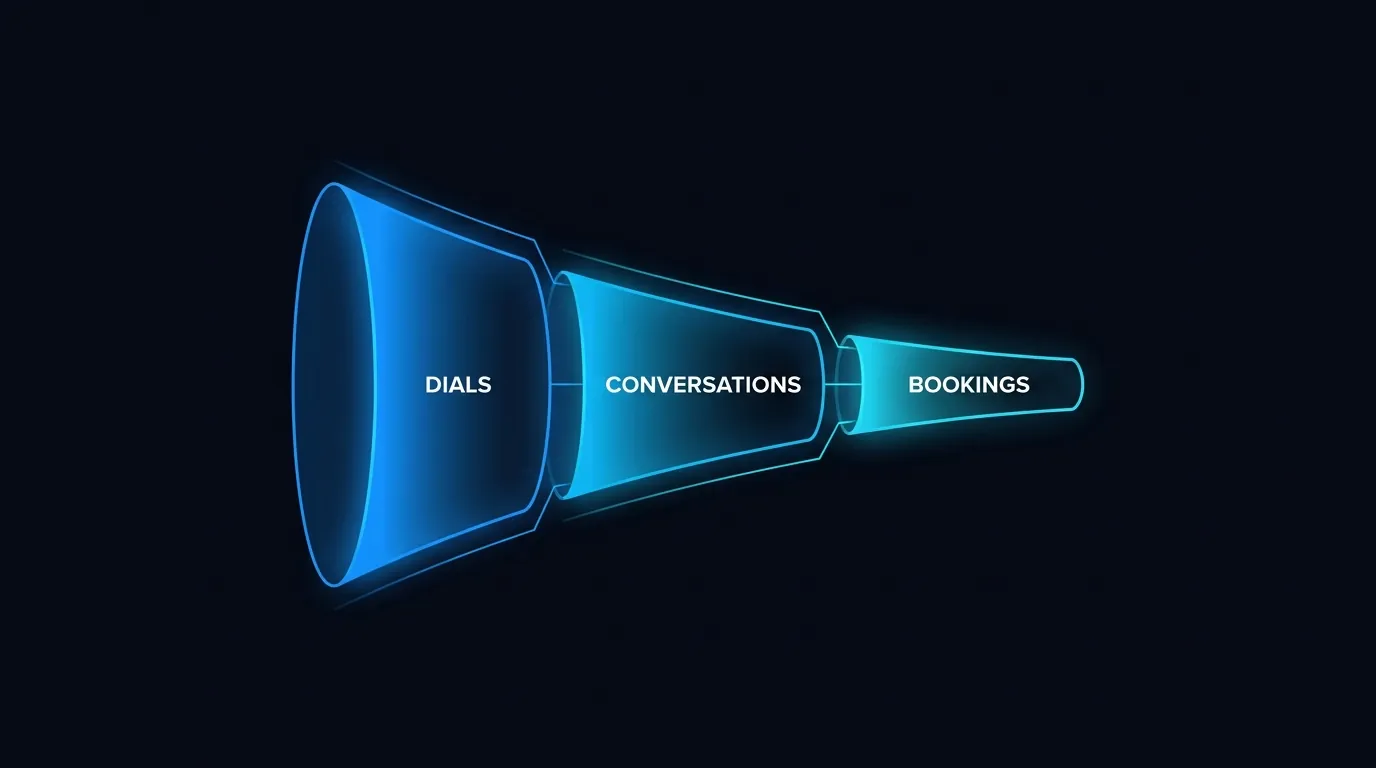
The honest funnel: dials are cheap, conversations are the number that matters.
What is an outbound dialler, and what should it actually do?
An outbound dialler places calls from your list, detects who actually answers, and routes live conversations forward. The best outbound dialler does three jobs well. It dials fast, it filters out voicemail and dead air, and it hands over a warm line with context attached. Everything else is noise.
We see teams obsess over dial volume. Volume is cheap. What matters is qualified talk time per hour.
A good agent dials, screens, and logs. A bad one floods your reps with hang-ups. The difference shows up in your calendar by week two.
If a dialler cannot tell a human from an answerphone, it is not saving you time. It is reselling you the same problem at scale. That is the bar. Our AI sales agent is built around qualified conversations, not raw dial counts.
Why do connect-rate claims mislead you?
Connect rate is the share of dials that reach a live person, usually 47 to 65 percent in NZ and AU. It is not your booking rate. Only about 20 to 25 percent of dials become a real conversation longer than a minute. Vendors love quoting the first number and staying quiet on the second.
Run the maths on a 200-dial campaign. At a 55 percent connect rate, 110 people pick up. Maybe 40 to 50 of those turn into a real chat.
From there, a fraction book. If someone sells you on connect rate alone, they are hiding the funnel. We track the full chain instead.
How does this play out at scale? A Sydney agent we ran pulled 141 vendor leads in 90 days at $32.74 per seller. A Christchurch property campaign booked viewings at $7.12 each. Those numbers come from conversations, not dial counts.
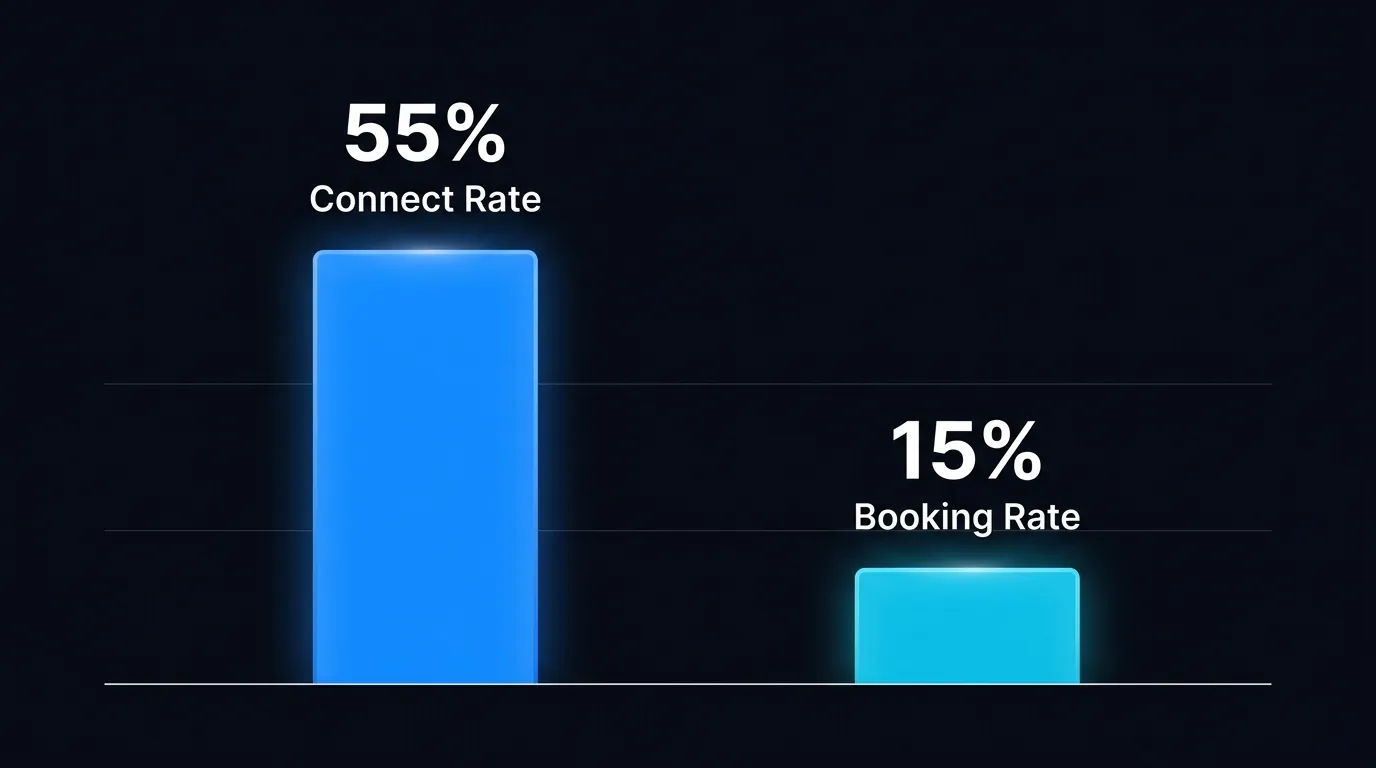
Connect rate is who picks up. Booking rate is a thin slice further down.
Stop buying dial counts.
See the full per-second economics on our voice agent pricing page and work out your real cost per conversation.
What does a real outbound dialler cost to run in NZ or AU?
Our platform bills about 80 cents per minute in NZD or AUD, charged by the second. An average answered call runs about 30 seconds, so roughly 40 cents. A solid 1 to 2 minute conversation costs around $1 to $2. No per-seat licence stacked on top.
Do the campaign sum. A 200-dial campaign lands near $100 NZD all in. That covers the no-answers, the voicemails, and the real talks together.
Compare that to a part-time human. A receptionist or junior caller costs $28 to $35 an hour before KiwiSaver or super, ACC, and holiday pay. They dial maybe 30 numbers an hour and fade by Friday.
The agent never fades. It dials at a steady pace, every hour, without sick days. You pay for talk time, not seat time. Our full pricing breakdown shows where every cent goes.
What features actually matter, like voicemail detection and DNC scrubbing?
The features that pay for themselves are voicemail detection, DNC scrubbing, retry logic, and clean CRM logging. Voicemail detection stops you wasting reps on answerphones. DNC scrubbing keeps you legal. Skip either and you pay for it later.
Voicemail detection alone changes your economics. If a third of your dials hit voicemail, catching that early saves real money across a campaign.
DNC scrubbing is not optional. In Australia you must scrub against the Do Not Call Register and follow the Spam Act 2003. In New Zealand the Unsolicited Electronic Messages Act 2007 governs your messaging. The OAIC and the Office of the Privacy Commissioner publish the rules in plain terms.
Retry logic matters too. The best window is not random. We have measured 8am Monday against 10am Tuesday and the gaps are real.
Every call also discloses that the caller is speaking with an AI. That is not a feature you toggle off. It is how we keep you on the right side of the NZ Privacy Act 2020 and the AU Privacy Act 1988.
How does an AI dialler keep your numbers from getting flagged?
It paces dials, rotates numbers, and respects answer patterns so carriers do not flag you as spam. Hammer one number through 500 dials an hour and it gets marked. A smart dialler spreads volume and watches answer rates per number.
We have written about how numbers get burned and how to avoid it. The short version is pace and rotation.
A flagged number tanks your connect rate overnight. You can drop from 55 percent to single digits. Then your whole list underperforms through no fault of the list.
The fix is built in. The agent monitors per-number answer rates and pulls numbers showing signs of trouble before carriers do.
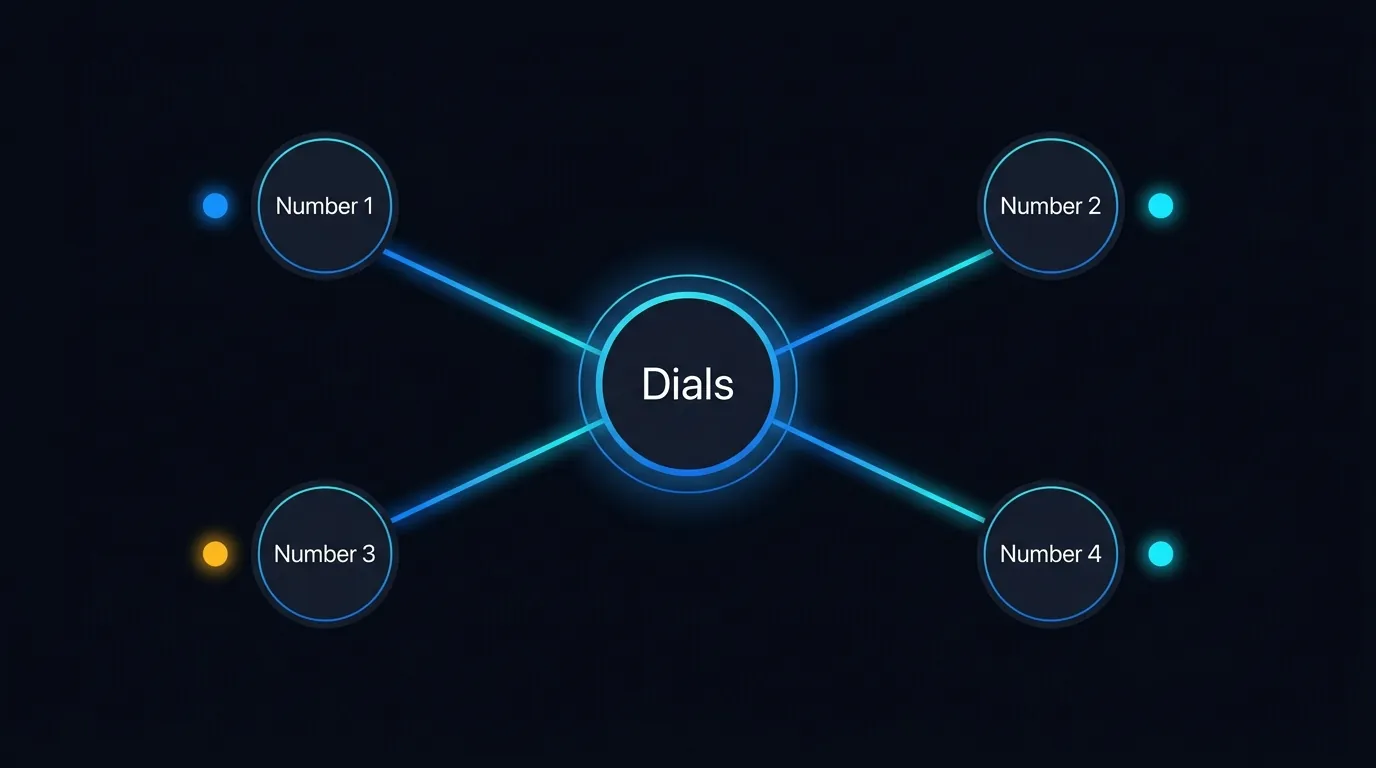
Spread, rotate, and retire weak numbers before carriers flag them.
How does it fit your CRM and your list?
The agent pulls your list, dials it, and writes every outcome back to your CRM automatically. Call status, disposition, transcript, and next action all land on the record. No rep retypes a thing.
This is where most diallers fall down. They dial fine but dump messy data. Then your pipeline rots inside a week.
Good logging means your reps trust the system. They open a record and see exactly what happened. The agent did the work, the CRM holds the proof.
List quality still matters most. A clean, segmented list beats a huge messy one every time. The dialler amplifies whatever list you feed it. Our guide on how to implement AI outbound sales calls covers list prep step by step.
How do you trial one without burning your list?
You trial it on a small, low-stakes segment first, never your best leads. Take 200 cold or aged records, run them through, and read the full funnel. Connect rate, conversation rate, and bookings, not just dials.
A 200-record test costs about $100 NZD. That is cheap insurance against rolling out something that flops on your A-list.
Watch the numbers that matter. We track outbound calling KPIs the right way so you are not fooled by vanity metrics.
If the small batch books at a sane cost per conversation, scale it. If it does not, you have lost $100, not your pipeline. That is how you trial a dialler honestly.
Test it on 200 aged leads.
Run a real funnel, not a demo, with our AI sales agent and let the cost per conversation make the call.
Frequently Asked Questions
What is the best outbound dialler for a small NZ or AU sales team?
The best outbound dialler for a small team is one that fills calendars, not dial logs. Look for voicemail detection, DNC scrubbing, and CRM write-back. Our platform bills about 80 cents per minute and a 200-dial test runs near $100 NZD, so you can prove it cheaply before scaling.
Is an AI dialler legal in New Zealand and Australia?
Yes, when run correctly. Every call discloses the caller is speaking with an AI. Outbound respects the AU Do Not Call Register, the Spam Act 2003, and NZ's Unsolicited Electronic Messages Act 2007. We operate under the NZ Privacy Act 2020 and the AU Privacy Act 1988 with the OPC and OAIC.
How much does an AI outbound dialler cost to run?
About 80 cents per minute in NZD or AUD, billed by the second. An average answered call near 30 seconds costs roughly 40 cents. A 1 to 2 minute conversation costs $1 to $2. A 200-dial campaign lands near $100 NZD covering every no-answer, voicemail, and real talk.
Where is my call data stored?
Your portal, transcripts, and structured records sit on Sydney servers. Live audio is processed offshore under documented arrangements with our voice infrastructure partner. You can delete a call record in 10 minutes. We treat this as honest outcomes, not a marketing line about everything staying in one country.
How is connect rate different from booking rate?
Connect rate is who picks up, usually 47 to 65 percent. Booking rate is who agrees to a meeting, far lower. Only 20 to 25 percent of dials become a real conversation over a minute, and bookings are a slice of that. Never read a connect-rate claim as a booking promise.
How fast can I get an outbound campaign live?
Most teams go from list to live dials in days, not weeks. You load a clean, segmented list, scrub it against the relevant DNC rules, and start on a small aged batch. We watch the full funnel from day one so you scale on evidence, not hope.
For the full security picture, read how Waboom secures voice AI.
Leonardo Garcia-Curtis
Founder & CEO at Waboom AI. Building voice AI agents that convert.
Ready to Build Your AI Voice Agent?
Let's discuss how Waboom AI can help automate your customer conversations.
Book a Free Demo

