
A buyer calls your dealership at 5.40pm about the used Hilux on your website. Nobody picks up. They call the yard down the road instead.
That call was worth thousands. It went to voicemail because your one phone line was busy and your salespeople were on the floor with walk-ins.
An AI voice agent for car dealerships fixes that gap. It answers every sales and service call, day or night. No customer hears a busy tone again.
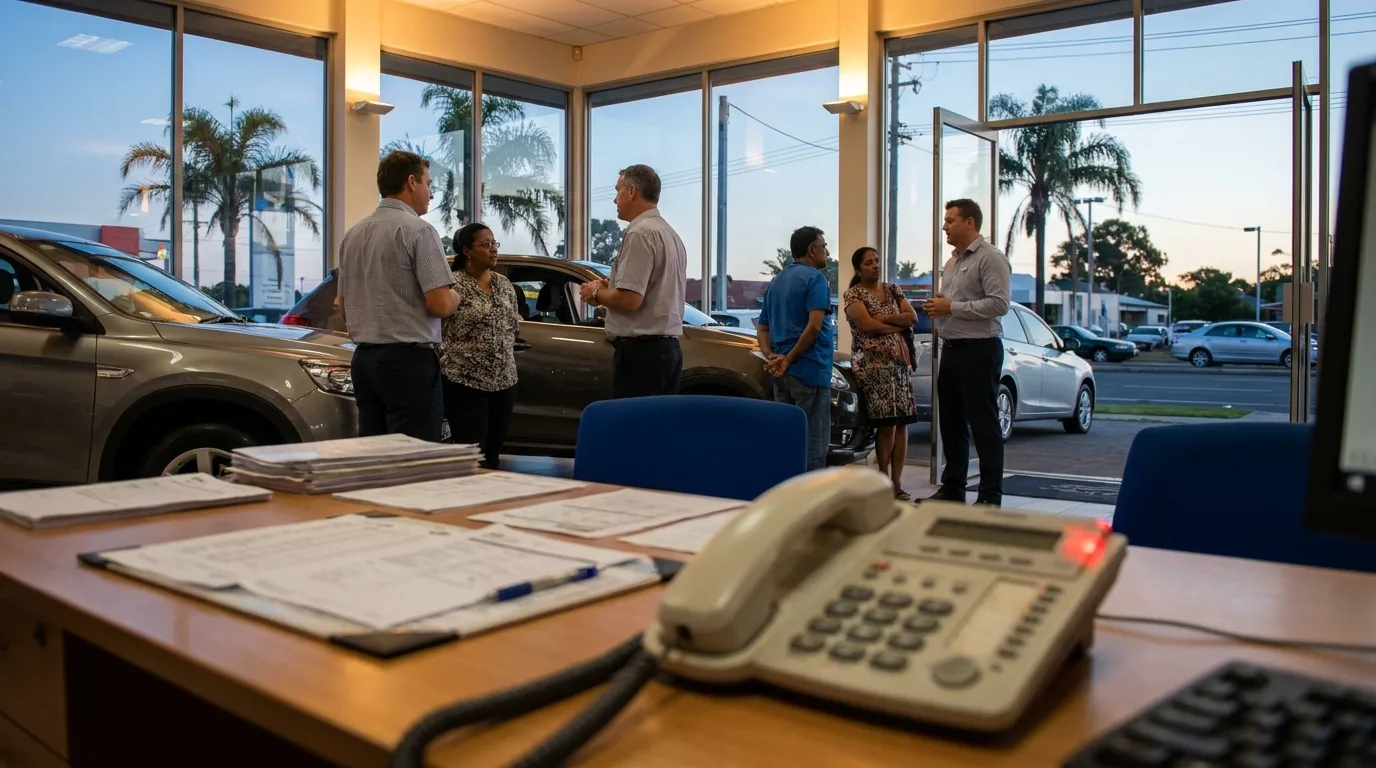
Every used-car enquiry and service call answered on the first ring, day or night.
What does an AI voice agent do for a car dealership?
It answers your phone, qualifies the caller, and either books them in or routes them to a human. The agent handles used-car enquiries, service bookings and test-drive requests. It works after hours and during your busiest mid-morning rush.
Think of it as a receptionist who never takes a smoko break. The agent picks up on the first ring. It greets the caller, tells them it is an AI assistant, then asks what they need.
For a sales enquiry it captures the vehicle of interest, the caller's name and number, and books a test drive. For a service call it finds a slot and confirms the booking. Every call is logged and a transcript lands in your inbox.
The agent runs dozens of calls at once. So three buyers ringing about the same listing all get answered. No queue, no hold music, no lost deal.
Why do dealerships miss sales and service calls?
Most dealerships miss calls because the busy times and the staffed times never line up. Saturday mornings, late afternoons and the lunch hour are when buyers ring. That is exactly when your team is selling on the floor or out on a test drive.
Picture a Saturday at 11am. Two salespeople are with customers. The service desk is processing a handover. The phone rings four times and nobody is free.
When the phone rings during your busiest hours, a chunk of those callers just move to the next listing. They do not leave a message and they do not ring back.
After-hours is worse. A buyer browsing your stock at 9pm has no one to call. By morning they have booked a viewing elsewhere. Our coverage is built for exactly this, and you can read more in our piece on after-hours phone cover for NZ businesses.
The cost is invisible because a missed call leaves no trace. You never see the deal you lost. The agent removes that blind spot by answering and logging every single call.
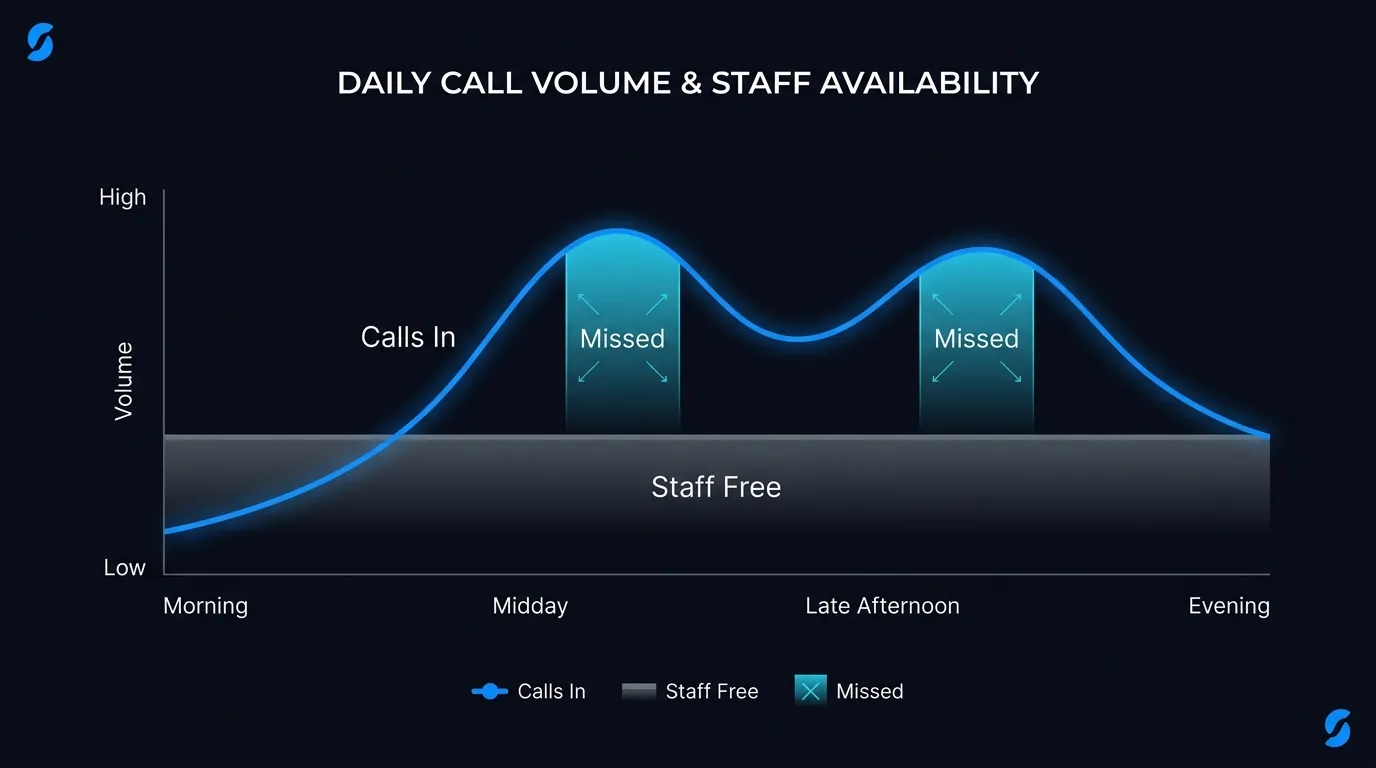
Call volume peaks exactly when your floor staff are least free to pick up.
How does it handle a used-car enquiry?
The agent answers, identifies which vehicle the caller wants, and captures their details. It can confirm whether the car is still available and book a test drive on the spot. Then it texts the lead to your sales team straight away.
Here is the flow in plain terms. A caller asks about the silver Outlander on your site. The agent checks the listing reference, confirms it is in stock, and answers basic questions on price and kilometres.
It does not bluff. If the caller asks something only a salesperson can answer, like trade-in value, the agent says a specialist will call back. It books that callback and flags it as hot.
Speed matters here. A lead contacted in five minutes is far more likely to convert than one chased the next day. Our approach to fast lead chasing is covered in our guide to following up hot leads before they cool.
How does it book a service or a test drive?
The agent checks your calendar, offers open slots, and confirms the booking by text. It handles the back-and-forth of finding a time that suits. No human needs to touch the diary.
A service caller says their Ranger is due for its 60,000km service. The agent offers Tuesday at 8am or Thursday at 10am. The caller picks Thursday and gets an instant confirmation.
The same logic books test drives. The agent offers two or three windows, locks one in, and adds the caller's vehicle of interest to the note. Your salesperson walks in knowing exactly who is coming and why.
This booking flow plugs into the tools you already run. We go deep on calendar and booking mechanics in our article on AI receptionist appointment booking.
Stop losing buyers to a busy phone line.
See how the agent answers and books for your yard on our NZ dealership solution page.
How does it route a call to sales versus service?
The agent asks one or two quick questions, works out whether the caller wants to buy or to service, then routes accordingly. Sales enquiries get qualified and booked. Service calls go to the service diary or the right human.
The routing is not a clumsy phone menu. The caller just talks. If they mention a warrant of fitness or a rattle, the agent treats it as service. If they mention a listing or a price, it treats it as sales.
When a call needs a person, the agent transfers cleanly with context. Your team is not handed a cold line. They get the caller's name, the reason, and what has already been discussed.
AI does not replace your people. It catches the overflow and the after-hours calls, then hands the human conversations to humans. We explain that balance in our piece on why voice agents still need humans.
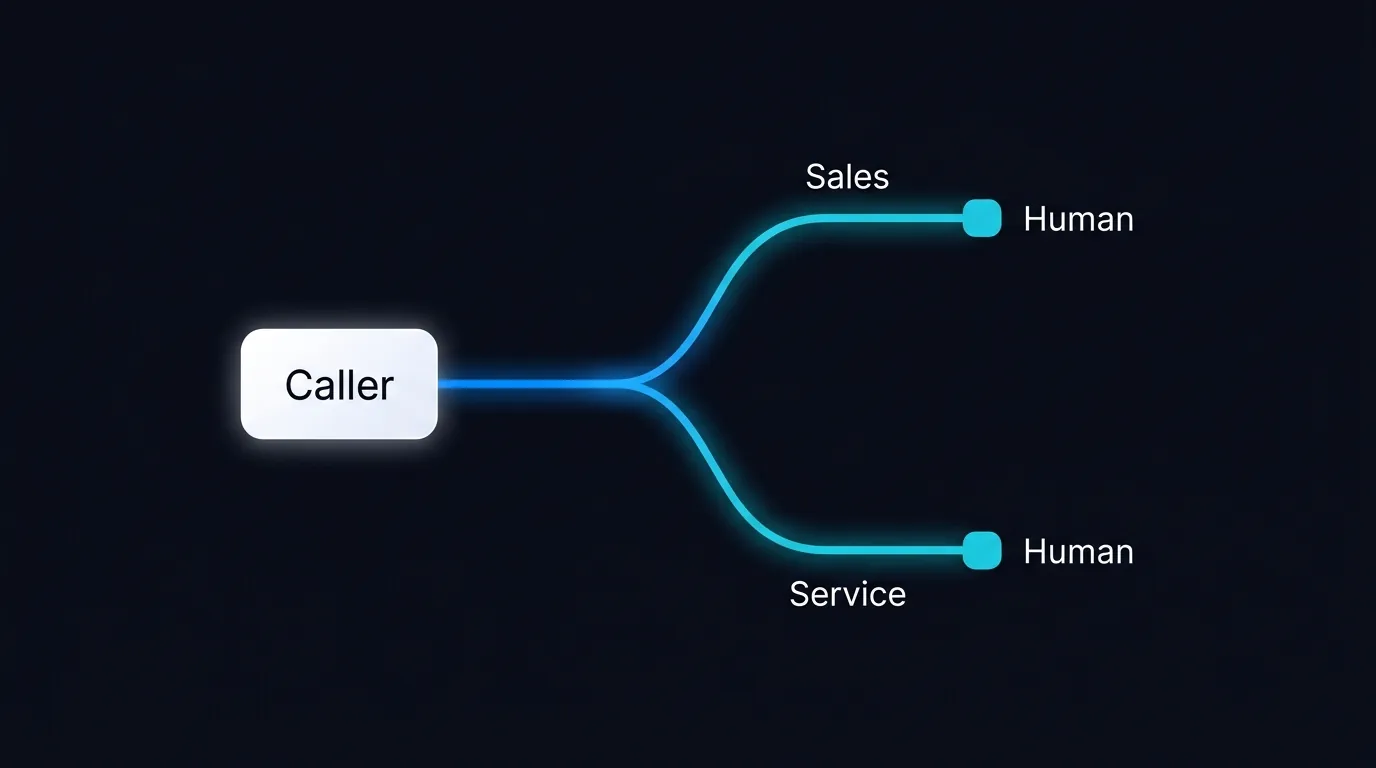
One conversation, routed to sales or service, with a clean handoff to your people when needed.
How does it keep customer data private?
Your structured records, transcripts and bookings sit on our servers in Sydney. Live call audio is processed offshore under documented arrangements with our voice infrastructure partner. We never claim all data stays in Australia, because that would not be true.
This split matters for compliance. In New Zealand the Privacy Act 2020 and the Office of the Privacy Commissioner set the rules. In Australia the Privacy Act 1988, the 13 Australian Privacy Principles and the OAIC apply.
The agent discloses it is an AI at the start of every call. Callers know they are talking to an assistant, not a person pretending to be one. That honesty is a compliance requirement and a trust builder.
We treat caller data as the dealership's data. You control retention and access. For a deeper read, see our explainer on the NZ Privacy Act and AI voice agents.
What does it cost a NZ or AU dealership?
You pay about 80 cents a minute, billed by the second, in NZD or AUD. An average answered call runs about 30 seconds, so roughly 40 cents. A typical one to two minute booking call costs about one to two dollars.
Compare that to a part-time receptionist at about 28 to 35 dollars an hour before KiwiSaver or super, ACC and holiday pay. The agent has no roster gaps and no sick days. It covers the after-hours window a human shift cannot.
For outbound work the numbers stack up too. A 200-dial follow-up campaign costs about 100 dollars. Of those dials, 47 to 65 percent connect, and around 20 to 25 percent become a real one-minute-plus conversation.
Real results back this up. A Sydney sales agent produced 141 leads in 90 days at 32.74 dollars per seller. A Christchurch developer booked viewings at 7.12 dollars each. For a full cost breakdown, read our guide on what an AI receptionist costs.
Ready to stop sending buyers to voicemail?
See exactly how the agent answers your sales and service calls on the Australian dealership page, or check how every lead can flow into your CRM in our guide to AI voice agent CRM integration. You can also see how the same engine handles a standard inbound reception line.
Frequently Asked Questions
Does the AI voice agent tell callers it is an AI?
Yes. The agent discloses it is an AI assistant at the start of every call. That is both a compliance requirement under NZ and AU privacy rules and a trust builder. Callers respond well when they know what they are dealing with, and they still book test drives and services without hesitation.
Can it handle two callers asking about the same car at once?
Yes. The agent runs dozens of calls in parallel. Three buyers ringing about the same listing all get answered on the first ring. No one waits on hold. Each gets qualified, and each lead is logged separately so your sales team can follow up every one.
What happens when a caller needs a real salesperson?
The agent transfers the call to a human with full context. Your salesperson gets the caller's name, the vehicle of interest, and what has already been discussed. For questions only a person can answer, like a trade-in value, the agent books a callback and flags it as a hot lead.
Does it work after hours and on weekends?
Yes. The agent covers nights, weekends and public holidays with no roster gaps. A buyer browsing your stock at 9pm gets answered and booked instead of ringing a competitor in the morning. This after-hours window is where most dealerships lose the calls they never knew about.
Where is my dealership's customer data stored?
Your structured records, transcripts and bookings sit on our servers in Sydney. Live call audio is processed offshore under documented arrangements with our voice infrastructure partner. We never claim all data stays in Australia. You control retention and access, in line with the NZ Privacy Act 2020 and the Australian Privacy Principles.
How much does it cost to run?
You pay about 80 cents a minute, billed by the second. An average 30-second call is about 40 cents, and a one to two minute booking call is about one to two dollars. That undercuts a part-time receptionist at 28 to 35 dollars an hour, and it covers the after-hours window a human shift cannot.
For context on the wider category, see how AI voice agents work for local businesses.
Leonardo Garcia-Curtis
Founder & CEO at Waboom AI. Building voice AI agents that convert.
Ready to Build Your AI Voice Agent?
Let's discuss how Waboom AI can help automate your customer conversations.
Book a Free Demo

