
Most voice AI pricing pages sell you the wrong number. They quote cents per minute. That tells you almost nothing about whether the agent pays.
The number that matters is cost per booked lead. Not the call. Not the minute. The booked outcome.
A demo, a viewing, a qualified seller, a confirmed appointment. That is what you bank.
This guide shows you how that number works. We use real NZ and AU campaign figures. We show you how to calculate your own, and when it is too high.
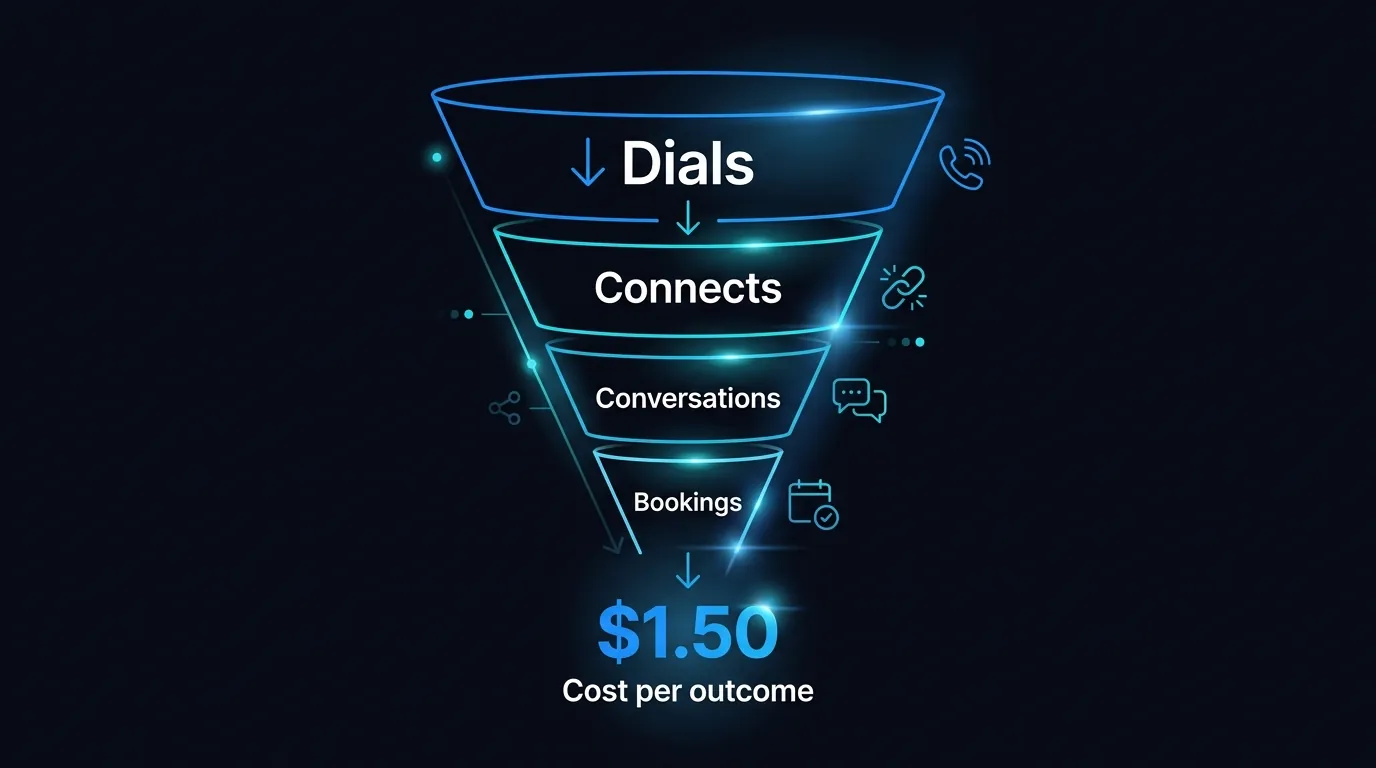
Your real cost lives in the funnel, not the per-minute meter.
What is cost per booked outcome?
Cost per booked outcome is your total campaign spend divided by the real results it produced. Spend 100 dollars and book 14 viewings, and your cost per booked lead is about 7 dollars. The minute rate is irrelevant. The outcome decides if the agent pays.
A booked outcome is whatever your business actually wants. For a real estate team it is a viewing. For a sales floor it is a qualified seller. For a clinic it is a confirmed appointment.
We tag every call that hits that outcome. Then we divide spend by tags. That single figure tells you more than any per-minute quote ever will.
If you want the wider picture first, our voice agent pricing breakdown lays out the maths by industry.
Why is cost per minute the wrong number to judge on?
Cost per minute hides the two things that drive your cost: how many people answer, and how many say yes. A cheap minute on a campaign that never connects is expensive per result. The minute is an input. The booked outcome is the output you bank.
Here is the trap. A vendor quotes a low per-minute rate. You assume the maths is simple. But you pay for every second the agent is live, including ringing, voicemail and dead air.
Our platform bills about 80 cents per minute in NZD or AUD, charged by the second. An average answered call runs about 30 seconds. So a typical answered call costs about 40 cents.
But you do not pay only for answered calls. You pay for the dials that ring out too. That is why the per-minute number lies. Your real cost lives in the funnel, not the meter.
Want the full breakdown of what a minute contains? We wrote that up in our per-minute cost guide.
How do connect rate and success rate decide your real cost?
Two rates set your true cost per booked lead: connect rate and success rate. Outbound connect rate runs 47 to 65 percent. About 20 to 25 percent of dials become a conversation longer than a minute. Stack those two and you get your real cost.
Walk it through with round numbers. You run 200 dials. That costs about 100 dollars NZD. A connect rate of 55 percent means about 110 people pick up.
Of those, roughly 20 to 25 percent of your total dials turn into a proper conversation. So about 40 to 50 real talks. Then your success tag rate decides how many become a booking.
Say one in three good conversations books. That is roughly 14 to 16 bookings from 200 dials. So 100 dollars divided by 15 is about 6 to 7 dollars per booked outcome.
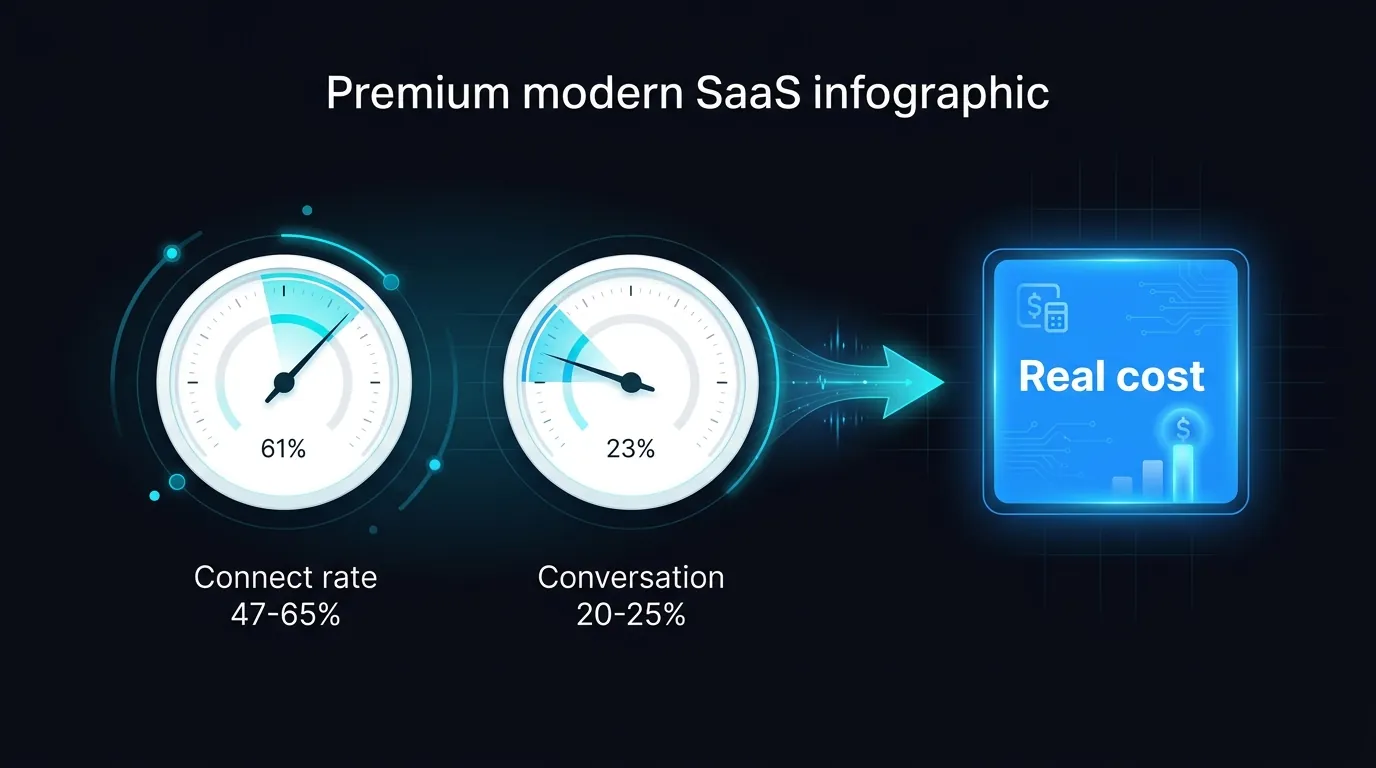
Move either rate and your cost per booked outcome shifts hard.
Change one rate and the whole sum moves. A weak script that books one in six doubles your cost overnight. This is why we track the funnel, not the meter. We break down which numbers to watch in our outbound calling KPIs guide.
Want your number, not a generic quote?
Our pricing page models cost per booked outcome for your industry, not just cents per minute.
What did real NZ and AU campaigns cost per outcome?
Real campaigns land between 7 and 33 dollars per booked outcome, depending on the offer. A Sydney sales agent produced 141 vendor leads in 90 days at 32.74 dollars per seller. A Christchurch developer booked viewings at 7.12 dollars each. Both beat human dialling on cost per result.
Take the Sydney case first. The agent ran outbound for a real estate group across 90 days. It logged 141 qualified vendor leads. The full spend worked out to 32.74 dollars per seller.
A human appointment setter on 30 dollars an hour does not touch that. Read the full Sydney vendor lead breakdown for the call-by-call detail.
The Christchurch developer ran a tighter, warmer list. Higher connect rate, simpler ask. Viewings landed at 7.12 dollars each.
Same platform, different cost per booked lead. The gap is the offer and the list, not the technology.
How do you work out your own cost per booked lead?
Take your campaign spend, then divide by your tagged outcomes. That is your cost per booked lead. No tags yet? Estimate with three rates: connect, conversation and booking. Multiply your dials by all three to get expected bookings.
Here is the formula in plain English. Dials times connect rate gives connects. Connects times conversation rate gives real talks. Real talks times booking rate gives bookings.
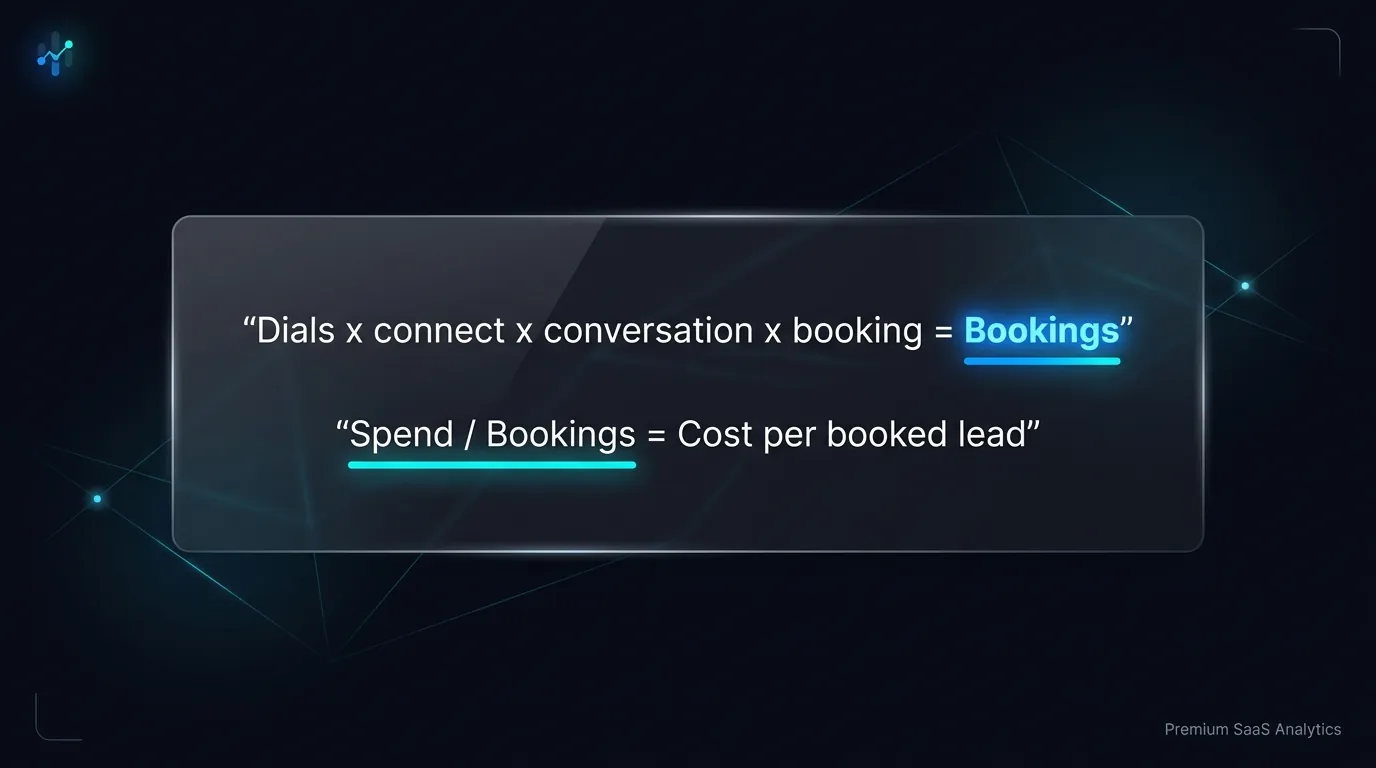
Spend divided by tagged bookings is the only number that matters.
Then spend divided by bookings is your number. For a 200-dial run at 100 dollars, plug in your own rates. We walk through the full economics in our 200-dial campaign cost guide.
Start conservative. Use 50 percent connect, 20 percent conversation and 30 percent booking. That gives you a worst-case figure you can defend to your accountant.
Then run a real batch and replace the estimates with tags. Your real cost almost always beats the conservative model. That is the moment the agent earns its place.
When is the cost per outcome too high?
Cost per outcome is too high when one booking costs more than that booking is worth to you. If a viewing earns 200 dollars in commission and costs 7 dollars to book, you are fine. If a low-value enquiry costs 40 dollars to surface, stop and fix the funnel.
The honest threshold is your own margin. A mortgage broker can pay 50 dollars per qualified lead and smile. A cafe taking bookings cannot.
So set a ceiling before you launch. Decide the most you would happily pay for one real result. If the campaign blows past it, the problem is usually the list or the script, not the price.
We have killed campaigns at 80 dollars per outcome and relaunched them at 12. Same agent. Better targeting.
How do you drive it down?
You drive cost per booked lead down by lifting the three rates, not by haggling the minute price. Better lists lift connect rate. A sharper opening lifts conversation rate. A clearer ask lifts booking rate. Move all three and your cost can halve without touching the meter.
Start with the list. A clean, recent, well-matched list connects far better than a cold scrape. Connect rate is the cheapest lever you have.
Next, the first eight seconds. The agent discloses it is an AI, then earns the next sentence. A weak opener bleeds connects into hang-ups.
Last, the ask. One clear next step books better than a vague pitch. Tighten those three and watch the number fall.
If you want to see how the agent fits your business, start with our AI voice agents overview or check what an always-on line costs in our AI receptionist cost guide.
Stop judging on cents per minute.
See the cost per booked outcome for your offer on our pricing page, then run a real 200-dial test.
Frequently Asked Questions
What is a good cost per booked outcome?
A good figure depends on what one booking is worth to you. Real NZ and AU campaigns land between 7 and 33 dollars per booked outcome. If a single result earns you more than that, the agent pays. A 7-dollar viewing or a 33-dollar vendor lead beats human dialling on almost every sales floor.
Does cost per minute still matter at all?
It matters as an input, not a verdict. Our platform bills about 80 cents per minute in NZD or AUD, by the second. An average answered call is about 30 seconds, so roughly 40 cents. But you judge the campaign on cost per booked lead, because the minute rate alone cannot tell you if the funnel pays.
How many dials do I need to see a real number?
About 200 dials gives you a stable read. That run costs around 100 dollars NZD. From there you can see your true connect rate, conversation rate and booking rate. Smaller batches swing too much to trust. Once you have 200 dials tagged, your cost per booked outcome stops being a guess.
Is my customer data safe on these calls?
Yes. Your portal, transcripts and structured records sit on our Sydney servers. Live audio is processed offshore under documented arrangements with our voice infrastructure partner. In NZ we operate under the Privacy Act 2020 and the OPC. In AU it is the Privacy Act 1988, the 13 Australian Privacy Principles and the OAIC. We can delete a contact in 10 minutes.
Do callers know they are talking to an AI?
Yes. The agent discloses it is an AI on every call. That is built in, not optional. It also lifts trust, which helps your conversation rate. People talk longer when they are not trying to work out who they are speaking to. Honesty is good economics here.
How fast can I test my own cost per booked lead?
You can run a 200-dial batch and read a real number inside a few days. We tag the outcomes, you see the spend, and the cost per booked lead falls out of the maths. No long contract to find out. Most clients know whether the agent pays after the first real campaign.
Leonardo Garcia-Curtis
Founder & CEO at Waboom AI. Building voice AI agents that convert.
Ready to Build Your AI Voice Agent?
Let's discuss how Waboom AI can help automate your customer conversations.
Book a Free Demo

