
Most quotes you'll see online list one number and hide four. The AI voice agent cost per minute is about 80 cents in NZD or AUD, billed by the second. That single figure carries five separate machines working at once. This is what sits inside that price, layer by layer, and why a 7-cents headline is a trap.
When a tradie's phone rings at 6pm on a Friday, the caller has no idea five systems just fired in under a second. That's the part the cheap headline never shows you.
What does an AI voice agent actually cost per minute in NZ and Australia?
About 80 cents per minute in NZD or AUD, billed by the second, not rounded up to whole minutes. A typical answered call runs around 30 seconds, so most calls land near 40 cents. A one to two minute booking sits between $1 and $2. That all-in rate is the honest number.
The reason it's all-in matters. Cheaper headline rates usually quote one layer and bill you separately for the other four. By the time the call ends, the real figure climbs back toward 80 cents anyway. We'd rather show you the full number up front than surprise you on the invoice.
If you want the plan-by-plan view, our voice agent pricing page lays out what each tier includes. This article is about what's actually inside the meter.

One per-minute price hides five separate systems running at once.
What are the five layers bundled into that per-minute price?
Five systems run on every call. Telephony carries the call, speech-to-text hears the caller, a language model thinks, text-to-speech replies in a human voice, and orchestration glues it together. Each one carries its own cost. The 80 cents covers all five.
Here's what each layer does on a live call.
Strip any one of those out and the call breaks. That's why we never sell them separately.
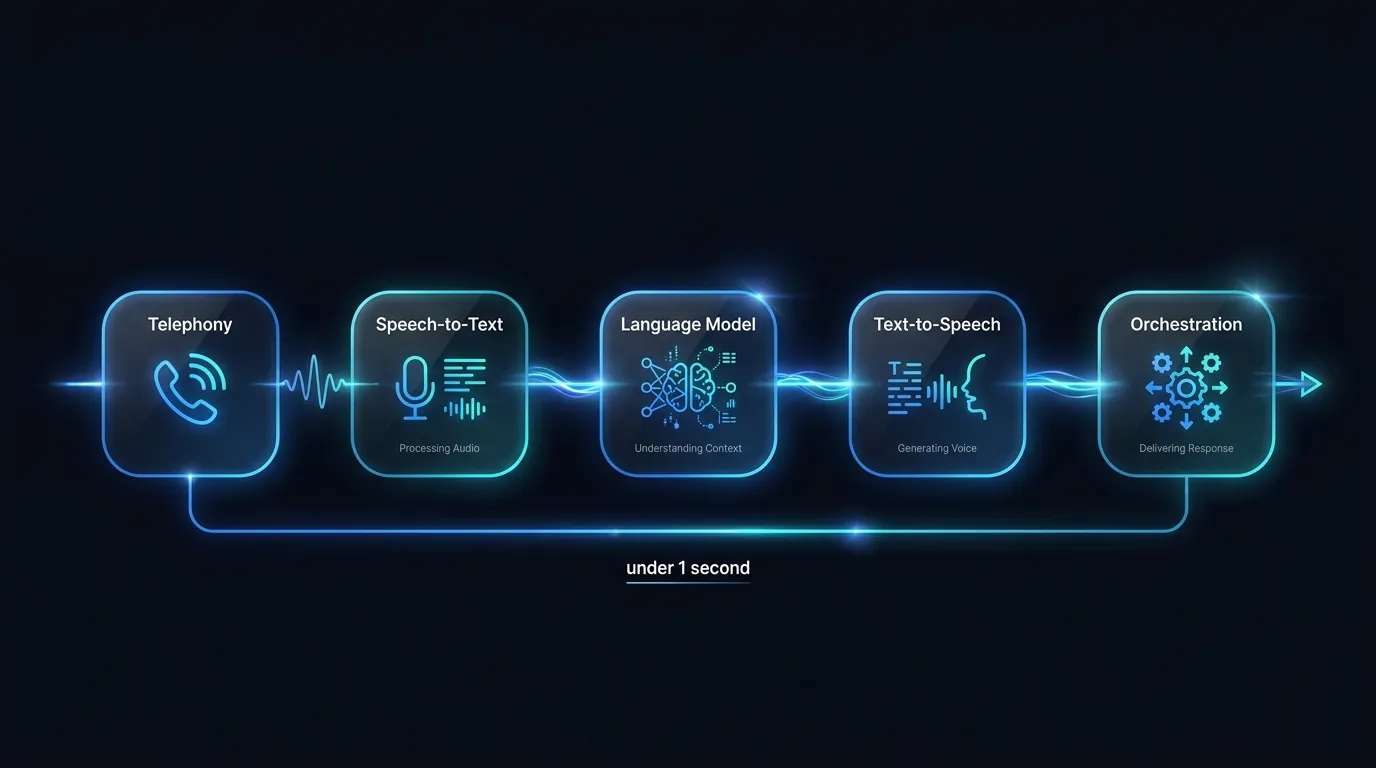
Every spoken sentence travels through all five layers and back in under a second.
Why does a 7-cents-a-minute headline rate mislead you?
A 7-cents-a-minute headline usually quotes the telephony layer alone. It hides speech-to-text, the language model, text-to-speech, and orchestration, the four layers that make the agent actually understand and respond. Add those back in and you land near 80 cents anyway.
Think of it like a car advertised at the price of the steering wheel. The wheel is real, but it won't get you to the job site. You still have to buy the engine, the gearbox, the seats, and the chassis. The 7-cents number is the wheel.
We've seen quotes that bury speech and language fees as "usage" or "tokens" in a separate line. By the time a clinic runs a full month of calls, the bill matches a straight 80-cents-a-minute rate. The headline just delayed the truth. If you want a plain-English breakdown of total monthly cost, read our walkthrough of what an AI receptionist really costs.
Want the number without the asterisks?
Our all-in pricing for voice agents shows one rate that already includes all five layers. No surprise usage lines.
How does per-second billing change what you really pay?
Per-second billing means you pay only for the seconds a call actually runs, not a rounded-up minute. A 35-second call costs about 47 cents, not a full 80. Across hundreds of short calls, that difference adds up fast in your favour.
Most real calls are short. A caller asking your opening hours is often done in 20 seconds. Round that up to a minute and you've overpaid by almost 200 percent, nearly 3x the real cost. Bill it by the second and you pay about 27 cents.
This is why the average answered call costs around 40 cents, not 80. Calls that resolve quickly are cheap, and most do. The per-minute rate is the ceiling, not the typical bill.
What does a real monthly bill look like at 100 and 300 calls?
At 100 answered calls a month averaging 30 seconds each, you're looking at roughly $40 in call cost. At 300 calls a month, that's about $120. These are call-cost figures at 80 cents a minute, before any plan fee.
Here's the shape of it.
Outbound looks different because connect rates apply. A 200-dial outbound campaign costs about $100 NZD. Only 47 to 65 percent connect, and roughly 20 to 25 percent become a real conversation over a minute long. We saw a Sydney sales agent produce 141 vendor leads in 90 days at $32.74 per seller. A Christchurch developer booked property viewings at $7.12 each. If you run high outbound volume, our pricing breakdown at 10,000 calls shows how the maths scales.
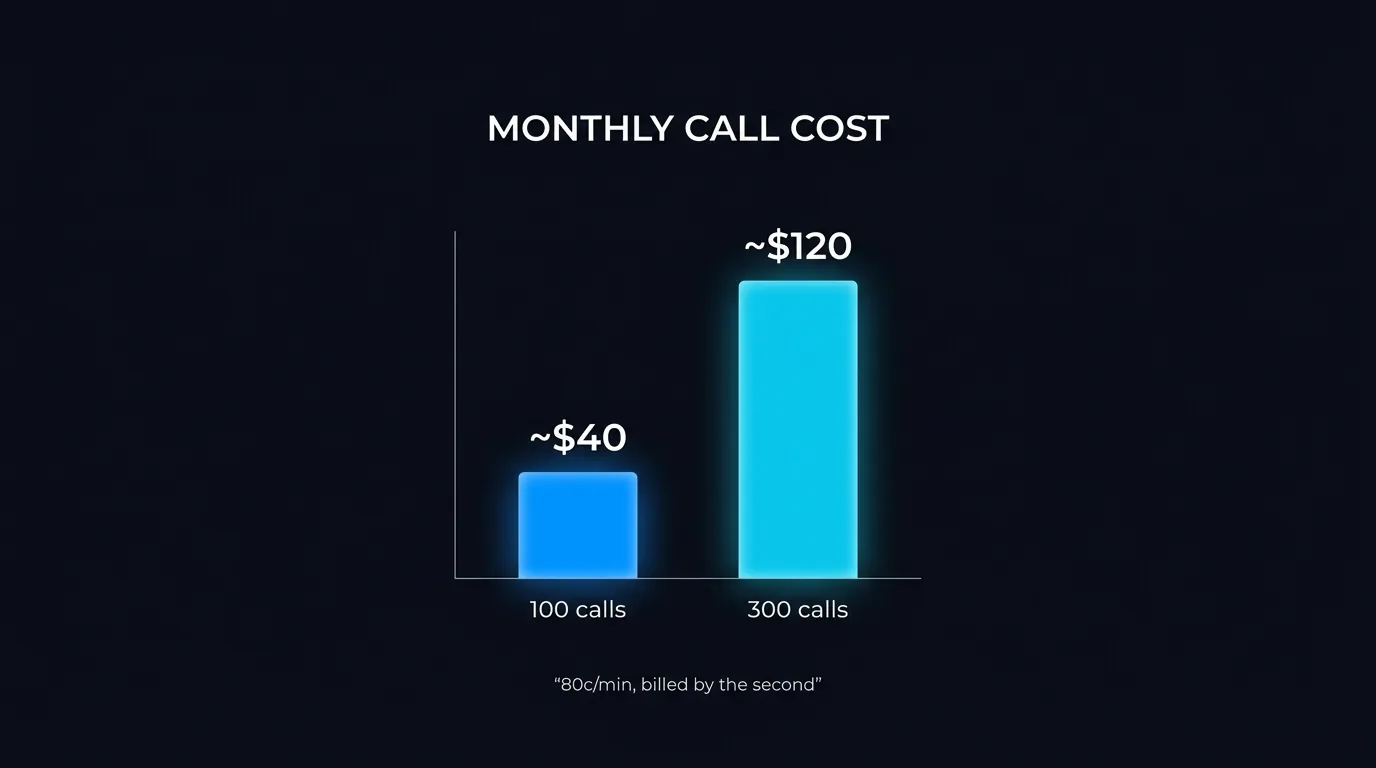
At 80 cents a minute billed by the second, volume scales predictably.
What sits outside the per-minute price, like setup and integrations?
Setup, integrations, and any custom build sit outside the per-minute meter. The per-minute rate covers running calls. Configuring the agent, connecting your calendar or CRM, and writing the call flow are one-off or plan-level costs, not per-second charges. We're upfront about which is which.
The per-minute price is the engine running. The build is getting the car out of the garage and onto your road. That includes the handbook the agent follows, the booking rules, and the hand-off logic for when a human is needed.
This is also where security lives. Your portal, transcripts, and structured call records sit on our Sydney servers, while live audio is processed offshore during the call. We disclose on every call that the caller is speaking with an AI. None of that shows up as a per-minute line, but it's part of what you're buying. Skipping the build is exactly why most do-it-yourself voice agents fall over within weeks.
How does 80 cents a minute compare to a receptionist wage?
A part-time NZ or AU receptionist runs roughly $28 to $35 an hour before KiwiSaver or super, ACC, and holiday pay. At 80 cents a minute, the agent costs 48 cents to handle a 36-second call. The agent also works at 6pm, on weekends, and through lunch with no overtime.
Run the comparison. One human hour at $30 buys you one phone at a time, eight hours a day, five days a week. The same $30 in agent time covers about 37 minutes of live calls, spread across midnight, Sunday, and three lines ringing at once.
The point isn't to replace your reception entirely. It's to catch the calls a human can't: the after-hours enquiry, the third caller in the queue, the Friday 6pm booking. For the full side-by-side, see this year's voice agent pricing guide or browse what our voice agents handle day to day.
See your real monthly number.
Plug your call volume into our voice agent pricing and see the all-in cost with every layer already included.
Frequently Asked Questions
Is the 80 cents a minute the same in NZD and AUD?
Yes. We price at about 80 cents per minute in both NZD and AUD, billed by the second. The rate is the same number in each currency, so a New Zealand clinic and an Australian trades business see the same per-minute figure. Your monthly bill then depends on your actual call volume and average call length.
Does a shorter call really cost less?
Yes, because we bill by the second, not the rounded minute. A 30-second call costs about 40 cents, and a 20-second call about 27 cents. You only pay for the seconds the agent is actually on the line. That's why the average answered call lands near 40 cents rather than the full per-minute ceiling.
Why not just buy the cheap 7-cents-a-minute option?
Because 7 cents usually covers only the telephony layer. It leaves out speech-to-text, the language model, text-to-speech, and orchestration, the four layers that let the agent understand and reply. Add those back and you're near 80 cents anyway. The cheap headline just moves the cost to a separate usage line you find later.
What's the most important thing technically on a call?
First-token latency at the open of the call. The agent has to start responding in under a second, or a cold caller assumes the line is dead and hangs up. Sub-second response is make-or-break. That speed is exactly what the orchestration and model layers are paying for, and it's why the cheapest stacks fail.
Does setup cost extra on top of the per-minute price?
Yes. Setup, calendar and CRM integration, and the call-flow build are separate from the per-minute meter. The per-minute rate only covers running live calls. The one-off build covers configuring the agent, writing its handbook, and wiring your booking rules. We're clear about which costs are per-second and which are one-off.
Where does my call data actually live?
Your portal, transcripts, and structured call records sit on our Sydney servers. Live audio is processed offshore during the call itself. We're honest about that split rather than claiming everything stays in one country. And the agent always discloses to the caller that they're speaking with an AI.
Leonardo Garcia-Curtis
Founder & CEO at Waboom AI. Building voice AI agents that convert.
Ready to Build Your AI Voice Agent?
Let's discuss how Waboom AI can help automate your customer conversations.
Book a Free Demo

