
You are 30 minutes into a board upgrade. Your hands are full. The phone rings three times and stops. That was a kitchen rewire worth real money, and it just rang the next sparky on the list.
That call did not go to voicemail. It went to your competitor.
An AI voice agent for electricians answers every call in your business name, qualifies the job, and books it into your diary while you stay on the tools. No beep. No missed lead. This guide walks through exactly how it works for a NZ or AU electrical business.
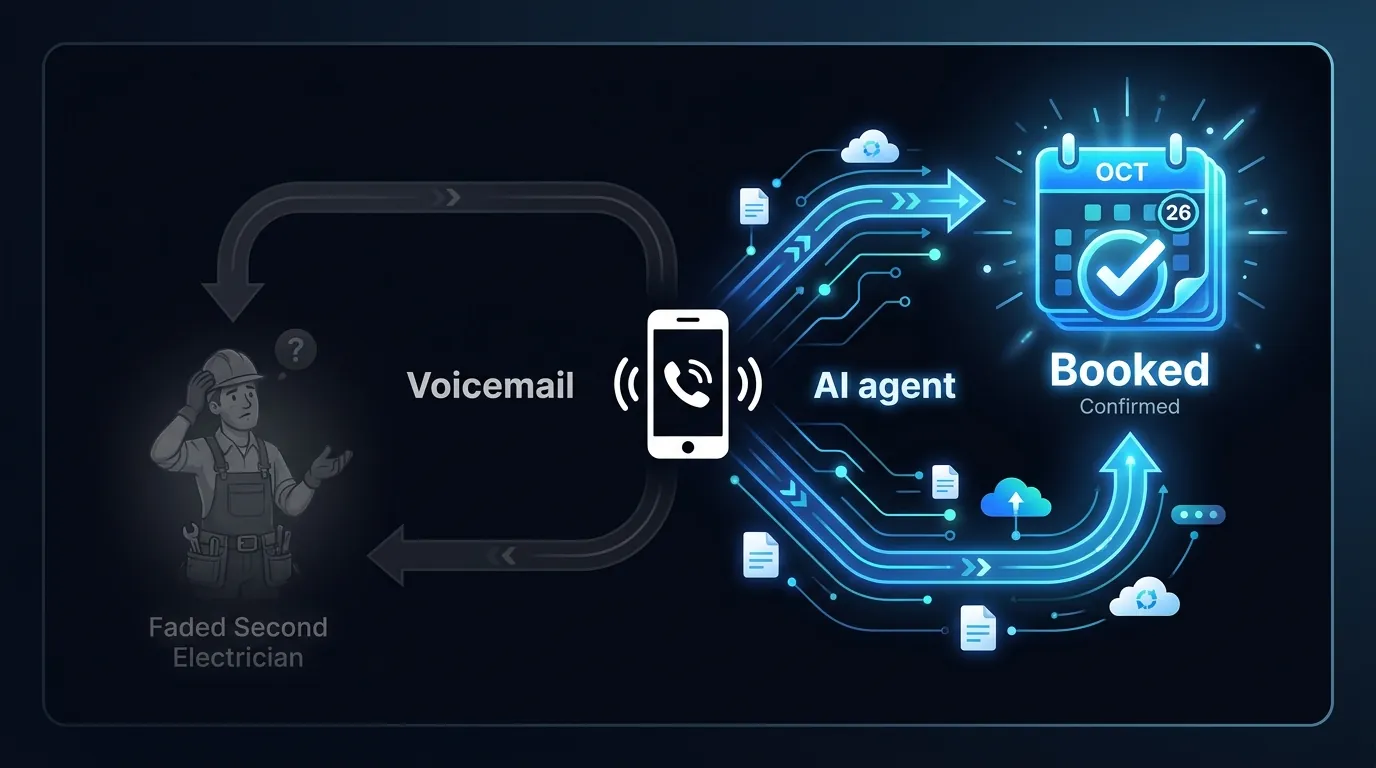
Every missed call is a lead handed to the next electrician on the list.
What does an AI voice agent do for an electrical business?
It answers your phone in your business name, asks the right questions, and books the job. The agent works while you are up a ladder, under a house, or driving between sites. Every caller gets a real conversation, not a beep. That turns a ringing phone into a booked callout.
Think of it as a receptionist who never sleeps, never takes lunch, and never puts a caller on hold. It knows your services, your pricing rules, and your diary.
If you want the full feature picture, our electrician voice agent page lays out every job it handles.
Why do electricians lose work to a missed call?
Electricians lose work because callers do not leave messages. They ring the next sparky. A missed call is a lost lead, and most callers never call back. The agent answers on the first ring so that lead becomes a booked job, not a competitor's win.
A part-time receptionist costs roughly $28 to $35 an hour before KiwiSaver or super, ACC, and holiday pay. They go home at 5pm. Faults do not.
You cannot answer a phone with live wires in your hand. That is the whole problem. The agent covers the hours and the moments you physically cannot pick up. We dug into the lost-revenue side of this in why callers hang up and how to stop it.
How does it qualify a callout versus a quote?
The agent asks two or three questions to sort a same-day callout from a quote job. It captures the fault, the address, and whether power is out. Then it routes the urgent ones to you and books the rest. You stop guessing which voicemail matters.
A switchboard sparking is not a kitchen renovation quote. The agent knows the difference and acts on it.
The questions it asks
Those four answers decide everything. A no-power fault gets flagged urgent. A renovation quote gets a calendar slot. You see clean notes, not a pile of vague messages.
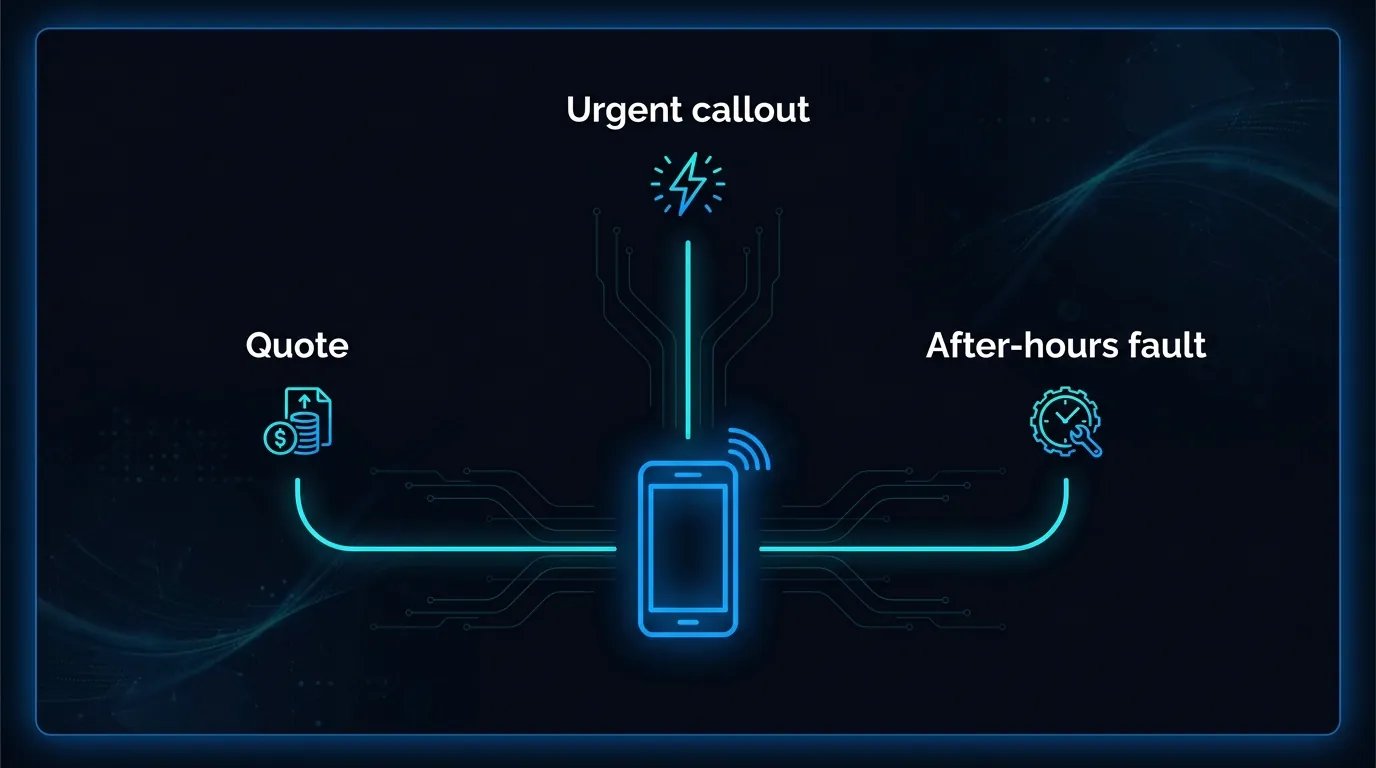
Three questions split a same-day callout from a quote and a genuine emergency.
How does it book the job into your diary?
The agent checks your live calendar and offers real time slots. The caller picks one, gives their details, and the job lands in your diary with the address and fault notes. You get a text. No double-booking. No back-and-forth.
It plugs into the calendar you already use, so nothing changes about how you run your day.
We cover the booking mechanics in depth in how AI handles appointment booking, and if you run a CRM, see connecting the agent to your CRM.
Stop handing kitchen rewires to the next sparky.
See exactly how the electrician voice agent answers, qualifies, and books while you are on the tools.
How does it handle after-hours and urgent faults?
The agent runs 24 hours, so a 9pm power fault gets answered, triaged, and logged. Genuine emergencies get flagged and sent to you straight away. Non-urgent jobs get booked for the morning. You sleep, and nothing falls through.
A storm rolls through and ten phones ring at once. A human answers one. The agent answers all ten.
You set the rules for what counts as urgent and how fast you want to know. A live fault with no power can buzz your phone in seconds. A routine quote can wait for a 7am summary. We unpack the night-shift case in the after-hours receptionist breakdown.
What does it cost compared with a missed callout?
The agent is billed by the second at roughly 80 cents a minute. A 30-second answered call costs about 40 cents. A one to two minute booking costs about a dollar or two. One missed kitchen rewire is worth more than a month of answered calls.
Run the maths. A 200-dial outbound follow-up campaign costs around $100. A single won callout covers that many times over.
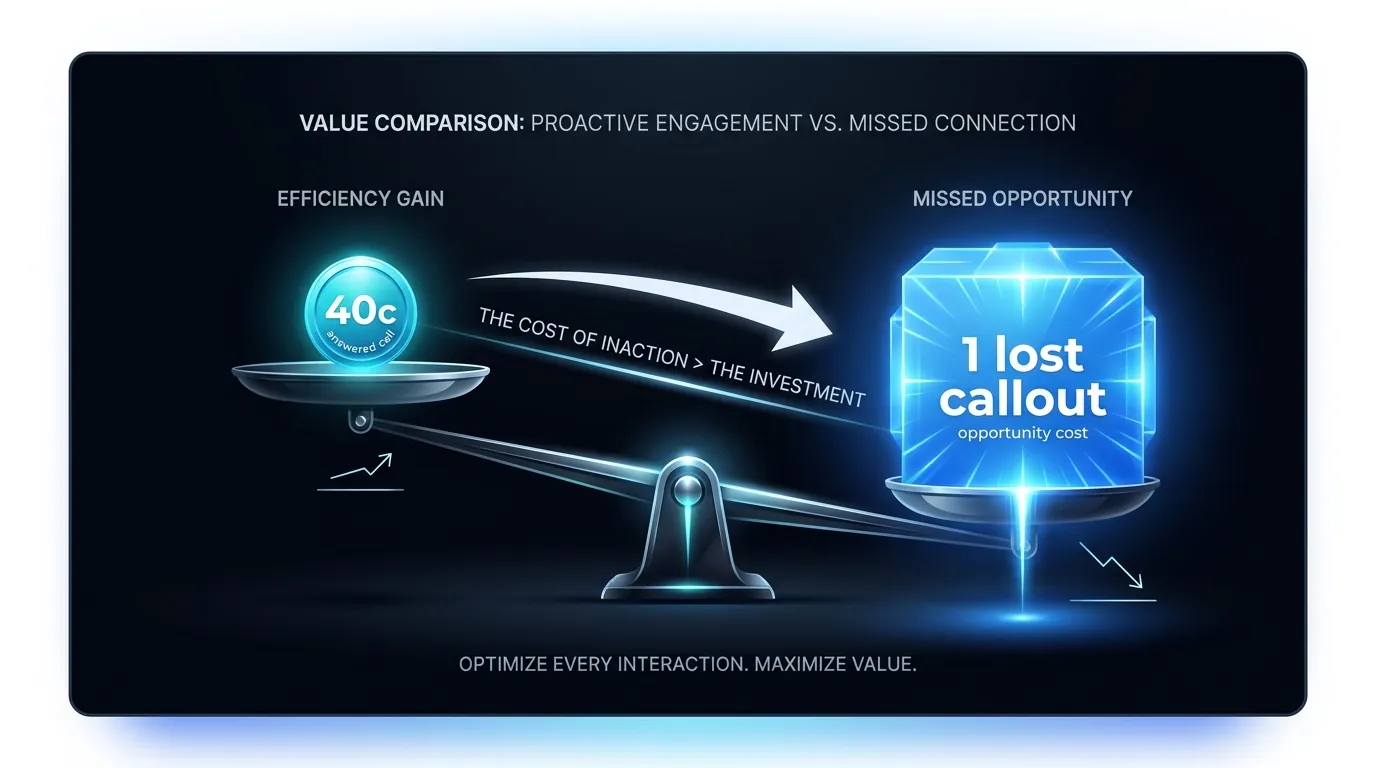
A 40 cent answered call against the value of one lost callout. The maths is not close.
Compare that with a part-time receptionist at $28 to $35 an hour plus on-costs, who clocks off at 5pm anyway. For a full pricing breakdown, read what an AI receptionist actually costs.
How fast can it go live?
Most electrical businesses are live within a few days. We forward your existing number, load your services and pricing rules, and connect your calendar. The agent discloses it is an AI on every call. You keep your number and your brand.
Forwarding is the easy part. We walk you through it in how to forward calls to the agent.
We comply with the NZ Privacy Act 2020 and the Office of the Privacy Commissioner. For Australian sparkies we follow the Privacy Act 1988 and the 13 Australian Privacy Principles under the OAIC. Your portal, transcripts, and call records sit on Sydney servers. Live audio is processed offshore. More detail lives in our Privacy Act compliance guide.
The agent does not replace your judgement on the hard calls. It handles the volume and hands you the ones that need a human. We are honest about that line in our inbound voice agent overview and in where AI agents still need a person.
Frequently Asked Questions
Does the agent tell callers it is an AI?
Yes. The agent discloses that it is an AI assistant on every call. Callers know they are talking to your virtual receptionist, not a person. This keeps you compliant and keeps trust high. Most callers do not mind once their job is booked and confirmed on the spot.
Can it handle two calls at once?
Yes. The agent answers every inbound call at the same time. If three callers ring during a storm, all three get answered and booked. A single human receptionist can only take one call at a time. You never lose the second or third caller again.
Will it work with my existing phone number?
Yes. You keep your current number. We forward calls to the agent so nothing changes for your callers. You can forward all calls, or only the ones you miss. Your number and your brand stay exactly as they are today.
What happens with a genuine emergency?
The agent triages it. A live fault with no power gets flagged urgent and sent to you straight away. Routine jobs get booked for the next available slot. You decide the rules for what counts as urgent and how fast you want to know about it.
Where is my customer data stored?
Your portal, transcripts, and call records sit on secure servers in Sydney. Live call audio is processed offshore for speed. We follow the NZ Privacy Act 2020 and the Australian Privacy Act 1988 with its 13 Privacy Principles. You control how long records are kept.
How much does it cost to run?
Billing is by the second at about 80 cents a minute. A typical 30-second answered call is around 40 cents. A booking call runs a dollar or two. One won callout pays for hundreds of answered calls. There is no holiday pay or sick leave to fund.
Your next missed call could be a full rewire.
Put an AI voice agent for electricians on your phone and book the jobs you are losing to voicemail.
Leonardo Garcia-Curtis
Founder & CEO at Waboom AI. Building voice AI agents that convert.
Ready to Build Your AI Voice Agent?
Let's discuss how Waboom AI can help automate your customer conversations.
Book a Free Demo

