
Your team is good. The clock is the problem. A caller asks a simple question and your receptionist spends ninety seconds finding the answer.
Average handle time is the total time a caller spends in a conversation, including talk and any wrap-up. It matters because it sets your cost per call and your queue length. Shave thirty seconds off the average and you free real capacity.
We run AI voice agents for NZ and AU teams. We have watched handle time fall without callers feeling rushed.
What is average handle time and why does it matter?
Average handle time is the mean time per call, from the moment a caller connects to the moment the matter is closed. It matters because it drives your staffing, queue length and cost. A long average means callers wait, and waiting kills bookings.
Most teams measure it wrong. They count talk time and forget the wrap-up. The notes, the system updates, the quick walk to ask a colleague. That hidden tail is often where the minutes hide.
Here is the simple maths. If your average handle time is four minutes and you take two hundred calls a day, that is over thirteen hours of talk. Trim it to three minutes and you save more than three hours every single day.
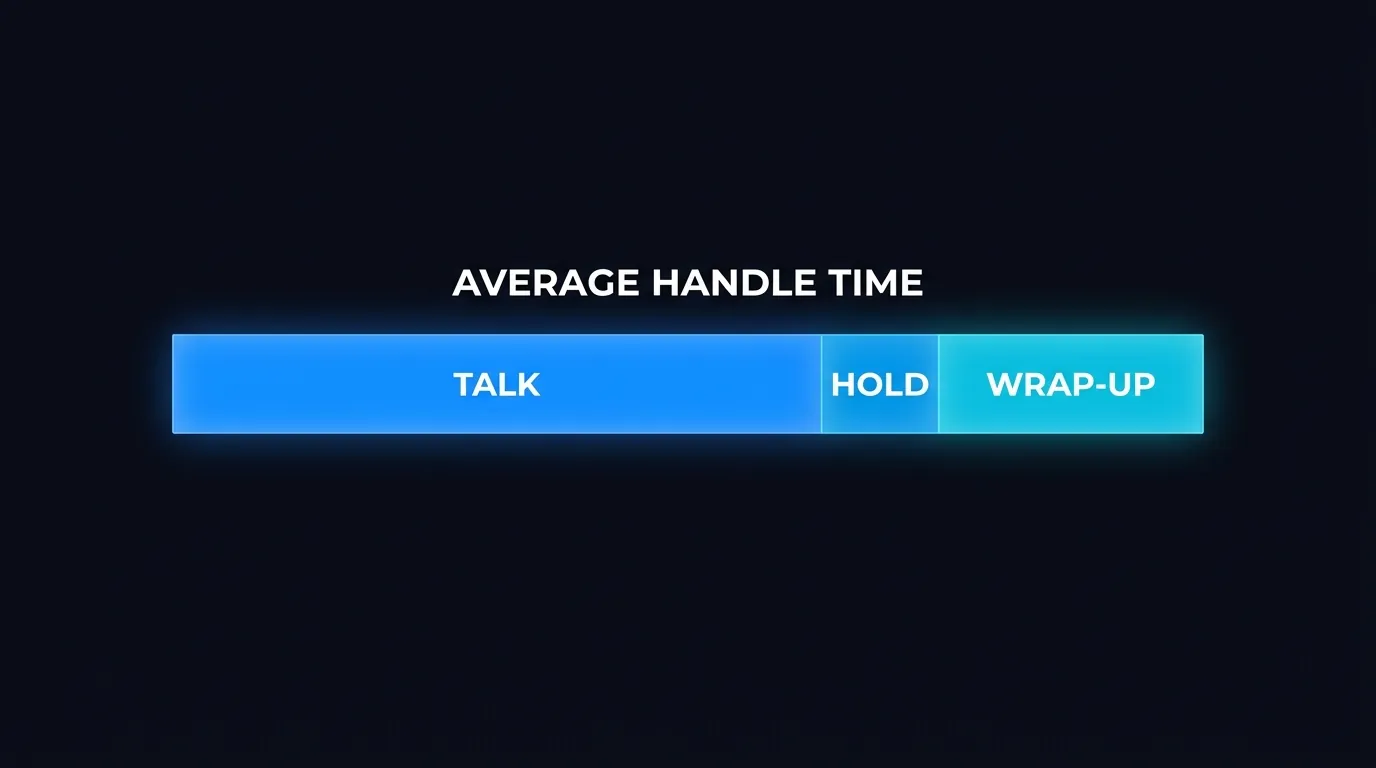
Average handle time is talk plus hold plus wrap-up, and the wrap-up tail is where most teams lose minutes.
How does an AI voice agent reduce average handle time?
An AI voice agent cuts handle time by removing the search. It reads your booking system, pricing and FAQs while the caller is still talking. There is no hold, no hunt, no transfer. The answer arrives in the same breath as the question.
Think about the dead seconds in a normal call. The receptionist asks the caller to wait. They open three tabs and scroll a price list. They ask a colleague who is on lunch. That is forty seconds of nothing.
Our platform skips all of it. The agent has the price, the diary and the policy loaded before it speaks. It answers, it books, it confirms. A simple enquiry that took two minutes now takes about forty seconds.
The economics follow. We bill about eighty cents a minute, charged by the second. An answered call that runs about thirty seconds costs you roughly forty cents. A tidy one to two minute booking call costs about one to two dollars.
Compare that to a part-time receptionist. In NZ and AU you pay about twenty-eight to thirty-five dollars an hour. That is before KiwiSaver or super, ACC and holiday pay. The agent never takes a smoko and never holds a caller to find a pen.
Want the simple calls answered in forty seconds?
See how the build works on our inbound AI voice agent page.
Does faster handling hurt the caller experience?
No, faster handling usually helps the caller, as long as the agent stays warm. People do not want a long call. They want their problem solved and their day back. Speed without rudeness is exactly what your callers ask for.
The danger is the wrong kind of speed. A human under pressure rushes, talks over the caller and skips the confirmation. That feels cold. The caller hangs up unsure whether the booking landed.
The agent removes that pressure entirely. It is never behind, never flustered, never watching a queue light. So it can answer in forty seconds and still read the booking back slowly and clearly.
We also let the agent pace itself. It pauses where a person would pause, and it does not barge in. Your callers tell us the agent felt calm, not quick. That is the whole trick.
It also discloses that it is an AI on every call. Callers know who they are talking to from the first sentence. That honesty builds trust, and trust shortens the call because nobody is fishing for a human.
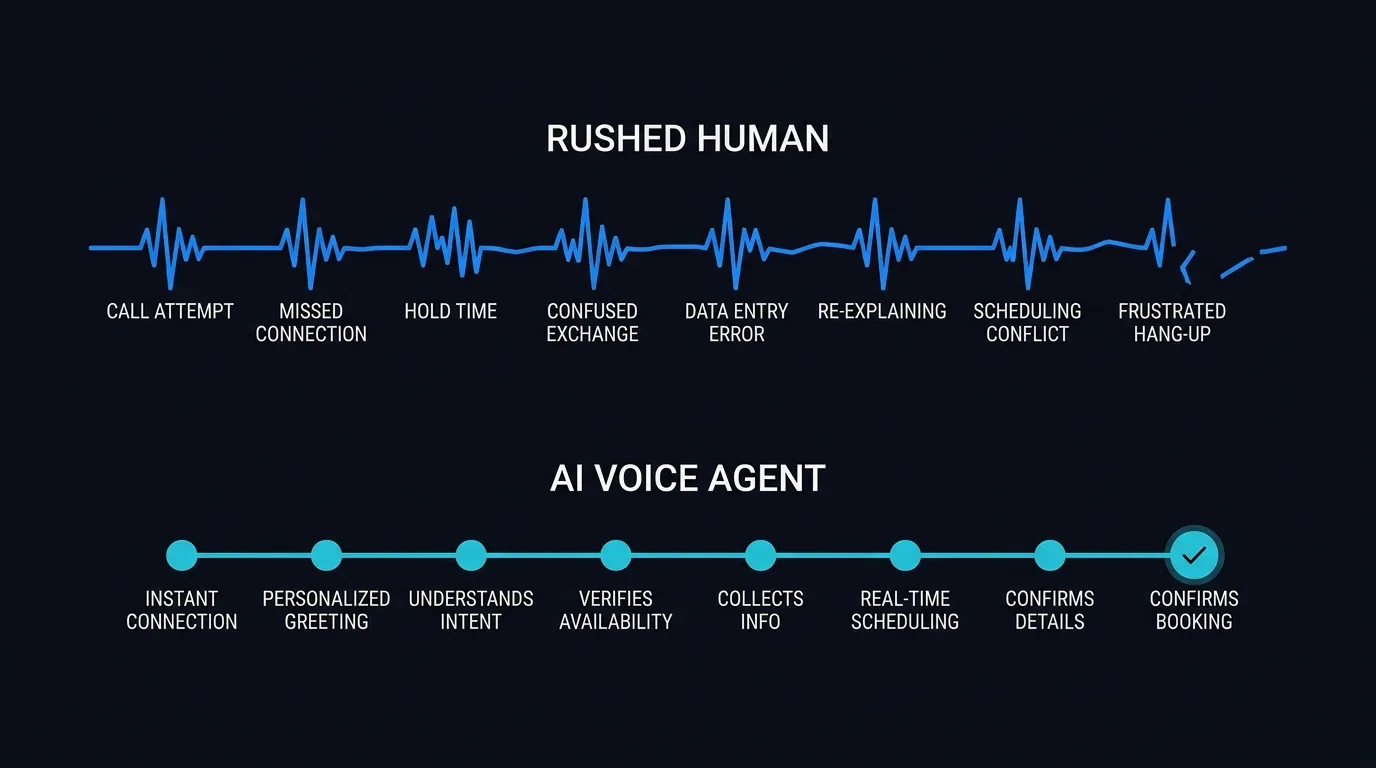
Same forty seconds, two feelings: a rushed human versus an agent that still confirms the booking slowly.
What average handle time can you realistically expect?
Expect simple enquiries to settle around thirty to sixty seconds, and standard booking calls around one to two minutes. Complex or emotional calls still run longer, and they should. The win is the volume of short calls handled cleanly, not a single magic number.
Be careful with promises. Anyone selling you a flat three-minute average is guessing. Real handle time depends on your call mix, your industry and how clean your data is.
Here is what we have measured in the field. A Sydney team running outbound produced 141 vendor leads in 90 days at 32.74 dollars per seller. A Christchurch property developer booked viewings at 7.12 dollars each. Those numbers come from short, focused calls, not marathons.
For inbound, the pattern is the same. The bulk of your calls are simple. When the simple ones drop to forty seconds, your overall average falls fast, even though the hard calls stay long.
How does it handle the long, complex calls?
It handles complex calls by staying on them, not by dumping them. The agent gathers every detail, asks the follow-up questions and only escalates when a human truly adds value. A long call handled fully beats a short call that fails.
Some calls deserve their length. A distressed customer, a complicated quote, a multi-part booking. Rushing those is how you lose the job. The agent knows the difference.
When a call needs a person, the agent hands over with the full context already captured. Your human does not start from scratch. That handover itself shaves minutes, because the caller never repeats themselves.
We wrote more about this balance in our piece on why voice AI agents still need humans. The goal is not zero humans. The goal is humans on the calls that earn their wage.
How do you measure average handle time properly?
Measure it across every call, split by type, and always include wrap-up time. A single blended number hides the truth. Track simple, standard and complex calls separately so you can see where the real minutes sit.
Watch these alongside handle time:
The agent logs all of this for you, by the second, on every call. No stopwatch, no guesswork. You see handle time per call type in your portal the next morning.
If you want the full scorecard, read our guide to the AI receptionist KPIs to track and our deeper rundown of call centre metrics for NZ and AU teams. Handle time is one dial. It only means something next to the others.
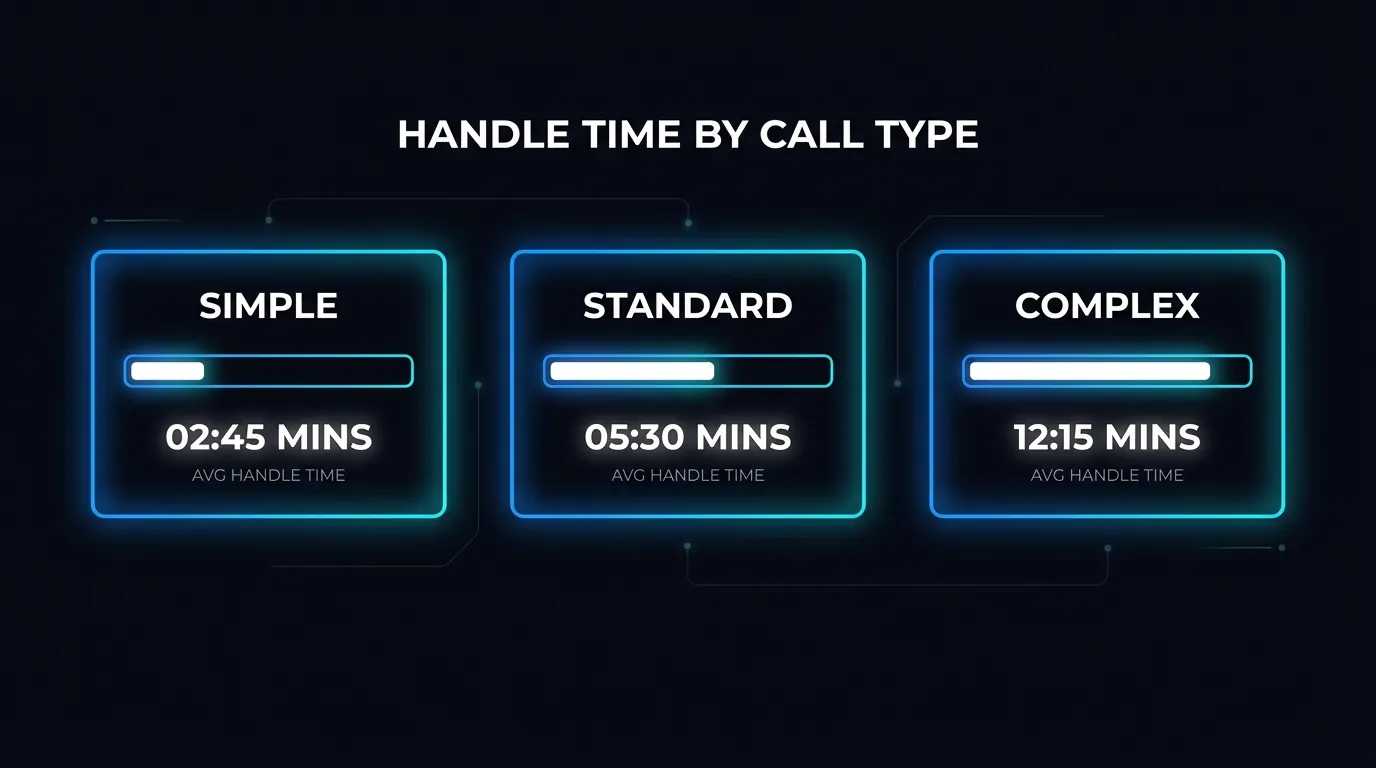
Split handle time by call type in your portal, with wrap-up counted and every call logged by the second.
Where does a human still beat the agent?
A human still wins on nuance, escalation and genuine emotion. A grieving caller, a furious complaint, a deal that needs a judgement call. The agent is fast and tireless, but it is not your senior operator. Use your people where empathy and authority matter.
That is the honest split. The agent takes the ninety percent of calls that are routine. Your team takes the ten percent that need a heartbeat. Everyone does better work.
Your data follows the same honest split. Your transcripts and structured records sit on our Sydney servers. The live audio is processed offshore under documented arrangements with our voice infrastructure partner. We never pretend every byte stays in Australia.
That matters for your compliance. In NZ you have the Privacy Act 2020 and the Office of the Privacy Commissioner. In AU you have the Privacy Act 1988, the 13 Australian Privacy Principles and the OAIC, with breaches reported through the Notifiable Data Breaches scheme. We disclose AI on every call and we can delete a caller's data in 10 minutes.
Where to start
Reduce average handle time by starting with your inbound line, where the simple calls live. Point the agent at your busiest hour and watch the short calls drop to forty seconds.
Ready to cut your handle time?
Start with the inbound AI voice agent build, and if hang-ups are your real pain, read our guide to reducing call abandonment first.
If you are weighing cost, our breakdown of what an AI receptionist costs lays out the per-minute maths. Handle time and cost move together. Cut one and you cut the other.
Frequently Asked Questions
What is a good average handle time for an AI voice agent?
There is no single good number. Simple enquiries should settle around thirty to sixty seconds and standard bookings around one to two minutes. Complex calls run longer by design. Judge the agent on the mix, not one figure, and always include wrap-up time in your maths.
Will faster calls make callers feel rushed?
No, not when the agent is paced properly. It answers in forty seconds because it already has your diary and pricing loaded. It still pauses, confirms and reads bookings back slowly. Your callers tell us the agent felt calm, not hurried.
How much does each call actually cost?
We bill about eighty cents a minute, charged by the second. An answered call around thirty seconds costs roughly forty cents. A one to two minute booking call costs about one to two dollars. Shorter handle time means a lower bill on every call you take.
Does the agent handle long, complicated calls?
Yes. It stays on complex calls, gathers every detail and only escalates when a human truly adds value. When it hands over, your person gets the full context, so the caller never repeats themselves. A long call done right beats a short call that fails.
Is my caller data safe and compliant?
Your transcripts and structured records sit on our Sydney servers, while live audio is processed offshore under documented arrangements with our voice infrastructure partner. We meet the NZ Privacy Act 2020 and the AU Privacy Act 1988 with its 13 Australian Privacy Principles. We disclose AI on every call and can delete data in 10 minutes.
How quickly will I see handle time drop?
Most teams see the simple calls fall to around forty seconds in the first week, because that is where the dead search time lived. Your blended average follows over the next month as the bulk of routine calls speed up while the hard calls stay long.
Leonardo Garcia-Curtis
Founder & CEO at Waboom AI. Building voice AI agents that convert.
Ready to Build Your AI Voice Agent?
Let's discuss how Waboom AI can help automate your customer conversations.
Book a Free Demo

