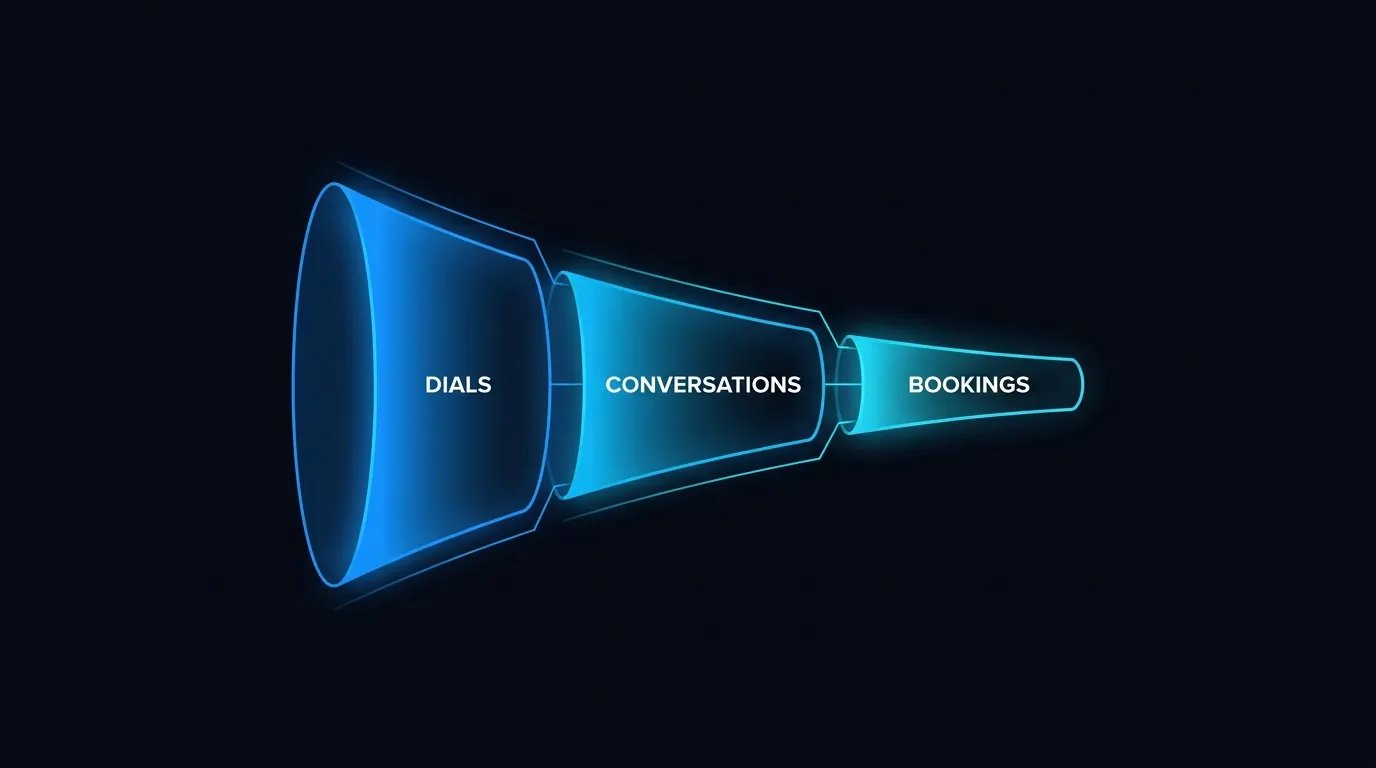
Implementing AI in outbound sales calls is one of the highest-impact AI projects an NZ or Australian business can run in 2026. The economics work: AI dials at $0.80 per minute, runs 24/7 inside legal calling windows, and qualifies leads at roughly 1.4x the human-baseline success rate per call. Done right, an outbound AI deployment recovers its cost within the first month.
This article is the implementation playbook. The product side (what the agent does end to end: dial, qualify, book, email, PDF, transfer, CRM write-back, compliance overlay) lives at our AI Sales Agent pillar page.
Done wrong, you burn carrier reputation, breach compliance, and damage your brand. This playbook covers the six steps to do it right, drawn from 30+ NZ outbound deployments live on the Waboom platform.
Step 1: Choose your stack
You need three layers: telephony, AI agent platform, and CRM integration.
Telephony: For NZ, Spark Voice, One NZ, or 2degrees Business. For AU, Telstra, Optus, or TPG. SIP trunks with caller ID and clean carrier reputation. Avoid VoIP wholesale providers with mixed reputation, since calls flagged as "Spam Likely" tank your connect rate (we covered why dialler numbers burn).
AI agent platform: This is the layer that listens, qualifies, books, and writes back to your CRM in real time. The real choice in NZ and Australia is a regional managed platform like Waboom AI (built around the AU and NZ telco regulatory bundle on every number, calling-hour enforcement under both regimes, recording disclosure on the opening line, IPP 3A handling as standard, Sydney-region voice routing, native Aussie and Kiwi voices like Charlie, Hannah, Matilda, and Steve so the caller hears a local) or a US-based platform that gives you a strong AI but leaves you to solve carrier registration, identity-bundle approval, AU and NZ compliance overlay, per-state DNC scrubbing, area-code and time-zone routing, and a believable local accent on top. The US platforms are excellent for US deployments. They are not equipped for the AU and NZ regulatory reality, the local voice library is American or generic, and getting them there takes months of integration work, a telco-grade compliance specialist, and a carrier relationship most operators do not have.
Build-it-yourself, stitching the voice runtime, telephony, compliance overlay, and CRM together from scratch, is not a real option for the operator audience this article is written for. It is a small-team engineering project. The right comparison is regional managed platform versus US managed platform, not buy versus build.
CRM integration: HubSpot, Pipedrive, Salesforce, Zoho. The agent needs to read the lead list (name, phone, last touchpoint, custom fields) and write back the call result (talked-to-DM, qualified, booked, declined, DNC-request, voicemail). Native two-way sync is non-negotiable. Email digests are a step backward.
For NZ and Australian SMEs in 2026, the right answer is a managed platform built for this region. The US platforms have impressive technology. The per-customer telco bundle, calling-hour enforcement under the AU and NZ regimes, and IPP 3A handling still have to be solved by someone. Either it sits inside your provider or it sits on you.
Step 2: List hygiene + DNC scrubbing
The list is 60% of the result. Junk list = junk calls = wasted minutes and brand damage.
Required cleanups before you dial a single number:
1. DNC scrub. Australia: register at the Do Not Call Register, scrub before each campaign (within 30 days), keep proof. NZ: no central DNC register but consumer requests must be honoured for 5 years. Internal opt-out list maintained in your CRM.
2. De-duplicate against your existing customers. Calling someone you already serve as a "cold lead" is a brand-tax event.
3. Confirm phone number format. +64 21 XXXXXX for NZ mobile, +64 9 XXXXXXX for landline. AU is +61. Strip any zero-prefix issues.
4. Append context. Industry, role, last touchpoint, recent web activity if your CRM tracks it. The script can use this to personalise the opener ("Hi, calling about the property listing you saw last week...").
5. Time-zone match. AU has 5 zones, NZ has 1. The agent should never call NSW at 7am from a Perth-based queue.
We covered the full Australian Spam Act + DNC compliance flow separately.
Step 3: Design the script
A good outbound AI script has four parts:
Opening (first 10 seconds): state who you are, what business you are calling from, and the AI disclosure. This is non-negotiable post-1-May-2026 for NZ (IPP 3A). Then state the reason for the call in one sentence.
Permission ask: "Is now a good time for a 90-second conversation about X?" If the answer is no, the agent should offer a callback time and respect it. Pushing past a "no" is the single biggest cause of complaints.
Discovery + qualification (60 to 90 seconds): 3-5 qualification questions tied to your buying criteria. Capture answers as structured CRM fields, not free-text notes. The agent should be trained on common objections ("not interested", "send me an email", "too busy") and the right response to each.
Close: book a meeting, send a follow-up SMS, transfer to a senior rep, or politely end. Every call should end with a clear next action recorded in the CRM.
A common mistake: scripts that are too long. The connect-to-success conversion peaks around 60-90 seconds. Beyond 2 minutes, the caller starts looking for a way out. Trim ruthlessly.
We benchmarked optimal call duration in our 50,000-call timing data.
Step 4: Compliance guardrails
Six things must be hard-coded into the agent before it dials.
1. Calling hours. AU: 9am-8pm weekdays, 9am-5pm weekends, no public holidays. NZ: no statutory window but ACMA's industry standard is the right voluntary baseline.
2. AI disclosure. The agent must disclose AI involvement at call start. Recording disclosure on top of that. Both in the first 5 seconds.
3. Opt-out handling. If the caller says "do not call me again", the agent must add the number to the DNC list immediately (no callback to confirm), end the call politely, and never re-dial.
4. Recording consent. NZ: implied consent post-disclosure. AU: same under federal Telecommunications (Interception and Access) Act with state-level twists in QLD and VIC.
5. Data residency. Call recordings, transcripts, and CRM data should stay in-region. NZ providers should host in Australia or NZ. Data exported to the US triggers additional disclosure obligations under both the Privacy Act 2020 and APP.
6. IPP 3A (NZ from 1 May 2026). If the agent is making a decision that significantly affects the caller (loan approval, employment screening, tenancy decision), the agent must offer human review. We covered the IPP-by-IPP detail here.
Step 5: Pilot with 500 calls
Do not turn the dialler on for 50,000 numbers and walk away. Pilot with 500 calls first.
A 500-call pilot answers four questions:
1. Does the script work? Listen to 30-50 random call recordings. Identify points where the agent fumbles, callers hang up, or qualification questions land flat. Iterate.
2. Is the list quality good? Connect rate below 25% suggests dirty data, bad numbers, or wrong audience. Connect rate above 40% in optimal hours is a strong list.
3. Are the integrations writing back cleanly? Check 50 records in your CRM. Confirm every field landed. Confirm DNC requests were honoured.
4. Are you getting any complaints? Even one complaint in 500 calls is a signal worth investigating. Tighten the script or list before scaling.
A pilot costs around $250-$400 (500 minutes at $0.80) plus a few hours of script-iteration time. Anyone selling you a "deploy in production from day one" approach is selling you a refund.
Step 6: Scale + measurement
Once the pilot is clean, scale by adding numbers (more SIP DIDs to spread load and avoid single-number reputation hits) and adding queue depth (more concurrent calls, but inside calling windows).
Six metrics to watch weekly:
| Metric | Target | Trigger to investigate |
|---|---|---|
| Connect rate | 28-38% | Below 25% = list or carrier issue |
| Conversation success | 22-31% | Below 18% = script issue |
| Avg call duration | 60-90s | Over 120s = trim script |
| Spam-likely flag rate | Below 3% | Above 5% = burn rotation in carrier reputation |
| Complaint rate | Under 0.2% | Anything above 0.5% = stop and audit |
| Cost per success | $1.60-$2.40 | Above $4 = list or script issue |
The State of NZ AI Voice 2026 report has full benchmarks across 30 NZ deployments.
Cost and realistic timeline
| Phase | Time | Cost |
|---|---|---|
| Stack selection + setup | Day 1-2 | $0-$500 setup on a regional managed platform |
| List hygiene + DNC scrub | Day 2-3 | $200-$500 (optional list service) |
| Script design + agent training | Day 3-5 | $1,000-$3,000 (one-off) |
| Compliance review | Day 5-6 | $0-$1,500 (depends on industry) |
| 500-call pilot | Day 6-7 | $400 (calls) |
| Iterate + scale | Week 2 | $0.80 per minute production |
Total to first production call: 7 days. Total all-in pilot cost: $2,000 to $7,000 depending on stack and complexity. Production marginal cost: $0.80 per minute.
For a typical 5,000-calls-per-month outbound campaign, run-rate is around $4,000 per month all-in. Vs a human BDR team running the same volume, costs are roughly 80% lower with comparable success rates.
Frequently asked questions
Is AI outbound calling legal in NZ and Australia?
Yes, with proper compliance. AU has formal rules (DNC, ACMA, Spam Act). NZ relies on Privacy Act + Fair Trading Act + sector codes. AI disclosure is required from 1 May 2026 in NZ.
Will callers hang up when they realise it is AI?
Some do. Most do not, especially if the disclosure is matter-of-fact and the script gets to the value quickly. Hang-up rates are similar to human BDR teams (40-60% drop-off in the first 30 seconds).
What is the cheapest way to start?
A managed platform with a 30-day trial. $500 + platform fee gets you 500 minutes and full features. Use the trial for the pilot.
How long until I see ROI?
A typical NZ outbound deployment recovers the implementation cost within 30-60 days, assuming the underlying list and offer are sound.
Ready to run an outbound pilot?
A 500-call pilot lands in 7 days with a per-minute cost of $0.80. We handle the carrier setup, compliance overlay, and CRM integration. Or work the numbers first.
ROI calculator · Pricing · Book a strategy call · 2026 NZ benchmarks
Leonardo Garcia-Curtis
Founder & CEO at Waboom AI. Building voice AI agents that convert.
Ready to Build Your AI Voice Agent?
Let's discuss how Waboom AI can help automate your customer conversations.
Book a Free Demo