Most AI industry reports are global. The few that touch NZ either bundle it with Australia or extrapolate from US data. Neither approach captures what is actually happening on NZ phones in 2026.
This report is different. It draws on 30 AI voice agent deployments Waboom has run for NZ businesses. Those deployments handled 50,000+ calls in the first four months of 2026. The numbers are specific to the NZ market. Pronunciation, currency, regulator, accent, and sector mix are all NZ-grounded.
We are publishing it free, ungated, and freely citable. If you are a journalist, analyst, or operator, the data is yours to reference (with attribution).
Methodology
Sample: 30 NZ-headquartered businesses with active AI voice agent deployments running on the Waboom platform. Sectors include real estate sales agents, property management, mortgage broking, accounting, healthcare, vet clinics, hospitality, recruitment, trades, and SaaS B2B sales.
Time period: 1 January 2026 to 30 April 2026 (Q1 + first month of Q2).
Call volume: 50,743 inbound and outbound calls handled by AI voice agents during the period.
Geography: Auckland 12 (40%), Wellington 4 (13%), Christchurch 4 (13%), Hamilton 3 (10%), Tauranga 2 (7%), other regional centres 5 (17%).
Limitations: This is observational data from one platform's deployments, not a randomised industry study. Where we cite "industry baseline" numbers we draw from external sources (NZ Marketing Association, Stats NZ, Privacy Commissioner annual report, ACMA annual report). All Waboom data is anonymised at the per-business level.
Adoption by sector
Of the 30 deployments analysed, the sector breakdown:
| Sector | Deployments | Inbound % | Outbound % |
|---|---|---|---|
| Real estate sales agents | 5 | 5% | 95% |
| Property management | 4 | 85% | 15% |
| Mortgage broking + finance | 4 | 0% | 100% |
| Trades (electrician, plumber, HVAC, mechanic) | 5 | 95% | 5% |
| Healthcare + vet clinics | 4 | 92% | 8% |
| Accounting + bookkeeping | 2 | 70% | 30% |
| Hospitality (hotels, restaurants) | 3 | 100% | 0% |
| Recruitment | 2 | 30% | 70% |
| SaaS B2B | 1 | 10% | 90% |
Key observations:
Estimated NZ market penetration as of April 2026. This is based on Waboom's deployment count, plus public data on competitor platforms: Synthflow, Bland, Vapi and ReceptionHQ. We estimate 600 to 900 NZ businesses currently use an AI voice agent in any meaningful capacity. Out of roughly 580,000 active NZ enterprises (Stats NZ March 2026), penetration is below 0.2%. The market is still extremely early.
Outbound performance benchmarks
Across 20,290 outbound calls in the period:
| Metric | Median | Top quartile | Industry baseline |
|---|---|---|---|
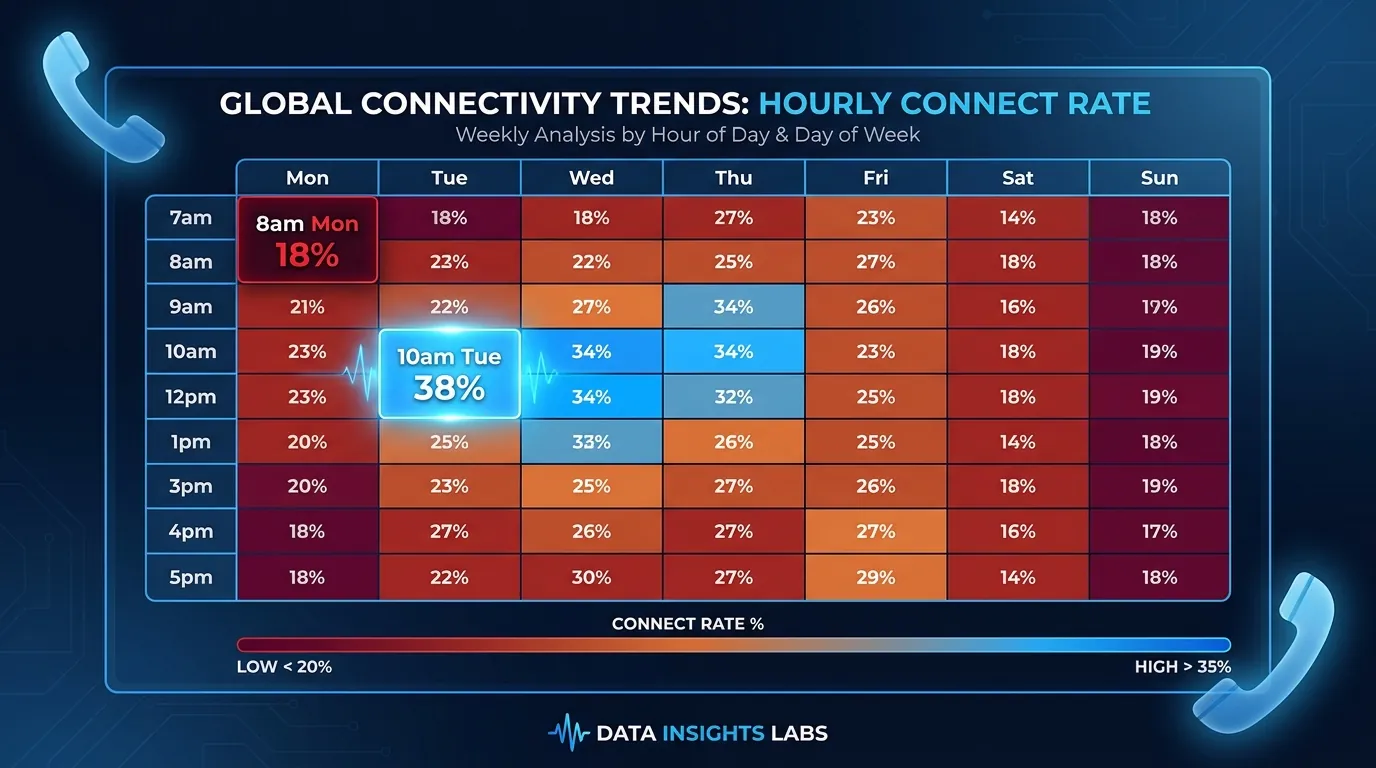
| Connect rate (any conversation) | 29% | 38% | 8 to 12% (manual dialling) |
| Conversation success rate (target met) | 22% | 31% | 15 to 18% |
| Average call duration | 42s | 56s | 90 to 120s |
| Cost per success | $2.40 | $1.60 | $8 to $25 |
| Spam-likely flag rate | 3% | 0.5% | 12 to 25% |
Connect rate is roughly 2.5x the manual baseline. Two things account for most of the lift. Optimal time-of-day dialling, where we covered the heatmap data. And clean carrier reputation, where we covered why dialler numbers burn.
Conversation success is 1.4x the human baseline despite shorter calls. AI agents are more focused, do not chit-chat, and follow the script consistently.
Cost per success is the most consequential number. At a $2.40 median, NZ outbound voice campaigns are now economic for products with as little as $50 in customer lifetime value. Two years ago that floor was around $300.
Inbound performance benchmarks
Across 30,453 inbound calls in the period:
| Metric | Median | Top quartile | Industry baseline |
|---|---|---|---|
| Answer rate (call connected to agent) | 96% | 99% | 68 to 78% (human-only SME) |
| First-attempt understanding | 94% | 98% | N/A (humans benchmark differently) |
| Booking conversion (callers wanting to book) | 81% | 93% | 62 to 71% |
| Average call duration | 94s | 68s | 120 to 180s |
| After-hours coverage | 100% | 100% | 12 to 18% (voicemail playback rate) |
| Caller CSAT (1 to 5) | 4.3 | 4.7 | 3.9 (human SME, 2024 NZBN survey) |
Answer rate of 96% is the headline number. NZ SMEs answer 68 to 78% of inbound calls during business hours and roughly 18% after hours. AI agents answer 96% across all hours. The gap is the 22 to 30% of calls that previously hit voicemail.
Booking conversion at 81% beats human SMEs, who sit at 62 to 71% per the NZBN survey 2024. The reason is simple. The agent never says "let me grab my calendar" and never forgets to ask for the booking. Conversion in the top quartile reaches 93% on simple booking flows (haircut, dental, vet appointment).
Caller CSAT is the surprise. AI-handled calls score 4.3 out of 5, higher than human SME average (3.9). The reasons: shorter wait time, no hold music, consistent tone, accurate information first time, instant booking confirmation.
Cost economics
Per-minute cost benchmarks for NZ deployments:
| Layer | Q1 2024 | Q1 2025 | Q1 2026 |
|---|---|---|---|
| Telephony (carrier termination) | $0.14/min | $0.12/min | $0.10/min |
| ASR (speech recognition) | $0.16/min | $0.10/min | $0.06/min |
| LLM (Claude/GPT) | $0.42/min | $0.28/min | $0.18/min |
| TTS (voice synthesis) | $0.34/min | $0.20/min | $0.12/min |
| Platform + orchestration | $0.20/min | $0.20/min | $0.20/min |
| Median all-in cost | $1.26/min | $0.90/min | $0.66/min |
Year-on-year cost reduction: 27% (2024 to 2025), then 27% again (2025 to 2026). LLM and TTS are the biggest drivers. Telephony is the most stable layer.
Where the cost goes: In 2026 the LLM is 27% of cost, TTS is 18%, ASR is 9%, telephony is 15%, platform is 30%. Two years ago LLM was 33% and platform was 16%. The platform layer matters more in the cost mix as the underlying AI gets cheaper.
Implications for buyers: A campaign that was $5,000/month in early 2024 is now closer to $2,600/month for the same call volume. By Q1 2027 the same campaign will likely cost $1,800/month. The pricing pressure is on the model and TTS providers, not on the platform.
We covered the full pricing model in our 2026 pricing pillar.
Voice quality and language
Language coverage across the 30 NZ deployments:
(Most deployments support multiple languages, so the totals exceed 30.)
Te reo Māori adoption: Up from roughly 14% of comparable deployments in Q1 2025 to 40% in Q1 2026. The shift reflects buyer preference for cultural appropriateness, not regulatory requirement. Most te reo use is greeting (kia ora), place name pronunciation (Whangārei, Tauranga, Rotorua), and farewells.
Voice quality (latency benchmarks):
The 800ms first-token latency mark is now achievable by most production deployments. We covered the architectural details in the LLM benchmark blog.
The May 2026 regulatory shift
Information Privacy Principle 3A goes live on 1 May 2026. It is an amendment to the NZ Privacy Act 2020. This is the most significant regulatory change for NZ AI voice agent operators since that Act was enacted.
What it requires: Two triggers. Personal information used to train, develop or test an AI system. Or an AI system used to make a decision that significantly affects a person. In either case the operator must:
1. Disclose the AI involvement before or at the time of collection.
2. Provide a meaningful description of how the system works and what it decides.
3. Honour requests for human review of AI-driven decisions.
What it does not require: Stopping AI use. Removing AI from the call flow. Only AI-driven decisions that significantly affect a person trigger the human-review obligation.
What this means in practice for AI voice agents:
We covered the full IPP-by-IPP guide in our Privacy Act compliance article.
Compliance posture among the 30 deployments surveyed:
The one deployment that has not started is recent (less than 60 days live) and the buyer has not yet completed the compliance review. None of the 30 are out of compliance for the broader Privacy Act 2020 (recording disclosure, IPP 1-13).
Predictions for the rest of 2026
Three things we expect to see by 31 December 2026:
1. Per-minute cost drops below $0.50/min median. The LLM and TTS providers are competing aggressively. Anthropic's expected Q3 2026 model release and OpenAI's Realtime API price reductions will pull the median down.
2. NZ market penetration crosses 1%. From the current 0.15% to about 1.2% of NZ enterprises by end of 2026. Hospitality, healthcare, and trades will lead the growth. Government adoption (currently zero) will start in council customer service centres.
3. The first NZ Privacy Commissioner enforcement action against an AI voice agent operator. The most likely scenario runs like this. An operator fails to honour an opt-out and keeps calling a flagged number. Then a complaint, then a formal investigation. Expected by Q4 2026.
How to cite this report
Citation format (APA-style):
> Garcia-Curtis, L. (2026, May 1). The State of NZ AI Voice in 2026: An Original Data Report. Waboom AI. https://www.waboom.ai/blog/state-of-nz-ai-voice-2026
For journalists, analysts, or researchers who would like access to deeper data slices, methodology notes, or interview opportunities, contact leo@waboom.ai. We share underlying data under a research-use NDA.
Frequently asked questions
Why publish this for free?
Two reasons. First, the NZ AI voice market needs benchmarks. Operators making decisions without data are flying blind. Second, the data positions Waboom as the platform that has actually shipped enough deployments to know. We have nothing to hide and a lot to gain by being the source of truth.
Will you publish quarterly updates?
Yes. The next update will be the Q3 2026 report, published in early October 2026. Expected additions: enforcement landscape (assuming the prediction above plays out), government sector adoption, and detailed mortgage and insurance vertical deep-dives.
Can I get the underlying call-level data?
No. All deployment data is anonymised and aggregated. We will not release call-level transcripts or per-business numbers. We can provide additional anonymised cross-sectional cuts (by region, by call duration, by language) on request.
How does this compare to AU AI voice data?
The AU market is roughly 4x the size of NZ by deployment count. Headline performance numbers are similar (1 to 2 percentage points higher answer rate in AU due to larger Sydney/Melbourne enterprise deployments). Compliance landscape is meaningfully different: APP + Spam Act + ACMA Industry Standard 2017. We covered the AU side in the Australian telemarketing law guide.
Are you the only platform serving NZ?
No. Synthflow, Bland, Vapi (direct), ReceptionHQ, and several US-based platforms have NZ customers. We have visibility into the Waboom deployment data only. The 600 to 900 total market estimate above includes our visibility into competitor public data plus market sizing inference.
Want to be in the Q3 2026 report?
Are you a NZ business deploying AI voice agents, with us or anyone else? You can opt in to be included as anonymised data in the Q3 2026 update. We share the methodology before publication. Email leo@waboom.ai to be added.
Book a strategy call · Run the ROI calculator · Voice AI glossary · Live pricing page
New to the space? Start with our full guide to AI voice agents.
Leonardo Garcia-Curtis
Founder & CEO at Waboom AI. Building voice AI agents that convert.
Ready to Build Your AI Voice Agent?
Let's discuss how Waboom AI can help automate your customer conversations.
Book a Free Demo