You have probably seen a list called the best AI answering service, ranked one to ten, with an American software brand sitting at the top. Most of those tools have never answered a +64 or +61 number. They have never read the Privacy Act 2020 or the Australian Privacy Principles. And they quote a per-minute rate that hides what you actually pay at the end of the month.
We build and run AI answering services for Kiwi and Aussie businesses every day, so this guide skips the vendor leaderboard. It answers the question you actually have. Which one picks up every call, sounds local, books the job, and does not cost more than the front desk it replaces.
What is an AI answering service versus an old answering bureau?
An AI answering service is a voice agent that answers your phone. It holds a real back and forth conversation, books the job or takes the message, and texts you the details. All without a person on the line. The difference from an old answering bureau is completion. A bureau takes a message and emails it on. A good AI answering service finishes the task inside the same call.
There are three models on the market now. A fully human bureau, where staff answer scripted calls. A pure AI receptionist, where a voice agent handles the whole conversation. And a hybrid, where the AI takes the routine calls and a human picks up the hard ones.
It is not a press 1 for sales phone menu either. An AI receptionist talks, listens, and acts. If you want the plain definition first, read AI receptionist versus virtual receptionist before you compare prices.
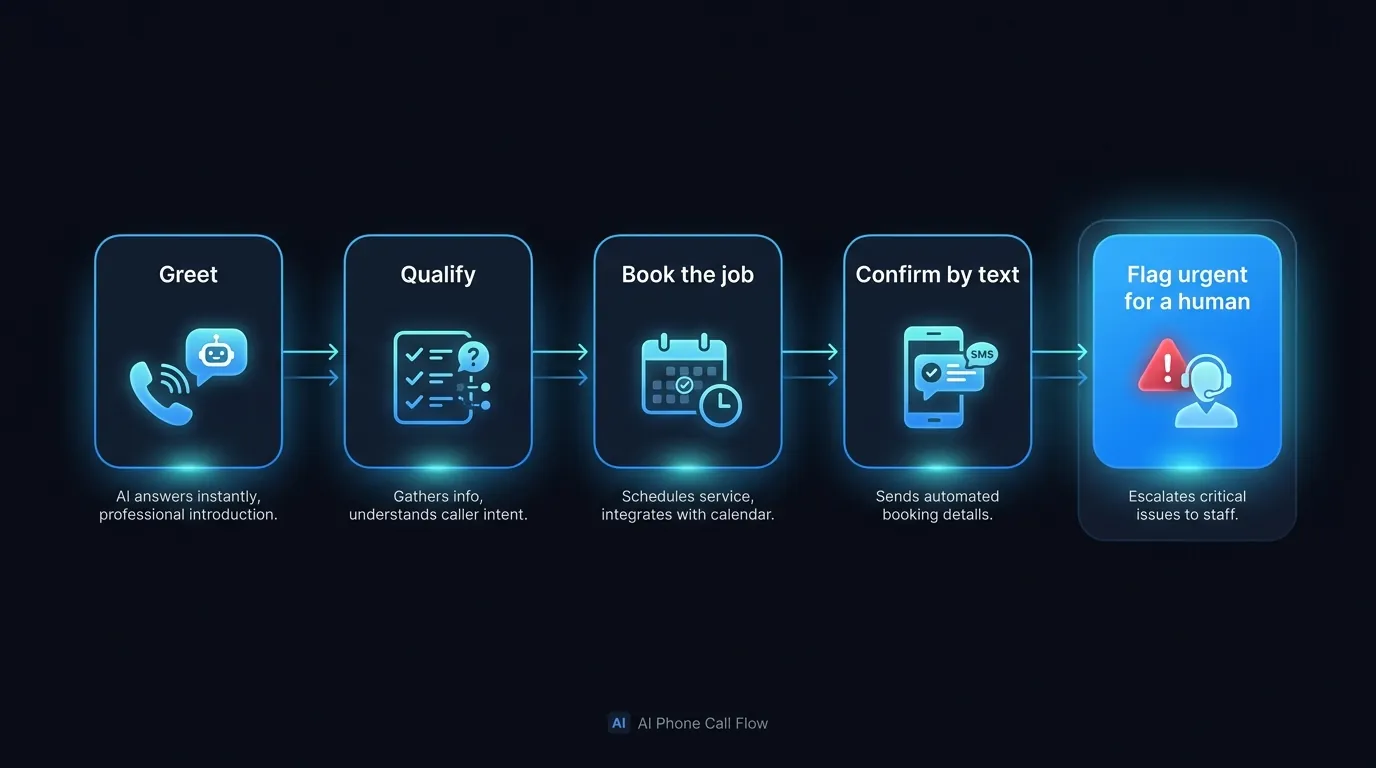
An AI answering service finishes the job inside the call: greet, qualify, book, confirm by text, and flag the urgent ones for a human.
What does an AI answering service actually cost in NZ and Australia?
In plain numbers, our AI answering service runs at about 80 cents per minute in NZD or AUD, billed by the second. The average answered call is short, around 30 seconds, so a typical call costs roughly 40 cents. A longer booking that runs a minute or two costs about one to two dollars.
Watch the headline rate. A US tool quoting 7 cents a minute is quoting the raw telephony. Not the voice, the transcription, or the language model that actually hold the conversation. Once those are added, the real all in number lands near 80 cents. Per second billing means you only pay for the seconds a caller is actually talking.
Here is the monthly maths an operator can check. At 100 calls a month you are looking at well under a hundred dollars. At 300 calls you are still under a part time wage. Compare that to a receptionist on roughly 28 to 35 dollars an hour, before you add KiwiSaver or super, ACC, and holiday pay. The gap is obvious once the after hours and lunchtime calls are counted.
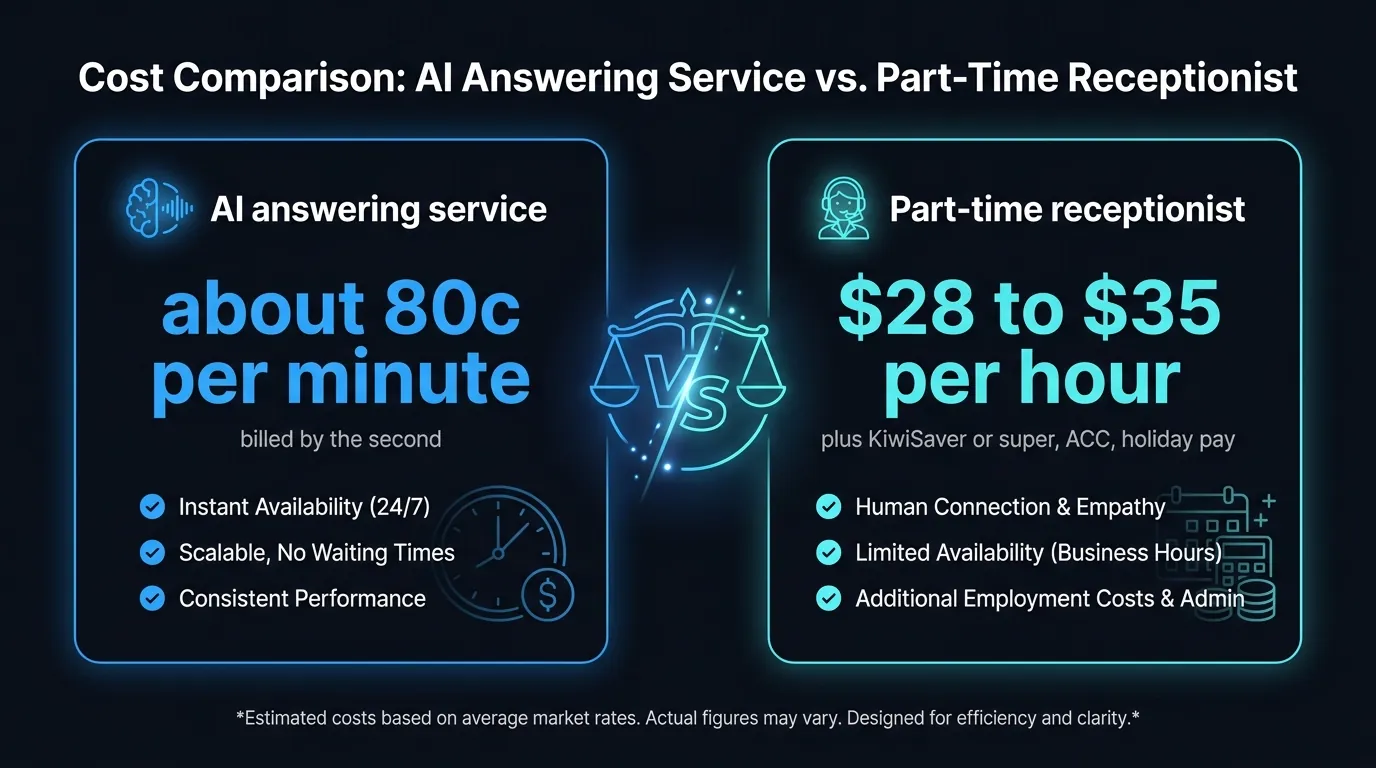
Per second billing at about 80c a minute versus a loaded part time receptionist wage in NZD and AUD.
For the full breakdown by plan, see our NZD and AUD pricing, and for the human comparison read how much an AI receptionist costs.
At what call volume does an AI answering service beat a human?
Sooner than you think, because it is not really about volume. A single receptionist covers business hours and one call at a time. An AI answers every call at once, day or night. The calls that pay for it are the ones a human was never going to reach: after five, at lunch, and when three lines ring together.
Every missed call is a job that rings your competitor next. A tradie on the tools. A clinic with a full waiting room. A law firm after hours. Each loses the work to voicemail without ever seeing it on a report. Read how an after hours receptionist recovers those calls for the missed call maths.
Is an AI answering service legal under NZ and Australian privacy law?
Yes, when it is set up correctly. In New Zealand the Privacy Act 2020 and the Office of the Privacy Commissioner govern how caller information is collected, stored, and disclosed. In Australia the Privacy Act 1988 and the 13 Australian Privacy Principles, overseen by the OAIC, do the same job.
The questions that actually matter are disclosure, storage, and access. The agent should tell callers they are speaking with an AI. Your data should sit somewhere you can name. And only the right people should reach it. None of this is HIPAA. That is a US health law that does not apply to a Kiwi or Aussie business, no matter what an American consultant tells your clinic.
For the detail, read our guides on the NZ Privacy Act 2020 for voice agents and voice AI privacy across NZ and Australia. The primary sources are the Office of the Privacy Commissioner and the OAIC.
Where does my call data actually live?
This is the question most vendors dodge. The honest answer for an Australian or New Zealand business is a split. Your portal, your transcripts, and your structured call records sit on our Sydney servers. The live audio stream is processed offshore.
That means your call records stay on our Sydney servers, you always know exactly where your data lives, and nothing here is a claim that does not hold up. Anyone who promises all of your data stays in Australia is either confused or selling. For how we handle the lot, see how Waboom handles your call data.
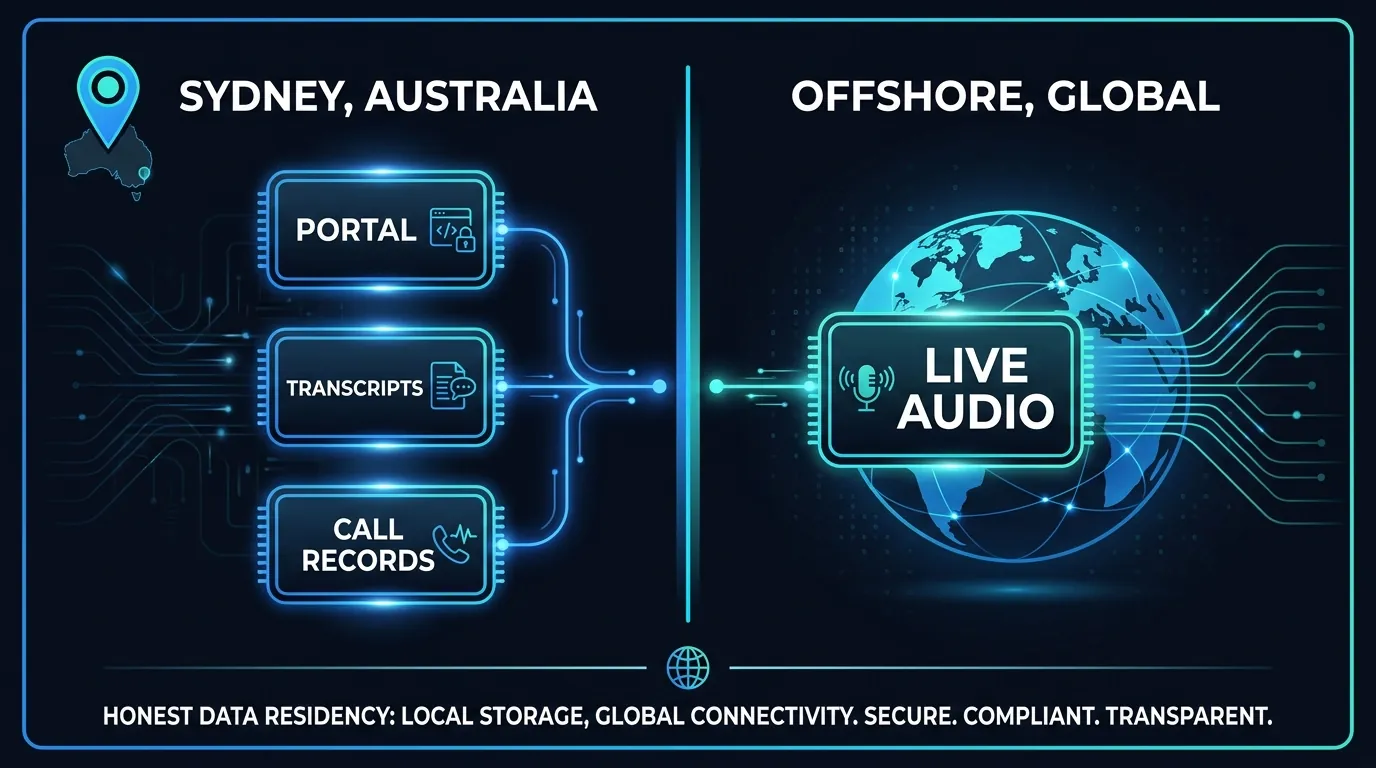
The honest residency split: portal, transcripts, and call records in Sydney; live audio processed offshore.
Can it book appointments and write the call into my CRM?
Yes. A good AI answering service books straight into your calendar, whether that is Google Calendar, Outlook, or a booking system. It writes the outcome of the call into your CRM. The booking is confirmed by text before the caller hangs up.
It connects to the tools NZ and AU operators actually run, from HubSpot and Pipedrive to ServiceM8, Tradify, and clinic systems like Cliniko. See how appointment booking works on a call and how the call writes back to your CRM.
How fast can an AI answering service go live for a small business?
A focused single inbound flow can be live the same day. A build that integrates one CRM or practice system takes days, not weeks. The only moving parts are the number and the script.
You can keep your existing number and forward it, port the number across, or bring your own VoIP line. None of it requires ripping out your phone system. Read how forwarding to an AI receptionist works for the setup options.
Want to hear one answer a real call?
You can listen to a live AI receptionist before you decide. See how our NZ inbound receptionist runs after hours, or the Australian inbound receptionist if you are across the Tasman.
What happens when the AI cannot handle a call?
It hands the call to a human or takes a detailed message and flags it, depending on the rules you set. A good answering service is built to know its own limits, not to bluff its way through a call it cannot finish.
You decide the escalation thresholds: a warm transfer to a mobile for an urgent job, a message to the right inbox for everything else. Read why voice agents still need humans and how a warm transfer keeps the full context.
Where does an AI answering service fall short, and which calls should stay human?
Be honest about this before you buy, because a vendor who claims the AI handles everything is the one to avoid. An AI answering service is the wrong tool for an emotionally charged call. Grief, a serious complaint, a distressed client, an ambiguous legal or medical matter; those belong with a person.
The right design routes the routine, repetitive calls to the agent and sends the hard ones to a human fast. That mix is what keeps callers happy and your reputation intact.
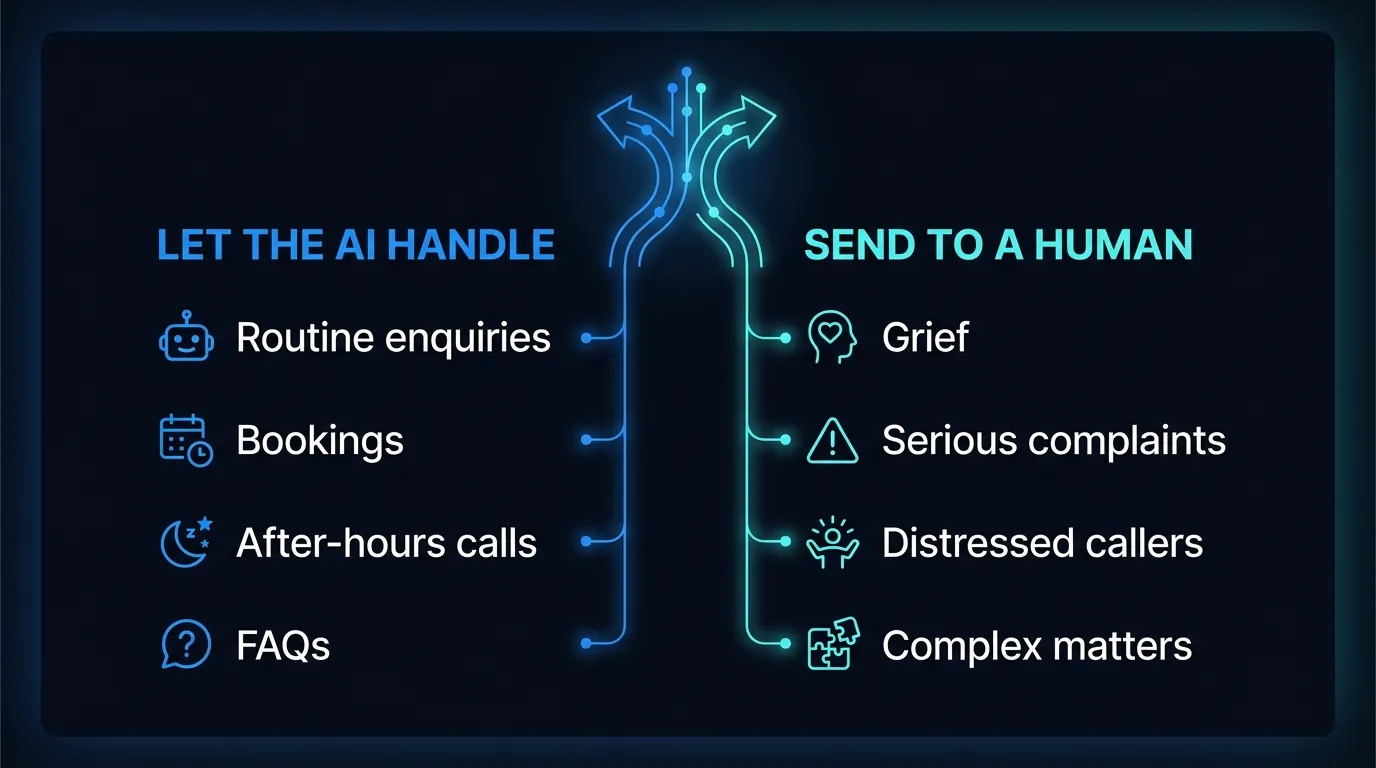
Route the routine and repetitive calls to the agent; send grief, complaints, and ambiguous matters straight to a person.
How do I choose? A checklist for NZ and AU buyers
Skip the brand ranking and score any service against what actually matters for a local operator:
If you want to see how a service answers an offshore bureau on price and trust, read a Philippines call centre versus an AI voice agent and the honest take in the Manila truth about virtual receptionists in Australia.
Stop losing calls to voicemail.
We build AI answering services for NZ and Australian businesses that pick up every call, sound local, and book the job. See how our NZ AI receptionist and Australian AI receptionist run after hours, or check the pricing first.
Frequently Asked Questions
Is an AI answering service the same as a virtual receptionist?
They overlap. A virtual receptionist is the role, answering and routing your calls. An AI answering service is one way to fill that role with a voice agent rather than an offshore team. The AI version answers instantly, runs 24 hours a day, and handles several calls at once.
How much does an AI answering service cost in New Zealand?
Around 80 cents per minute in NZD, billed by the second, so a typical 30 second call costs roughly 40 cents. Most small businesses spend well under a part time wage once after hours and overflow calls are included. There is no per call surcharge that doubles the headline rate.
Does an AI answering service work after hours and on weekends?
Yes, and that is usually where it pays for itself. The agent answers at 2am on a Sunday exactly as it does at 10am on a Tuesday. The lead that would have hit voicemail gets booked instead. After hours and lunchtime are the calls a single receptionist was never going to reach.
Will callers know they are talking to an AI?
They should. We disclose that the caller is speaking with an AI on every call. That is both the honest approach and the right one under NZ and Australian privacy expectations. Done well, callers care far more that the call gets answered and the job gets booked.
Can an AI answering service transfer urgent calls to my mobile?
Yes. You set the rules for what counts as urgent, and the agent warm transfers those calls to a mobile or another line with the full context of the conversation. Everything else becomes a message or a booking that lands in the right inbox seconds after the call ends.
Is an AI answering service secure enough for a clinic or law firm?
It can be, when residency, disclosure, and access are handled properly under the Privacy Act 2020 and the Australian Privacy Principles. Your portal and transcripts sit in Sydney, the agent discloses itself, and sensitive or distressed callers are routed to a person. A clinic or firm should still send the genuinely complex calls to a human.
See Waboom's phone answering service for Australian businesses.
Leonardo Garcia-Curtis
Founder & CEO at Waboom AI. Building voice AI agents that convert.
Ready to Build Your AI Voice Agent?
Let's discuss how Waboom AI can help automate your customer conversations.
Book a Free Demo