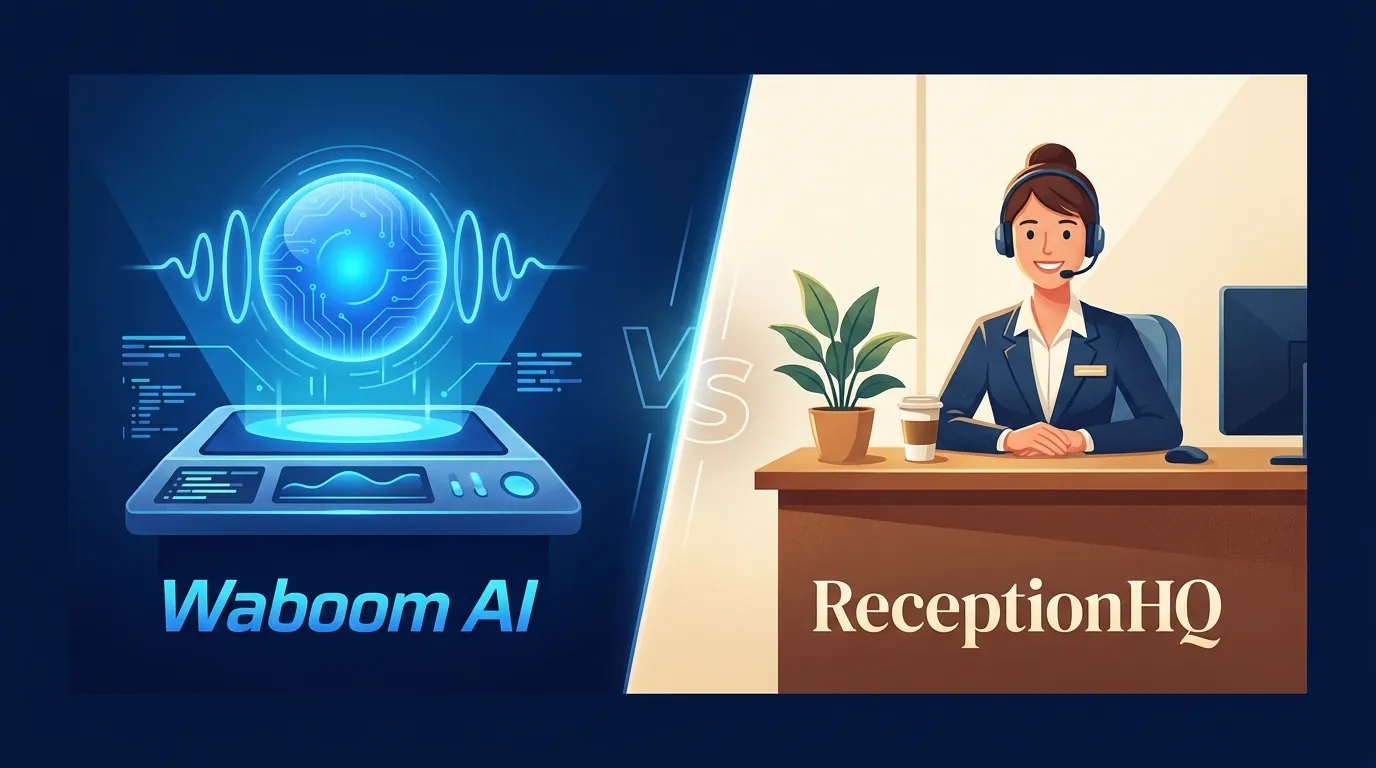
Search "virtual receptionist nz" in 2026 and Google still lists ReceptionHQ at the top. Search "AI receptionist nz" and the listings are mostly empty. The market has not caught up to the fact that these are different products with different economics.
Here is the honest comparison.
What each one actually is
A virtual receptionist is a remote human. They sit in a contact centre (often Auckland, Sydney, or Manila) and pick up your calls under your business name. They follow a script, take messages, transfer to your team, and book appointments if your software allows.
An AI receptionist is software. It picks up the phone, holds a real conversation in a natural voice, books appointments, qualifies leads, and transfers urgent calls. We covered the technology in detail in What is an AI receptionist?.
Both pick up your phone. The similarities end there.
Side by side comparison
| AI receptionist | Virtual receptionist | |
|---|---|---|
| Who picks up | Software | Remote human |
| Hours of coverage | 24/7/365 | Usually 7am-7pm weekdays |
| Concurrent calls | Hundreds | One per receptionist |
| Knowledge of your business | Trained on your full knowledge base | Reads from a script you provide |
| Books to your calendar | Yes, directly via API | Sometimes, depending on tools |
| Holds emotional conversations | Limited | Strong |
| Speed of response | Sub 800ms turn time | Human reaction speed |
| Cost per month | $130-$320 for most SMEs | $1,500-$4,000 |
| Onboarding time | Same day to one week | 2-4 weeks |
| Sick days, holidays | None | Covered by pool, but service quality varies |
| Multilingual | Most platforms support 30+ languages | Limited to staffed languages |
| Data residency | Configurable (AU/NZ on request) | Depends on the centre's location |
Where virtual receptionists win
Three scenarios where a remote human beats software.
One. Emotional intake. Grief support practices, mental health triage, complaints lines. The caller needs to hear another human. AI gets close but not there.
Two. High-touch concierge service. Premium hospitality, luxury real estate. The caller pays for the warmth. Software is correct but cold.
Three. Bespoke conversations. Family lawyers handling messy custody calls. Estate planners on a difficult day in the life of a client. The conversation cannot be scripted in advance.
If your inbound calls are mostly these, virtual receptionists are still the right answer. The cost is the cost.
Where AI receptionists win
Most other scenarios.
Volume. AI handles hundreds of calls simultaneously. A virtual receptionist handles one at a time. If your business has any spike pattern (Monday mornings, end of month, weather events), AI absorbs the spike without a queue.
Hours. AI covers 24/7. Virtual receptionists cover business hours. Most virtual receptionist providers add an after-hours surcharge or send to voicemail outside hours.
Cost. A small clinic taking 80 calls a week pays $130 a month for an AI receptionist. The same clinic on a virtual receptionist plan pays $1,500-$2,500 a month. The maths only stops working if your calls really need a human voice on the other end.
Speed and consistency. An AI agent answers your phone in under one ring, always. A virtual receptionist answers in under three rings, mostly. Spike volume drops the average. AI does not have a spike profile.
Booking accuracy. A trained AI agent reads from your live calendar and pricing. A virtual receptionist reads from a static script. AI agents update instantly. Scripts get out of date.
Multilingual. AI handles Te Reo, Mandarin, Spanish, Hindi, and 30+ others. Virtual receptionists handle whatever languages they staffed for.
The hybrid that beats both
The setup we recommend most often: AI receptionist as the front door, human team as the warm transfer target.
The agent answers every call. It handles 70-80% of the routine traffic itself: bookings, FAQs, status updates. The remaining 20-30% it warm-transfers to your team with a one-line summary already in their CRM. Your team picks up an in-context call instead of a cold one.
Result: every call answered, every booking captured, your team protected from low-value pickups, and the warmth where it matters.
This pattern beats both pure AI and pure virtual receptionist on cost, coverage, and customer experience. We deploy it across most of our trade and clinic clients.
For specifics on how it works on a New Zealand business: our NZ AI receptionist setup. For Australia: our AU AI receptionist setup.
Frequently asked questions
Will customers know it is AI?
Some will, most will not on a tuned platform. We tell agents to identify when asked directly.
Can the AI transfer to my virtual receptionist?
Yes. The two are not mutually exclusive. AI as the front door, virtual receptionist as the human handoff for emotional calls is a perfectly valid setup.
Which is more reliable?
AI uptime sits above 99.9% across most platforms. Virtual receptionist reliability is mostly a question of staff sickness, queue length, and time of day. Both work, AI is more consistent.
Does ReceptionHQ offer AI?
ReceptionHQ is primarily a virtual receptionist service. They have piloted AI features. Their core product is human.
What if the AI mishandles a call?
Every call is recorded and transcribed. We review the first 100 calls of any new deployment, tune the script, and re-deploy. Mishandles drop to under 2% within the first month.
Can I keep my existing phone number?
Yes. Both AI and virtual receptionists work with number porting or call forwarding. No need to change your published number.
Hear ours on your business
We tune a live demo on your services and pricing in under a week. Compare it directly to your current virtual receptionist on the calls that actually matter.
New to the space? Start with our full guide to AI voice agents.
Leonardo Garcia-Curtis
Founder & CEO at Waboom AI. Building voice AI agents that convert.
Ready to Build Your AI Voice Agent?
Let's discuss how Waboom AI can help automate your customer conversations.
Book a Free Demo