Fifty vendors right now will tell you they have an AI voice agent. Most have a wrapper around an open-source model, a half-built dashboard, and a Stripe link. The first time a campaign hits 10,000 calls a day or a regulator asks for an audit log, they fold.
Waboom is the other shape. A platform built around the agent. We're not going to walk you through the full feature list. We know our competitors read this blog (we read theirs). KFC doesn't publish the eleven herbs and spices on the side of the bucket. Here is the taste of what we built and why our clients sleep at night.
Why we are not listing the features
There is a real reason we are coy about the specifics, and it is not marketing. The 33 capabilities under the Waboom portal each took months to build. The combination of them is what makes it work. A competitor reading a blog post that says "we use a 4-signal phone health scoring algorithm with these signals and these thresholds" can be running a copy of our system inside a quarter.
So we describe outcomes. The capability group, what problem it solves, why it matters when a real campaign meets the real world. If you want to see the specifics in action, book a strategy call and we'll demo the actual portal on your real call data. The interesting bits show up in the live system, not the marketing site.
The takeaway is the architecture: we build the layer that wraps the agent, not just the agent itself. Most vendors stop at the model. We did not.
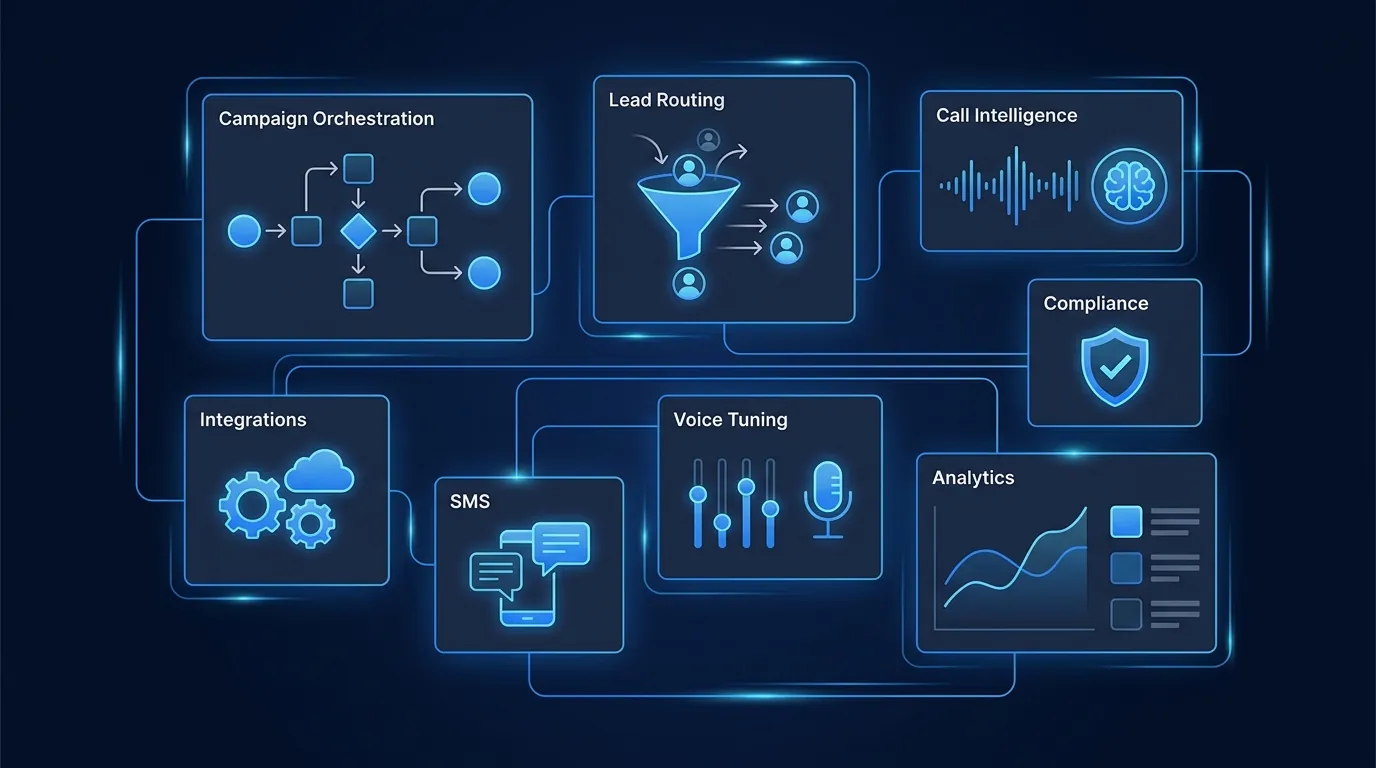
The 10 capability groups
1. Carrier intelligence
Every outbound campaign in 2026 fights three quiet wars: which numbers to call, when to call, and how often. Get any of them wrong and your phone numbers start showing up as "Scam Likely" inside two weeks.
We built the intelligence that watches carrier behaviour in realtime. The system knows the warmup pattern that keeps a brand-new number trusted. It knows when an aging number is about to flip. It rotates and rests numbers based on signals competitors do not even watch. The outcome you care about: campaigns that hold their connect rates over months while competitor campaigns burn through dialler numbers in weeks.
2. Compliance armour
NZ Privacy Act 2020. Australian Privacy Principles. Do Not Call Register. Spam Act. Industry Standard 2017 calling hours. Cross-border IPP 12 model clauses. Recording disclosure. Audit logging. The full stack, built into the platform from day one rather than bolted on.
When the Privacy Commissioner phones (or Te Mana Mātāpono Matatapu in te reo), you have answers. When ACMA opens an investigation, you have receipts. We covered the specifics in the NZ Privacy Act IPP-by-IPP guide and the Australian telemarketing law guide. The platform makes compliance the default, not an afterthought.
3. Realtime conversation intelligence
The valuable thing in a call is rarely the booking itself. It is the intent signal that arrives 90 seconds before the booking. The customer who hesitates on price. The caller who mentions a competitor by name. The objection that hits 30% of the calls this month and didn't last month.
We capture all of it in realtime. Sentiment, intent, custom tags. Alerts fire to the people who need to act before the call ends. Your team knows about the hot lead while the lead is still on the line. We covered one slice of this in call tags caught the 3 you would have lost.
4. Multi-channel orchestration
The agent does not just answer the phone. It sends the booking confirmation SMS. Triggers the new-patient form email. Drops the calendar invite. Pages your team in Slack. Pushes the lead summary into your CRM with the right tags.
One conversation, every channel that matters. The customer experience is smooth because the platform sequences it. No Zapier middleware, no manual intervention. The orchestration is the platform. Without it, you are stitching together five vendors and watching the seams.
5. Lead qualification at scale
Garbage in, garbage out. Most "AI voice campaigns" we audit at competitor platforms have list quality issues invisible to the operator. Bad numbers, wrong owners, lapsed consent.
We clean lists before they cost you airtime. Validate, dedupe, route to the right agent or team, retry intelligently when the first call doesn't connect. Score every contact on intent and conversion likelihood. Push high-scoring leads to the top of the human queue. Suppress the low-quality calls that would only damage your reputation.
This is the part of the platform that turns a mediocre list into a usable campaign. We covered the pattern in AI lead scoring: stop calling leads in the wrong order.
6. Knowledge handling
Your agent has to sound like your business. Not Waboom's. Not a generic AI's. Yours.
We built the layer that ingests your services, pricing, FAQs, policies, integrations, and updates them in real time as your business changes. The agent speaks in your voice on your products with your accent. Self-service updates: change the price tomorrow morning, the agent quotes the new price tomorrow afternoon. We covered the architecture in how to structure a voice agent knowledge base.
7. Voice tuning
The agent says "Whangārei" the way it should be said. Not "Wong-uh-RAY". It says "Rotorua", "Tauranga", "Remuera" correctly. It pronounces your client's surname even if it is Bhattacharya or Whakaaria or Garcia-Curtis.
It speaks Te Reo Māori when needed. Switches to Mandarin mid-call if the caller does. 30+ languages on demand without staffing changes. We documented the workflow in why your AI agent mispronounces Rotorua.
This is invisible until you skip it, then your AI sounds foreign in your own market. Which is the moment your prospect hangs up.
8. Integration breadth
The agent works with what you already use. HubSpot. Pipedrive. Salesforce. Zoho. GoHighLevel. Cliniko. Halaxy. MedTech32. ServiceM8. Tradify. Custom CRMs via webhook. Make, Zapier, n8n.
We meet your stack where it is. We do not ask you to migrate to our CRM, our calendar, our practice management. The integration breadth is the difference between "the AI is helping" and "the AI is also a data-entry job because nothing connects". Most vendors stop at one or two CRMs. We did not.
9. Operations engine
The unsexy layer that means the agent shows up every Monday, not just on launch day. Cron-driven campaign execution. Multi-currency billing in NZD, AUD, USD. Per-second cost tracking across telephony and model layers. Audit logs. Alert thresholds. Realtime dashboards.
This is the layer that turns "we built a cool demo" into "we run a service business reliably". Vendors that skip the operations engine lose clients in month four when the second invoice arrives and nothing matches.
10. Brand protection layer
The most important one and the one most vendors do not have. Content filtering across nine categories. Jailbreak protection. Prompt injection monitoring. Runtime cost caps so a runaway script cannot cost you $50K (a real war story we covered in how we war-test voice agents). Anomaly detection. Phone reputation watching. Audit logging.
We tested your agent against the worst of the internet so you do not have to. The jailbreak attempts we have seen would surprise you. The agents that have wandered off-script on competing platforms are case studies our compliance team uses for training.
Your AI voice agent is your brand answering the phone. We treat it like that.
What this means when you shop a vendor
When you compare Waboom to a vendor selling you "an AI voice agent", you are comparing two different products. They have the conversation engine. We have the conversation engine plus the ten capability groups above (and 23 more we did not mention).
The shopping question is not "which has the cheapest agent". The shopping question is "what do I get when the call goes wrong, the carrier flags my number, the regulator asks for the log, the LLM hallucinates, the prospect asks a hard question, the staff member quits, the campaign hits 10,000 calls in a day, the budget runs out at 11pm on Friday".
We have answers to every one of those. Most vendors have answers to none.
If you want to see the specifics, book the strategy call. We demo the actual portal on your real call data. The list of features is not the point. The architecture is the point.
Frequently asked questions
Why not just publish the full feature list?
Two reasons. First, the value is in the combination. A list of 33 features is not informative; the integration of them is what works. Second, our competitors read this blog. They watched us build call tagging in 2024 and shipped a thinner version in 2025. We are happy to share what we are doing. We are less happy to publish the implementation specifics for free.
How do I evaluate without the feature list?
The evaluation is a real demo on your business. Not a sales pitch. Not a slideware walk-through. We tune an agent on your services, run it on a sample of your inbound or outbound call mix, and you watch the platform handle real calls. The interesting bits emerge in 30 minutes of live use, not 30 minutes of slides.
Are you saying competitors copy your features?
We are saying it happens. We have published technical detail before, watched a competitor ship something close, and learned from that. The moat is not any single feature. The moat is the combination, the velocity of adding more, and the team building them. The combination is what we do not give away.
What if my favourite feature is on the platform but not in this article?
Probably. We picked 10 capability groups because that fits in a readable article. The portal has 33 distinct features. If you have a specific need (sales territory routing, branded caller ID rollout, holiday-aware scheduling, sentiment-triggered alerts), there is a good chance we already built it. Ask in the strategy call.
Are you one of the voice AI platforms like Vapi or Synthflow?
No. An enterprise conversational engine sits underneath as one of the components we use. Waboom is the platform on top: the campaign orchestration, phone health, compliance, integration, billing, operations, brand protection. The engine is one ingredient. Waboom is the kitchen.
What happens if I leave Waboom?
Full export of transcripts, recordings, contacts, tags, audit logs via the API or dashboard. No exit fees. Month-to-month billing on most tiers. We do not lock data in. The platform is a moat by being good, not by trapping you.
How do I know this is not just marketing?
Because we have published the technical detail behind several pieces of the platform already and the URLs are linked above. The carrier-intelligence side: why AI diallers burn phone numbers. The compliance side: building compliant AI voice agents. The realtime intelligence: call tags caught the 3 you would have lost. The brand protection: how we war-test voice agents. The lead handling: AI lead scoring.
The full picture is the platform. The pieces are real and shipped.
See the platform on your real call data
Bring your call mix, your CRM, your typical volume. We tune an agent on your services and run it on a sample of your inbound or outbound for a week. You see the bits that are not in this article working on your real calls.
Book a strategy call · Try a live voice agent · Voice agent pricing · AI Sales Agent
Leonardo Garcia-Curtis
Founder & CEO at Waboom AI. Building voice AI agents that convert.
Ready to Build Your AI Voice Agent?
Let's discuss how Waboom AI can help automate your customer conversations.
Book a Free Demo