
A demo voice agent is a controlled performance. A production grade voice agent is a survivor.
The demo runs in a quiet room, on a clean line, with a tester who knows the script. It sounds flawless. Then a real customer rings from a ute on State Highway 1. Thick accent, a screaming kid in the back seat. That is where most agents fall over.
We have run thousands of live calls across New Zealand and Australia. The pattern is brutal and consistent. The agents that pass a polished demo are not the agents that survive a Tuesday afternoon rush.
A production grade voice agent earns trust because it handles the messy edges, not the happy path. Here are the nine checks we use to tell a real agent from a scripted one. If you want the bigger picture first, start with our overview of AI voice agents for NZ and AU businesses.
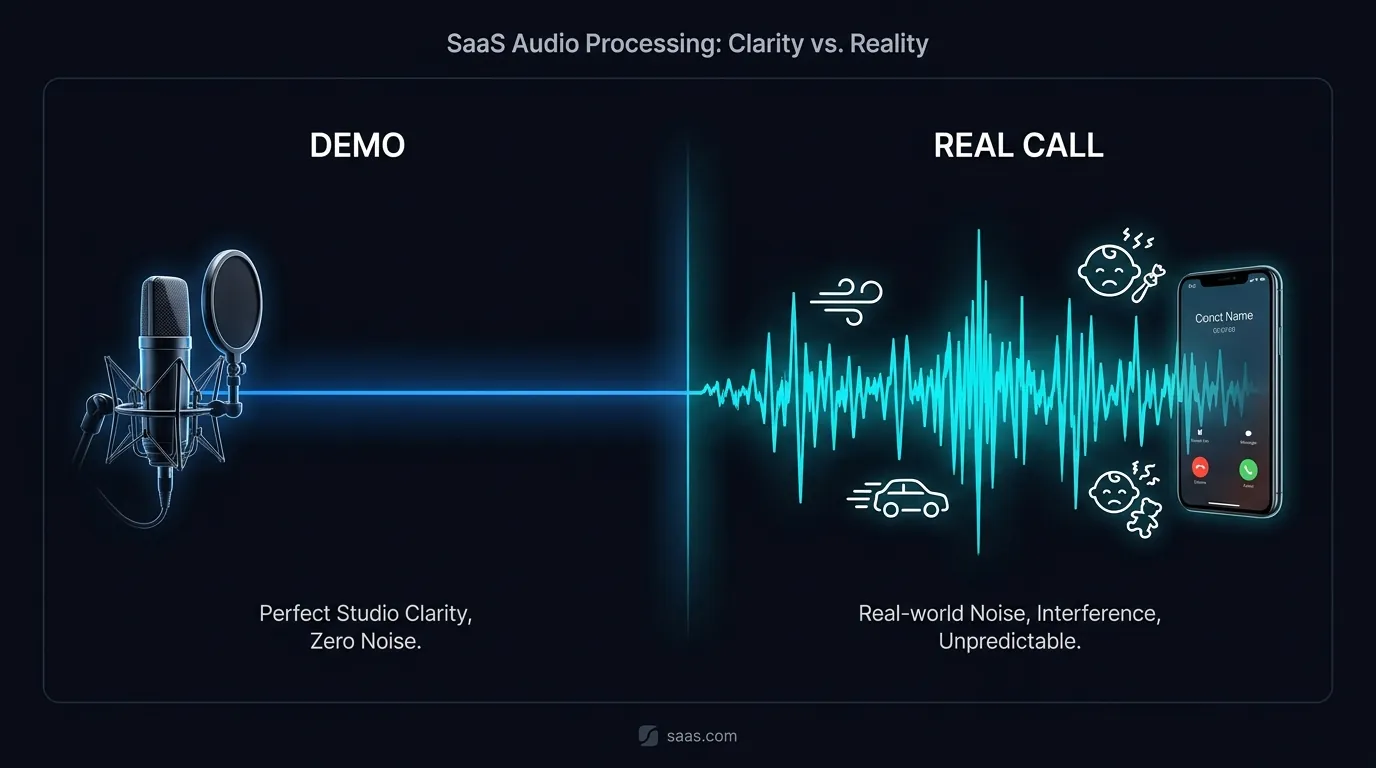
The demo lives in a quiet room. The real call lives in the wind, the road, and the rush.
Why does a demo agent fall apart on a real call?
A demo agent falls apart because it was only ever tested on the happy path. Clean audio, a co-operative caller, no interruptions. Real calls bring background noise, accents, and people who talk over the agent. The demo never rehearsed any of that.
Think about the gap. A demo call is maybe two turns long and everyone behaves. A real answered call averages about 30 seconds, costs around 40 cents, and the caller does whatever they like.
The agent that looked perfect in the boardroom now mishears a suburb, talks over the caller, and pauses two seconds before every reply. None of that showed up in the demo because nobody stress tested it.
This is the single biggest reason businesses get burned. They buy the demo. They deploy the demo. They never test the edges. We wrote about this failure pattern in our piece on why DIY voice agents fail.
What are the nine production checks that matter?
The nine checks cover the things a demo hides. Noise handling, accents, interruptions, off-script questions, answer speed, human handoff, hallucination control, data handling, and a live test plan. Each one is a place where a scripted agent breaks and a real one holds.
Here is the short list we run before we trust any line to an agent.
The rest of this guide walks the checks that catch the most agents out.
How does it handle a noisy mobile or a thick accent?
A production grade voice agent holds the line through noise because it was tuned on dirty audio, not studio recordings. It separates the speaker from the wind, the road, and the cafe. Then it understands the answer even when the accent is broad Kiwi or strong Aussie.
Most demos are recorded on a headset in a silent office. That is not the job. The job is a tradie on a building site, a parent in a carpark, a farmer in a paddock with wind across the mic.
We test agents against recordings of real noisy calls before launch. If an agent mishears a suburb or a name once in five noisy calls, it is not ready. The fix is noise handling, not a louder script. We pull this apart in our guide to handling background noise on voice calls.
Accents matter just as much. An agent trained on flat American English will hear "Tauranga" or "Woolloomooloo" as gibberish. We tune for the local map of place names and surnames so the agent gets them right the first time.
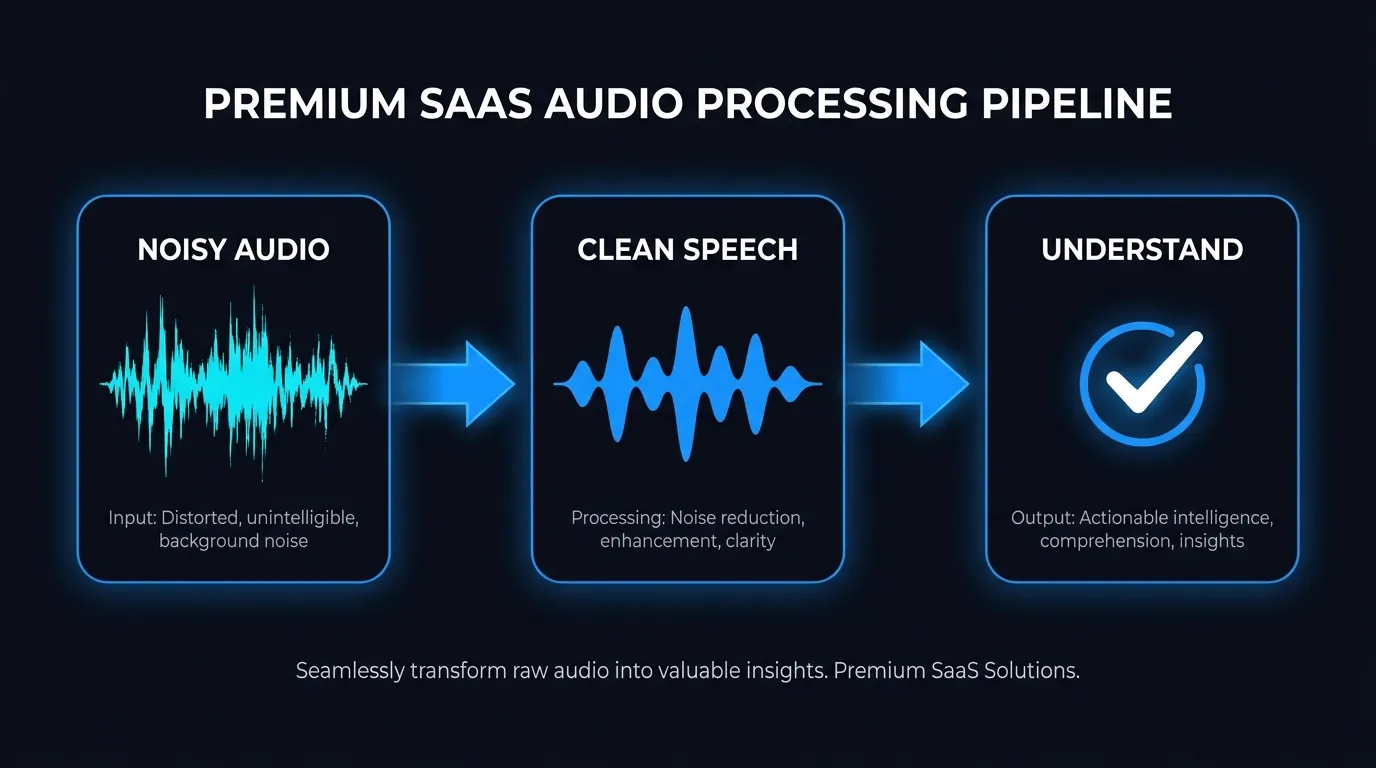
A production agent strips the road and the wind before it ever tries to understand the words.
Want an agent that survives the real call, not just the demo?
See how we build and tune production grade voice agents for NZ and AU on real noisy lines.
How does it cope when the caller goes off script?
A real agent stays useful when the caller ignores the script because it can hold a goal without a rigid flow. The caller asks three things at once, changes their mind, then circles back. The agent keeps the thread and still books the job.
Scripted agents collapse here. They have a tree. The caller steps off the tree and the agent loops, repeats itself, or dead ends. You have heard it. It is the phone equivalent of a wall.
We build agents that carry intent, not a flowchart. The caller can say "actually, can you do Thursday instead, and is there parking" and the agent handles both. That is the difference between a script and an agent.
There is a sharp edge to this. An agent that improvises can also invent. Strong off-script handling has to come with strong hallucination control, or you have just built a confident liar. We cover that trap in our note on how to stop AI voice agent hallucination.
How fast does it answer, really?
A production grade voice agent starts speaking in well under a second, because anything slower feels like a dropped call. Humans read silence as confusion or a bad line. Two seconds of dead air and the caller says "hello, are you there" and the call is already going sideways.
Speed is not one number. It is the gap before the first word, the gap between turns, and the gap when the agent has to look something up. All three have to feel natural.
We measure first token latency on every agent and tune until it disappears. A great target is the agent starting to speak inside 800 milliseconds of the caller finishing. We pull apart the whole chain in our guide to mastering voice AI latency.
If your agent feels laggy, the cause is usually one slow link, not the whole system. Our latency diagnostic walks you through finding it.
How does it know when to hand off to a human?
A real agent hands off the moment it hits something it cannot safely close. A frustrated caller, a complaint, a legal question, a deal outside its remit. It does not bluff. It says it is bringing in a person and makes that happen cleanly.
The worst agents never escalate. They loop, apologise, and trap an angry caller in a maze. That single experience can cost you the customer and a one star review.
We set explicit handoff triggers on every agent. Repeated confusion, a request to speak to a human, or a topic on the do-not-handle list all route to a person. The agent passes the context so the caller never repeats themselves. The same idea also lets it barge in and yield politely, which we cover in our note on interruptions and barge-in.
Knowing when not to handle a call is a feature, not a weakness. The best deployments pair the agent with a small human team for the hard 10 percent. We made the full case in our piece on why voice AI agents still need humans.
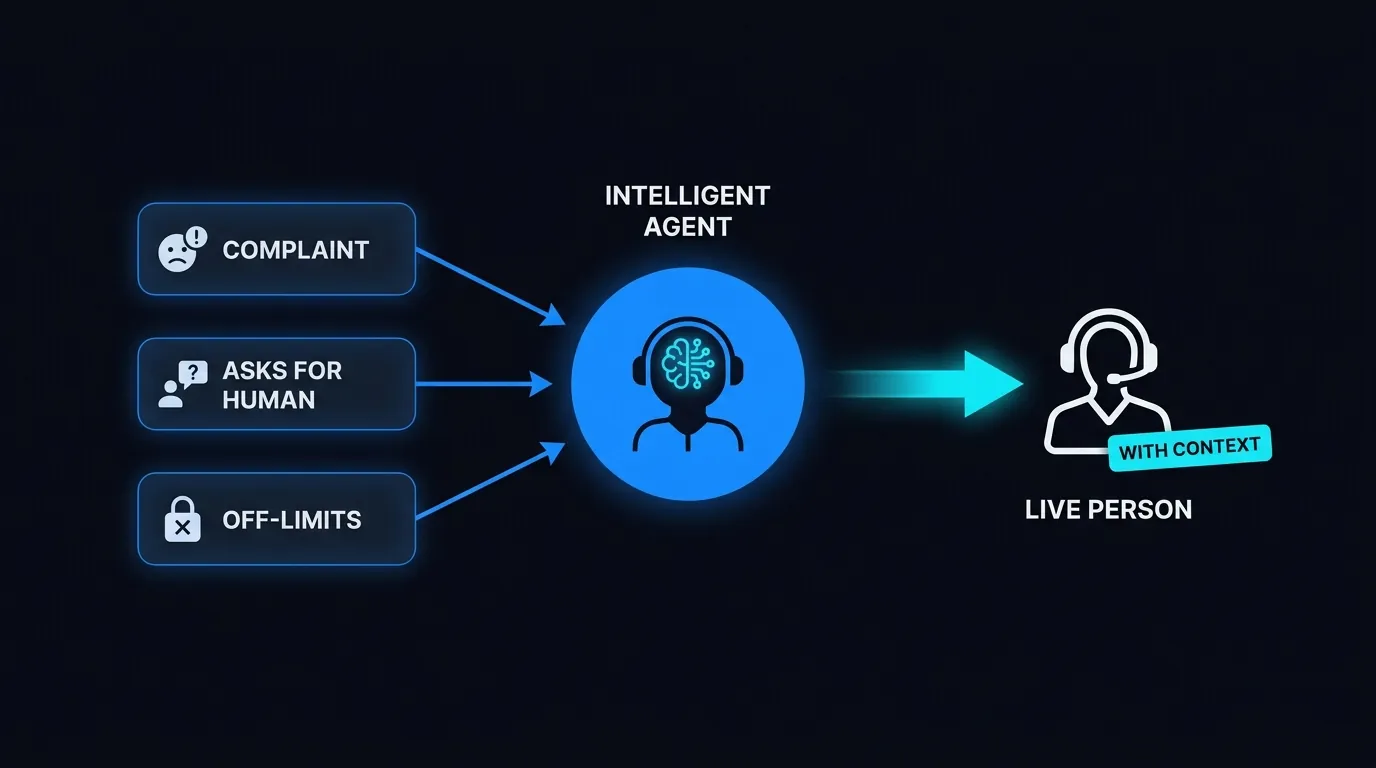
A clean handoff carries the context so the caller never has to repeat themselves.
What about caller data, and is it legal here?
A production grade voice agent treats caller data as a trust obligation, because in New Zealand and Australia it is also a legal one. Callers tell agents names, numbers, addresses, and sometimes sensitive details. How you store and protect that is the whole game.
We keep the buyer outcome simple. Your portal, your transcripts, and your structured records sit on servers in Sydney. The live audio is processed offshore by our voice infrastructure partner under documented arrangements. We can delete any call and its recording in 10 minutes on request.
Every call discloses up front that the caller is speaking with an AI. That is not optional. It keeps you on the right side of the NZ Privacy Act 2020 and the Office of the Privacy Commissioner. In Australia it is the Privacy Act 1988, the Australian Privacy Principles, and the OAIC.
If you run outbound, the rules tighten. The Australian Do Not Call Register and the Spam Act 2003 apply across the Tasman, and the NZ Unsolicited Electronic Messages Act 2007 covers messaging. You can read the primary sources at the Office of the Privacy Commissioner and the OAIC.
What should you test before you trust a line to it?
Test the edges, not the script, before you trust a line to an agent. Ring it from a moving car. Talk over it. Throw it a question it was not built for. Ask it something it should refuse. If it survives all four, it is closer to production grade.
Here is the test plan we run before any go-live.
Score each on whether the agent held the line and reached the goal. If it fails noise or hallucination, it is not ready, full stop. The economics only work when the agent actually completes calls.
And the economics are good when it works. Voice runs about 80 cents a minute, billed by the second. A typical one to two minute call costs roughly $1 to $2. A part time receptionist costs $28 to $35 an hour before KiwiSaver or super, ACC, and holiday pay. One person cannot pick up three lines at 9am.
Run the nine checks against a real agent.
We will put a production grade voice agent on a noisy line and let you try to break it before you commit.
Frequently Asked Questions
What is the difference between a demo voice agent and a production grade voice agent?
A demo runs on clean audio with a co-operative tester reading a script, so it sounds flawless. A production grade voice agent survives background noise, broad accents, interruptions, and off-script callers. The demo proves it can talk. Production proves it can finish a real call from a moving car at 9am.
Can a voice agent really understand strong NZ and AU accents?
Yes, when it is tuned for the local map of place names and surnames. An agent trained only on flat American English hears "Tauranga" or "Woolloomooloo" as noise. We test against recordings of real broad Kiwi and Aussie callers, and if it mishears a name once in five noisy calls, it is not ready to launch.
How fast should a good voice agent answer?
It should start speaking inside about 800 milliseconds of the caller finishing. Anything past two seconds of silence reads as a dropped call, and the caller starts saying "hello, are you there". Speed is three gaps, before the first word, between turns, and during a lookup, and all three have to feel natural.
Where is my caller data stored, and is it legal in New Zealand and Australia?
Your portal, transcripts, and structured records sit on servers in Sydney. Live audio is processed offshore by our voice infrastructure partner under documented arrangements. Every call discloses it is an AI, which keeps you aligned with the NZ Privacy Act 2020 and the AU Privacy Act 1988. We can delete any call in 10 minutes.
What does a voice agent cost to run per call?
Voice runs about 80 cents a minute, billed by the second. A typical one to two minute call costs roughly $1 to $2, and an average 30 second answered call lands near 40 cents. Compare that to a part time receptionist at $28 to $35 an hour before KiwiSaver or super, ACC, and holiday pay.
How do I test a voice agent before trusting it with live calls?
Test the edges, not the script. Ring it from a noisy mobile in a moving car, talk over it, throw it off-script curveballs, and ask it something it should refuse. Add one angry caller demanding a human. Score each call on whether the agent held the line and reached the goal before you go live.
Leonardo Garcia-Curtis
Founder & CEO at Waboom AI. Building voice AI agents that convert.
Ready to Build Your AI Voice Agent?
Let's discuss how Waboom AI can help automate your customer conversations.
Book a Free Demo

