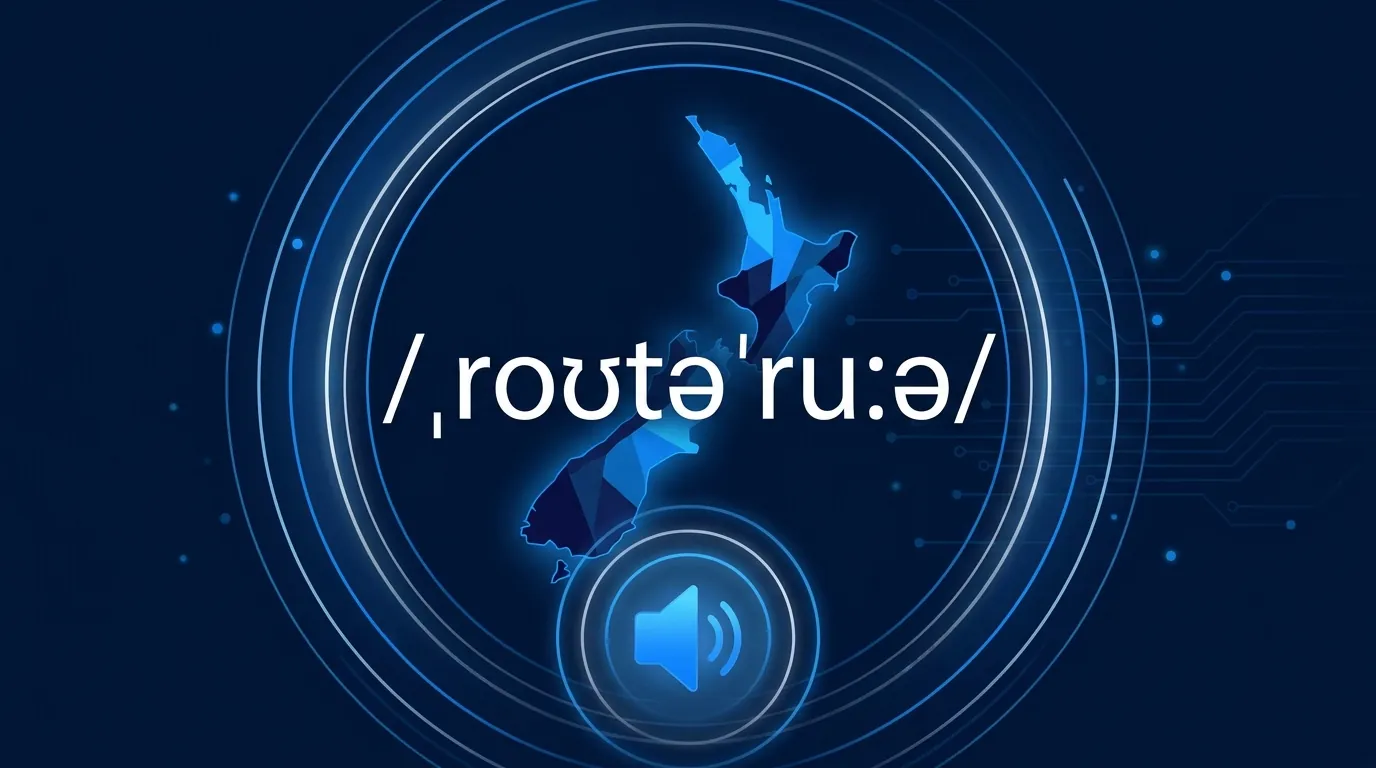
An AI agent calling on behalf of a luxury Auckland real estate agent says "Hi, I'm calling about the property in Roto-ROO-uh".
You wince. The prospect on the other end laughs. The brand just lost.
Out of the box, most modern voice AI engines are trained on a global English corpus. They handle Auckland and Sydney fine because those names are everywhere. They stumble on Rotorua, Whangārei, Tauranga, Taupō, Waiheke, Remuera, and most of Te Reo Māori. They butcher Welsh, Polish, Finnish, and a hundred other languages whose pronunciation rules differ from English.
For a New Zealand or Australian business, this is not a small issue. It is the difference between sounding local and sounding foreign.
Why TTS engines mispronounce place names
Modern text-to-speech engines work by mapping written text to phonemes (units of sound) and then to audio. The mapping rule for an English engine is broadly: take the spelling, apply English pronunciation rules.
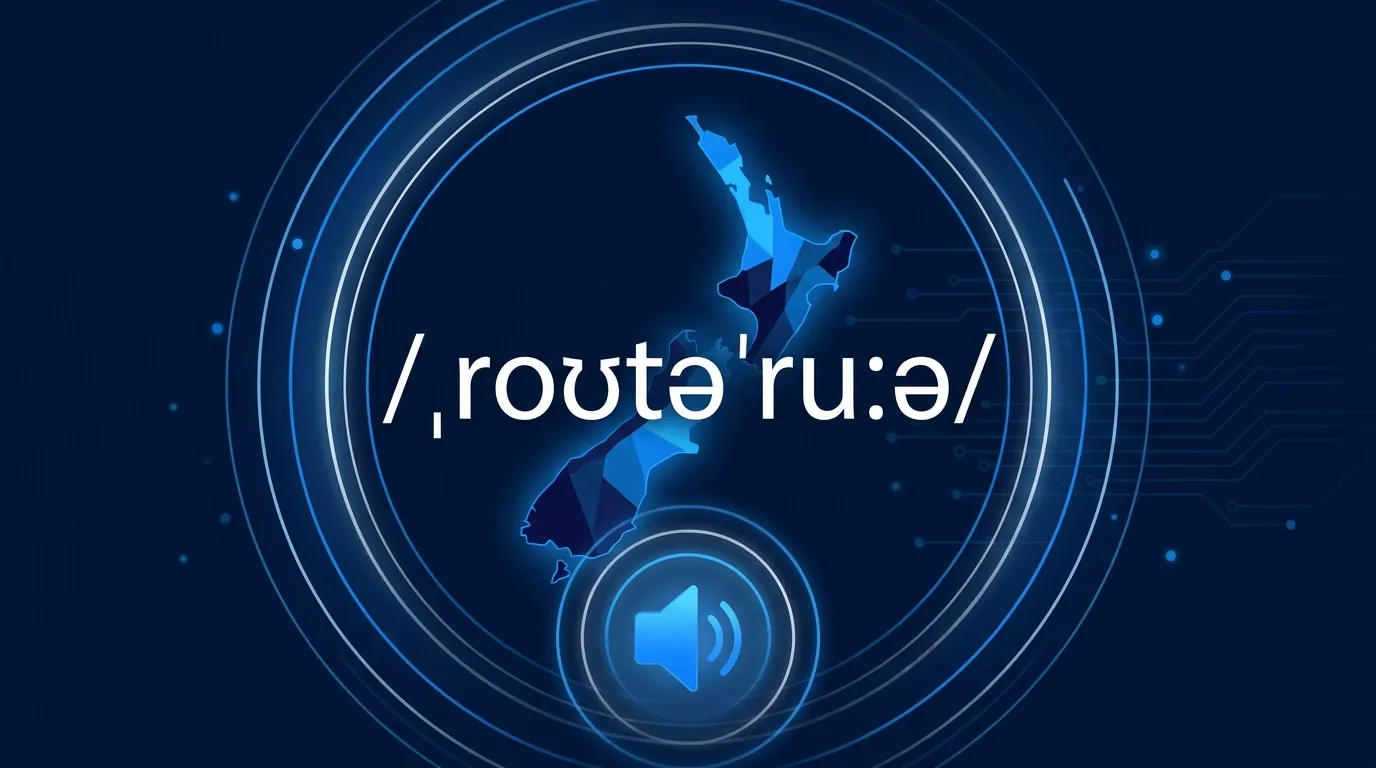
That works for "Auckland". It does not work for "Rotorua". The Māori R is a soft tap, the U sounds like "oo" not "you", and the stress falls on the second syllable. None of those rules come from English. Without an explicit pronunciation override, the engine guesses, and the guess is "Roto-ROO-uh".
Same problem for Whangārei (the engine drops the macron and stresses the wrong syllable), Taupō (the macron makes it Taupoh, not Taupow), and any name with a long vowel marked by a macron.
Same problem for client names. We have onboarded clients called Bhanupriya, Wojciech, Paolo, and Aroha. Every one of them needed a pronunciation override before the agent could say their name on a call.
The pronunciation dictionary
Inside every Waboom agent, under the Audio tab, there is a Pronunciation Dictionary. It looks like this:
Every entry has three columns:
When the engine encounters Rotorua in any context (your script, your knowledge base, a caller asking about it), it substitutes the phonetic spelling and pronounces it correctly.
What we ship by default
Every Waboom NZ agent comes pre-loaded with a New Zealand English locale dictionary. Around 80 entries covering:
For Australian clients we ship a parallel dictionary with Aboriginal place names, common Indigenous language vocabulary, and tricky Australian pronunciations (Cairns, Albany, Coolangatta, Wagga Wagga, Mooloolaba).
Adding your own
Three reasons clients add custom entries:
One. Client names. Especially anything non-English. We had a client whose surname was "Garcia-Curtis" pronounced "Gar-SEE-ya KURR-tis". The engine defaulted to Anglo "GAR-shuh CURR-tis". One pronunciation entry fixed it. Now the agent says it properly every call.
Two. Brand names. "Waboom" is straightforward but most brand names are not. Plural pronunciations of the same brand confuse the agent across calls. One entry forces consistency.
Three. Industry vocabulary. Real estate has weird ones: "Manukau" (Auckland) is not the Manukau most engines guess. Medical has "anaesthesia" vs "anesthesia". Legal has lots of Latin (subpoena, voir dire). Custom entries fix them all.
The workflow
Adding a new entry takes around 30 seconds.
Step one. Type the word. In the dictionary table, type the word the engine is mispronouncing.
Step two. Get an AI suggestion. Our portal queries the model for an IPA phonetic spelling based on regional accent. If you have selected New Zealand English locale, the suggestion follows NZ phonology. If you have selected Australian, it follows AU. The suggestion appears in the Phoneme column.
Step three. Preview. Hit the play button next to the suggestion. You hear the agent say the word using the suggested phonetic. If it sounds right, save. If not, edit the IPA directly (or ask for another suggestion) and preview again.
Step four. Save. The new entry takes effect on the next call. No deploy. No downtime.
We have clients whose dictionaries have grown to 200+ entries over the first month. Mostly client names, suburb-specific bits, and weird industry vocabulary. After a month most stop adding because the agent has already learned every word in their world.
Why this matters more than you think
Pronunciation accuracy is a trust signal. Callers consciously notice when something sounds off and unconsciously notice everything else. A voice agent that nails Rotorua sounds local. A voice agent that says Roto-ROO-uh sounds like a call centre operator from somewhere else.
For real estate, mortgage, healthcare, and any business where the caller has a relationship with their place, this matters. We have measured connect rate improvements of 8-14% on outbound campaigns where we cleaned up local place name pronunciation. The caller stays on the line. The agent gets a chance to qualify them.
Frequently asked questions
Does the dictionary work in the middle of a sentence?
Yes. The engine substitutes phonetic spellings inline. Your script can say "I'm calling about a property in Whangārei" and the agent will pronounce Whangārei correctly without you having to write the IPA in the script itself.
What about names I have not added yet?
The engine falls back to its English-default guess. Every call's transcript is reviewable, and we surface mispronounced words automatically in your weekly report so you can add them.
Can I have different pronunciations per agent?
Yes. Each agent has its own dictionary. Useful if you have one agent for AU clients (Aboriginal place names) and another for NZ (Te Reo).
Can it speak Te Reo Māori as a full language?
Yes, on multilingual platforms. See our multilingual receptionist page. The pronunciation dictionary is for handling Te Reo words inside English-speaking conversations.
What if the IPA suggestion sounds wrong?
Edit it. The IPA standard is precise enough that small adjustments fix specific issues. Or ask the model for a different suggestion. Most words land on the right pronunciation in 1-2 iterations.
Do I need to know IPA?
No. The play button means you can iterate by ear. We have clients who do not read IPA at all and still build perfect dictionaries by hitting play and saving the version that sounds right.
What does this cost?
Nothing extra. Pronunciation dictionary is included on every Waboom agent.
Hear it on the names you actually use
We will demo your agent on a list of NZ or AU place names you give us, and tune the dictionary live.
Book a strategy call · Multilingual AI receptionist · Best LLM for voice agents
Want the fundamentals first? Read the full AI voice agent guide.
Leonardo Garcia-Curtis
Founder & CEO at Waboom AI. Building voice AI agents that convert.
Ready to Build Your AI Voice Agent?
Let's discuss how Waboom AI can help automate your customer conversations.
Book a Free Demo