
Your privacy officer just asked for a privacy impact assessment AI voice agent before go-live. You have two weeks. Here is how we run one that actually passes review in New Zealand and Australia.
We have shipped voice agents for clinics, real estate offices, and trades firms across both countries. Every one had a privacy gate. This is the version that clears it.
A privacy impact assessment AI voice agent is a structured document. It maps every piece of personal information your agent touches, where that data flows, and what could go wrong. Then it lists controls. Most of the work is honesty, not legal Latin.
The OPC and the OAIC do not certify your assessment. They expect you to do it, keep it, and act on it. So the goal is a document your privacy officer signs, not a glossy PDF nobody reads. Our voice agent security overview is where the controls behind that document live.
What is a privacy impact assessment for an AI voice agent?
A privacy impact assessment is a written risk review you run before a new system touches personal information. For an AI voice agent it covers the call audio, the transcript, the caller's name and number, and any details the agent captures. It names the risks and the controls.
Think of it as a pre-flight check. You walk the whole data path before the agent takes a single live call.
The document has a standard shape. What the agent does. What information it collects. Who can see it. Where it goes. What could go wrong. What you do about each risk.
For a voice agent the scope is wider than a form. A web form captures the fields you ask for. A voice agent records a conversation. So it can capture things you never planned to collect, like a health condition or a family dispute.
That is the first thing reviewers look for. Did you account for the messy reality of speech, not just the tidy fields in your CRM.
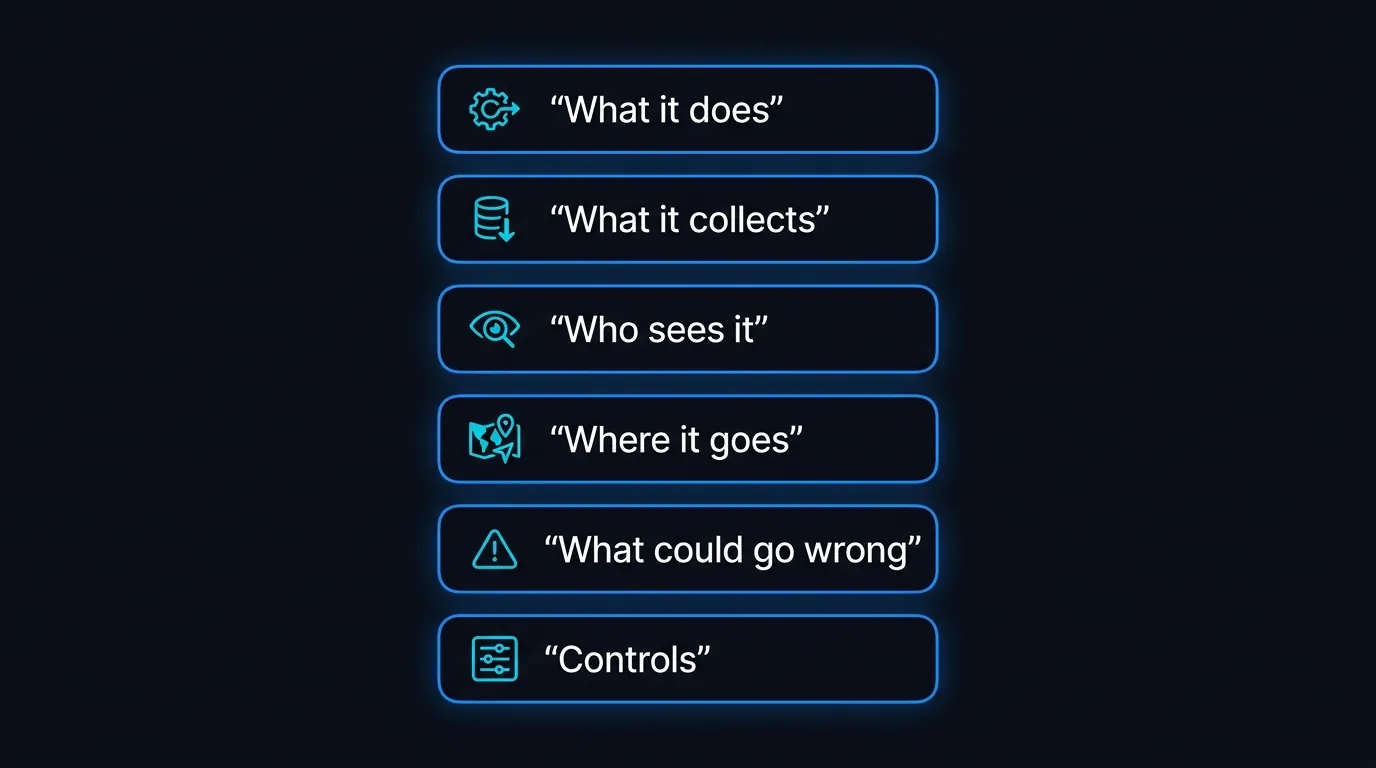
The six standard sections of a voice agent PIA, the same shape OPC and OAIC reviewers expect.
When do you actually need one?
You need a privacy impact assessment when the system is new, handles volumes of personal information, or carries real risk to people. An AI voice agent ticks all three. New technology, recorded conversations, automated decisions. Run one before go-live, not after the first complaint.
The OPC recommends a PIA for any project that collects or uses personal information in a new way. The OAIC makes it mandatory for Australian government agencies on high privacy risk projects, and strongly advised for everyone else.
Here is the practical trigger. If a board member or a customer could reasonably ask "what happens to my voice data", you need the document ready.
Three signals push it from nice-to-have to non-negotiable.
Skip it and you carry the risk personally. A signed assessment moves that risk into a documented, defensible process. That is the whole point.
What does the OPC expect in a New Zealand PIA?
The OPC expects you to walk your project against the 13 Information Privacy Principles and show your working. Collection, use, storage, disclosure, retention, access, and cross-border transfer. For an AI agent they also expect human review before the agent acts on its output.
The OPC publishes a free PIA toolkit on its website. It is plain English. We map our assessments to its structure so a reviewer recognises the format immediately.
A few principles bite harder for voice. IPP 3 means the agent discloses two things at the start of the call. That the caller is speaking with an AI, and that the call is recorded. We script that into the first ten seconds. No exceptions.
IPP 5 is storage and security. The OPC wants reasonable safeguards, not perfection. Encrypted transcripts, role-based access, and a clear retention rule satisfy it. Our default is delete the audio in 10 minutes and keep structured records only as long as the purpose needs.
IPP 12 is the cross-border principle, and it is the one most operators miss. Live voice processing happens offshore. You account for that openly, through documented arrangements with our voice infrastructure partner, and you note it in the assessment. You can read the full principle-by-principle walk in our NZ Privacy Act 2020 guide for voice agents.
What do the OAIC and the APPs expect in Australia?
In Australia you run the assessment against the 13 Australian Privacy Principles under the Privacy Act 1988. The OAIC publishes a PIA guide and an e-learning module. For government agencies a PIA is mandatory on high privacy risk projects. For business it is the expected standard of care.
The APPs cover similar ground to the NZ principles, with sharper edges in a few places. APP 5 is your notice obligation. The agent tells the caller who it is, that it is AI, why it is collecting, and where the data may go. The OAIC sets out its PIA expectations here.
APP 8 is cross-border disclosure. This is the Australian twin of the NZ trap. When personal information leaves Australia, you stay accountable for how the overseas recipient handles it. We address this through documented arrangements with our voice infrastructure partner and an honest residency note.
Be precise on residency. Your portal, transcripts, and structured call records sit on Sydney servers. The live audio stream and raw recordings are processed offshore. Never claim all data stays in Australia, because it does not, and a reviewer will catch the overstatement.
One more line that reassures every Australian reviewer. HIPAA is a United States health law and does not apply here. Australian health information falls under the Privacy Act 1988 and the APPs, full stop.
Want the controls your reviewer will ask about?
See the buyer-focused breakdown of encryption, access, retention, and residency on our AI voice agent security page, then map them straight into your assessment.
Where does the data flow, and where does it live?
The data flows from the caller's phone, through the telephony layer, to the agent's brain, and back as speech. Along the way it splits. Structured records land in Sydney. Live audio and raw recordings are processed offshore, then deleted. Map every hop in the assessment.
Reviewers love a clear data flow diagram. It proves you understand your own system. Vague answers here sink an assessment faster than anything else.
Here is the honest split we document on every project.
The portal stores a signed link to a recording, not the recording file itself. When the retention window closes, the audio is gone. Our default deletes it in 10 minutes, which shrinks the offshore footprint to minutes, not months.
That honesty is a feature. A reviewer who sees you naming the offshore step trusts the rest of the document. For the full picture of what we keep and for how long, see our note on what happens to AI voice agent call data.
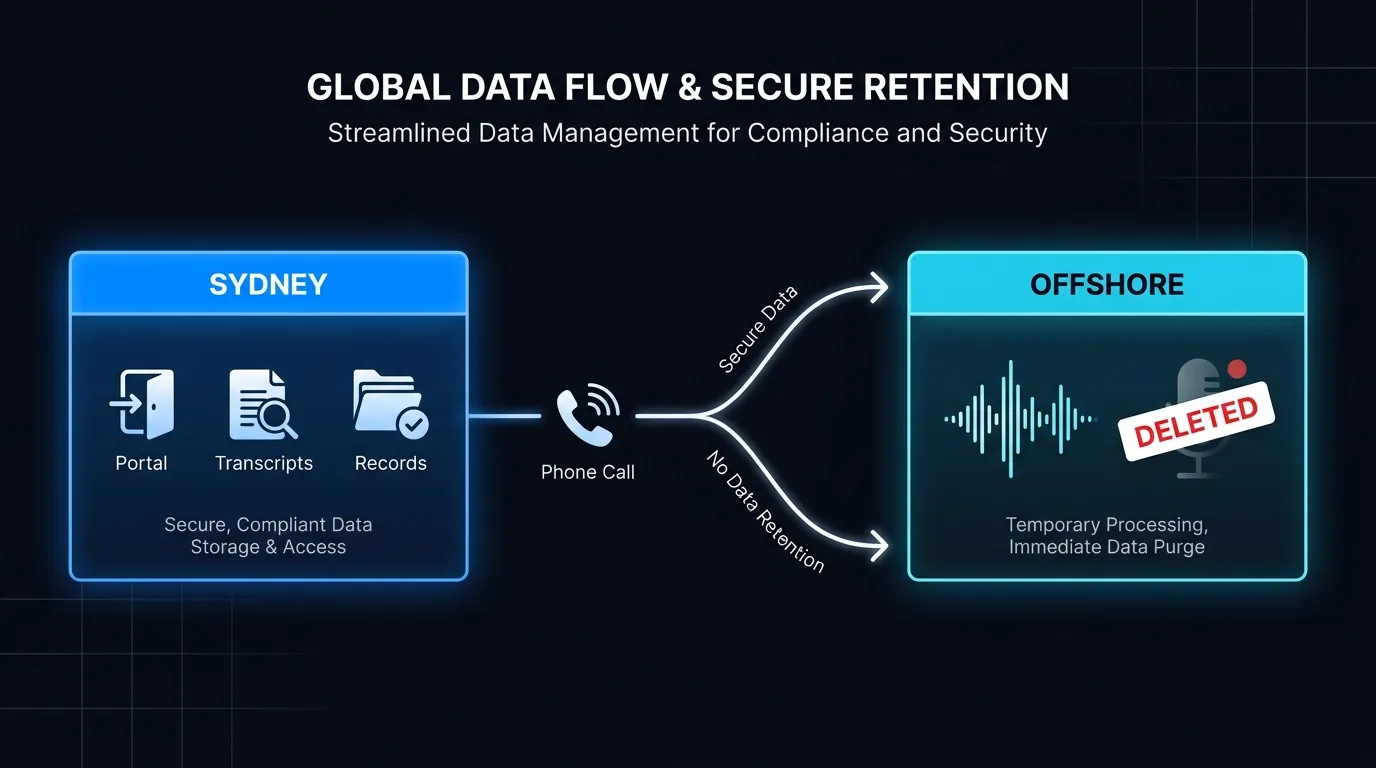
The honest residency split: structured records in Sydney, live audio processed offshore then deleted.
What are the highest-risk points to check?
The highest-risk points are over-collection from open speech, weak retention, unclear cross-border handling, and no human in the loop on automated decisions. Check each one against a concrete scene, not a checklist tick. Most failures hide in the gap between policy and what the agent actually does on a live call.
Walk these five with real call examples.
Outbound adds two more. The Australian Do Not Call Register and the Spam Act 2003 govern calls and messages there. New Zealand has the Unsolicited Electronic Messages Act 2007. Scrub your list before the agent dials.
The economics make scrubbing easy to justify. A 200-dial outbound campaign costs around 100 dollars in NZD, billed by the second at about 80 cents a minute. The fine for one bad list dwarfs the whole campaign. For the data-handling detail, our guide to zero-retention voice data covers the deletion mechanics.
How do you get a PIA signed off in two weeks?
You get it signed in two weeks by reusing a template and booking the privacy officer review on day eight. The document is 80 percent reusable across voice projects. The 20 percent that changes is your purpose, your fields, and your retention rule.
Here is the two-week run we use.
Days one to three. Write the project description and the data flow. List every field the agent captures and every system that sees it. This is the part only you can do, because only you know your purpose.
Days four to six. Map the flow against the 13 principles, NZ or Australian. For each, write the risk and the control in two sentences. Plain English. No legal padding.
Days seven to nine. Circulate the draft, hold the privacy officer review, and capture changes. Booking that review early is the single thing that keeps you on schedule.
Days ten to fourteen. Close the actions, lock the retention rule into the agent config, and get the signature. Disclosure line scripted. Audio delete set to 10 minutes. Done.
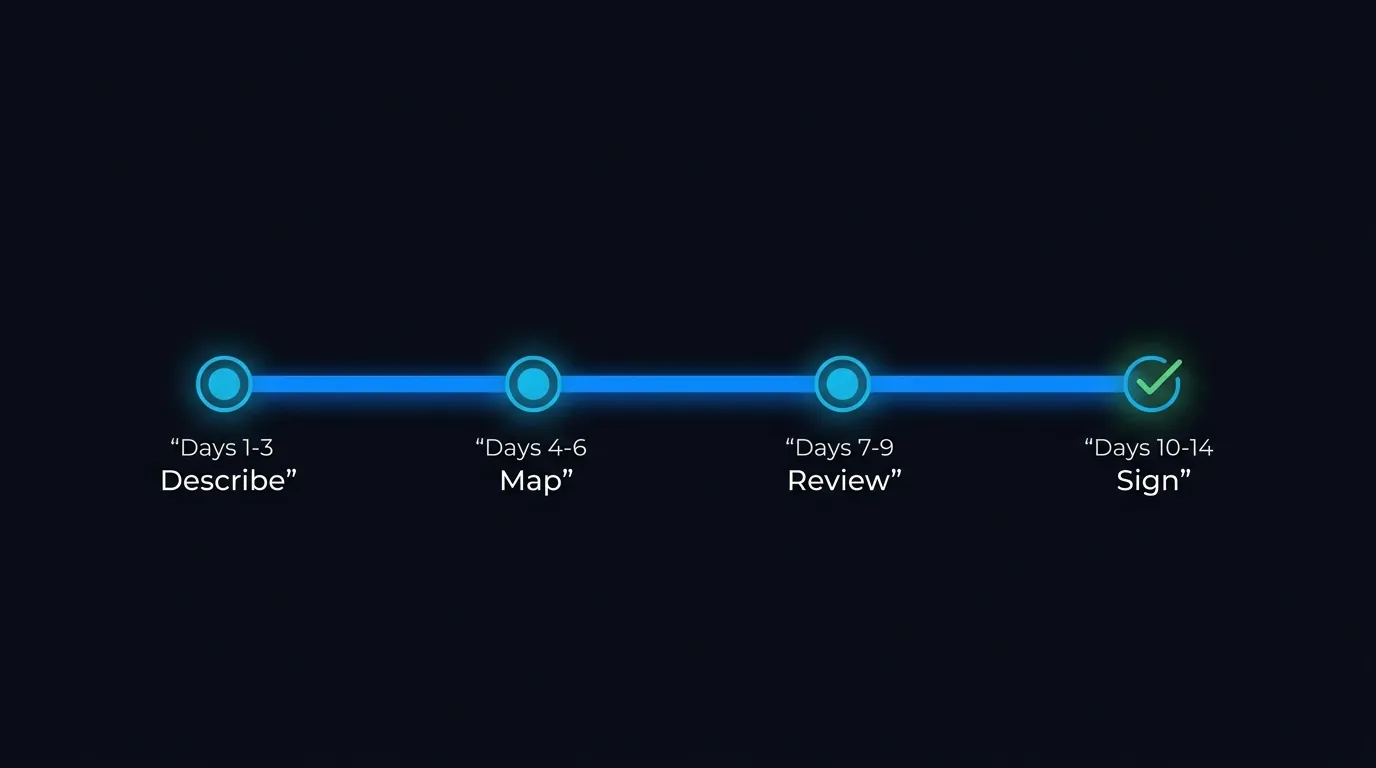
The two-week run from project description to a signed assessment, with the privacy officer review on day eight.
The payoff is real. A Sydney outbound agent we run booked 141 vendor leads in 90 days at 32.74 dollars per seller. It cleared its privacy gate before the first dial. The assessment did not slow the result. It protected it.
We build the agent and we help you assemble the assessment. The security outcomes your reviewer cares about are documented and ready.
Ready to clear your privacy gate?
Start with our voice agent security and compliance page, or see how the agents themselves work on our AI voice agents overview.
Frequently Asked Questions
Do I legally have to run a privacy impact assessment for an AI voice agent?
In Australia a PIA is mandatory for government agencies on high privacy risk projects and the expected standard of care for business. In New Zealand the OPC strongly recommends one for any new collection of personal information. An AI voice agent qualifies. Practically, you should always run one before go-live.
How long does a voice agent PIA take to complete?
About two weeks with a template and a focused privacy officer review. The document is roughly 80 percent reusable across voice projects. The work that takes real time is describing your specific purpose, your fields, and your retention rule, then mapping them against the 13 principles in your country.
Does the agent have to tell callers it is an AI?
Yes, in both countries, in the opening line of every call. We script the disclosure into the first ten seconds, alongside the recording notice. This satisfies the notice principles, IPP 3 in New Zealand and APP 5 in Australia, and it builds trust rather than eroding it.
Where is my call data stored?
Your portal, transcripts, and structured call records sit on Sydney servers. The live audio and raw recordings are processed offshore and then deleted, with our default removing the audio in 10 minutes. The portal keeps a signed link, not the file. We never claim all data stays in Australia, because the voice runtime is offshore. See our NZ and Australia voice privacy guide for more.
Does HIPAA apply to my Australian or New Zealand voice agent?
No. HIPAA is a United States health privacy law. Australian health information is governed by the Privacy Act 1988 and the Australian Privacy Principles, overseen by the OAIC. New Zealand health information falls under the Privacy Act 2020 and the Health Information Privacy Code, overseen by the OPC.
What does an outbound campaign cost, and what about the do-not-call rules?
A 200-dial outbound campaign runs around 100 dollars in NZD, billed by the second at about 80 cents a minute. Before dialling, scrub your list against the Australian Do Not Call Register and honour the Spam Act 2003. In New Zealand, honour the Unsolicited Electronic Messages Act 2007. One bad list costs more than the campaign.
Leonardo Garcia-Curtis
Founder & CEO at Waboom AI. Building voice AI agents that convert.
Ready to Build Your AI Voice Agent?
Let's discuss how Waboom AI can help automate your customer conversations.
Book a Free Demo

