A plumber misses a call at 6pm on a Friday. The agent answers, books the job, and records every word. Then someone asks the obvious question. Is it actually legal to record that call?
Our agents run in New Zealand and across every Australian state, and the rules on legally recording phone calls are not the same in each place. NZ is effectively single-party. Australian states each write their own. Here is the honest version, with the one operating rule that keeps you clean everywhere.
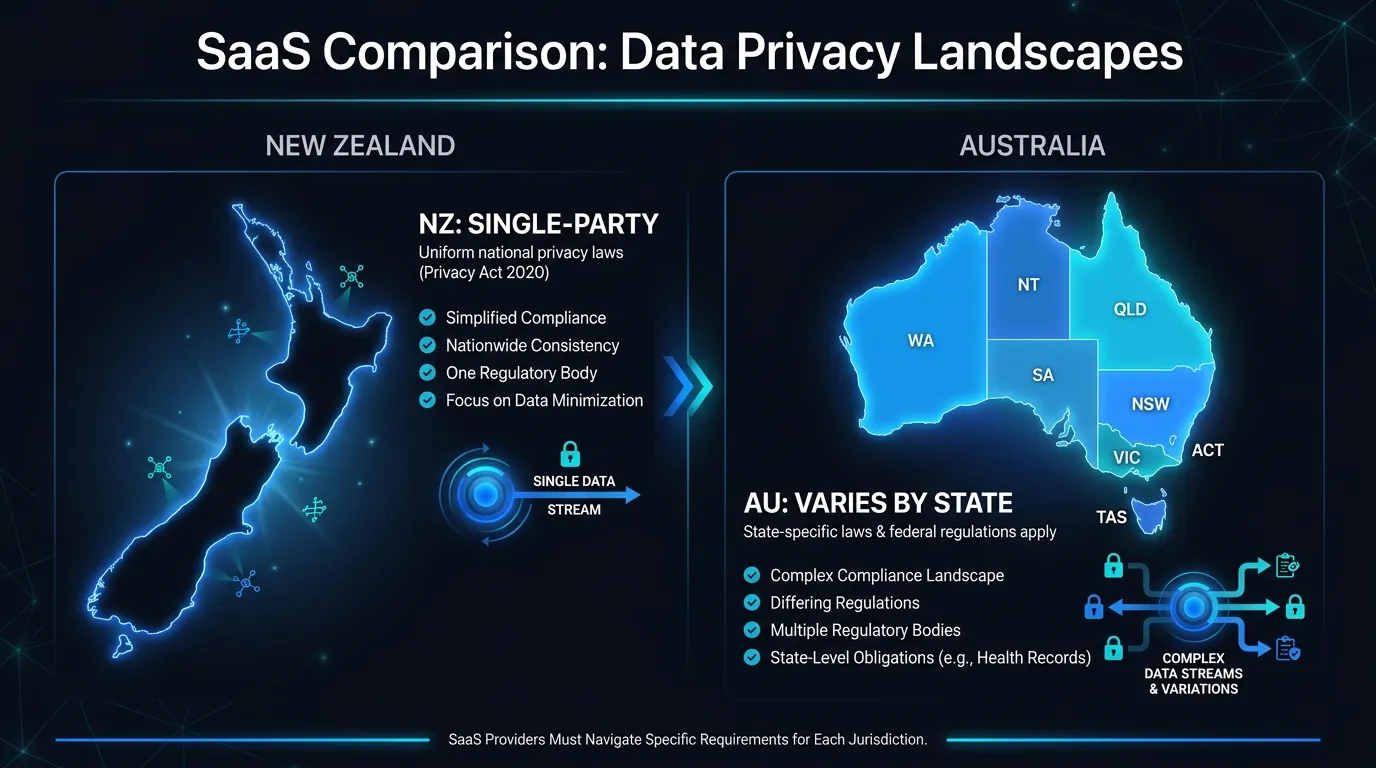
NZ runs effectively single-party consent. Australian recording law is set state by state.
Is it legal to record AI phone calls in New Zealand?
Yes. New Zealand is effectively a single-party consent country. If your agent is a party to the call, which it always is, you can lawfully record it. The Crimes Act covers private communication, and recording a call you are part of is fine.
The relevant law sits in the Crimes Act 1961, section 216B. It bans intercepting a private communication you are not part of. Your agent is a party to every call it takes, so this does not apply. You are recording your own conversation, not eavesdropping on someone else's.
That single-party position is why NZ is the simplest market we operate in. You still owe callers transparency under the Privacy Act 2020 rules for voice agents. You still need to tell them an AI is on the line. But you do not need a second yes before the recording starts.
Is it legal to record calls in Australia, and why does it vary by state?
It varies because recording law in Australia is state law, not federal. Each state and territory has its own Surveillance Devices Act, and the consent rules differ. Some states sit closer to single-party. Others require all parties to agree before you record a private conversation.
Queensland and Victoria are generally more permissive on recording a conversation you are part of. New South Wales, Western Australia, and others lean toward all-party consent for private conversations. The Northern Territory and the ACT have their own wording again. One agent serving a national client can touch all of them in a week.
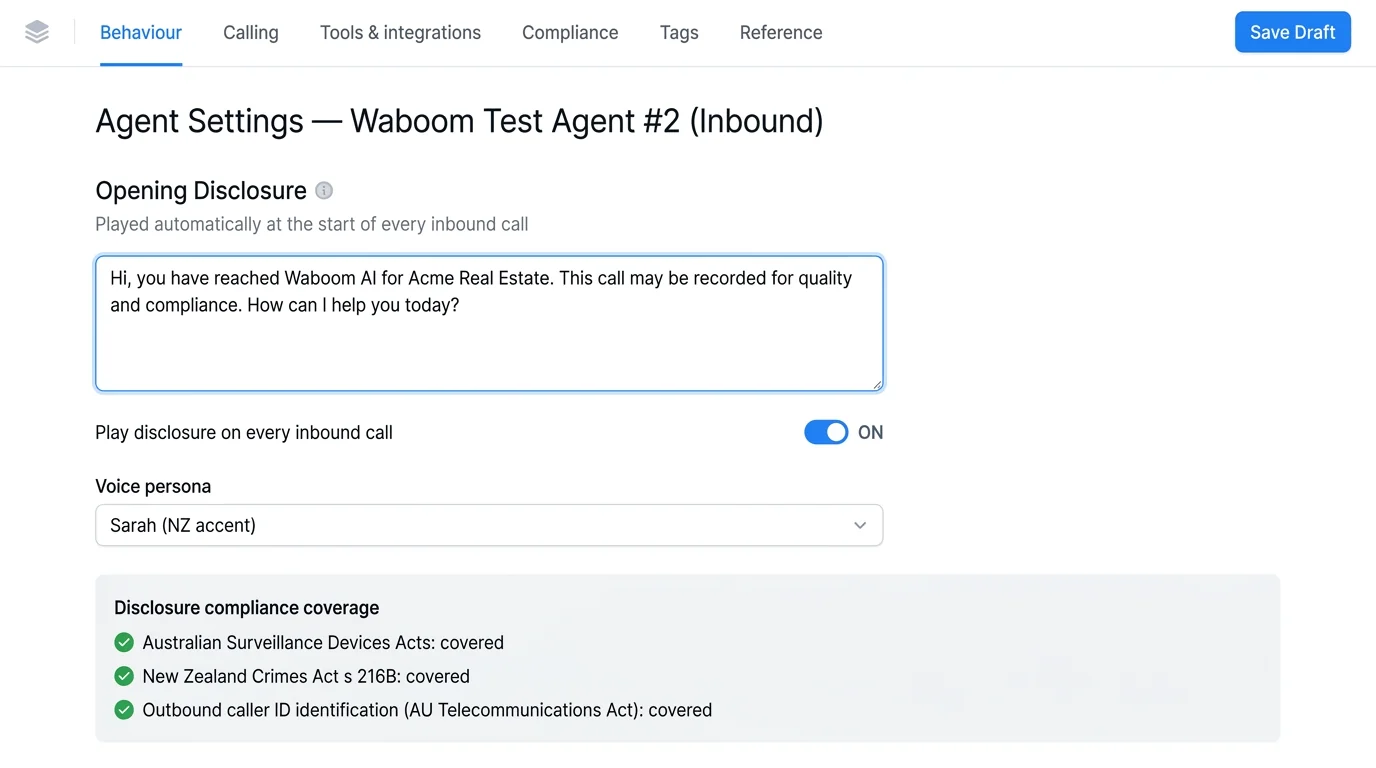
We do not try to memorise seven different rulebooks per call. We run one operating rule that satisfies the strictest state. The agent discloses recording up front on every single call. That clears the all-party bar everywhere, because once a caller is told and keeps talking, you have consent. Our full breakdown of recording consent by Australian state walks through each one.
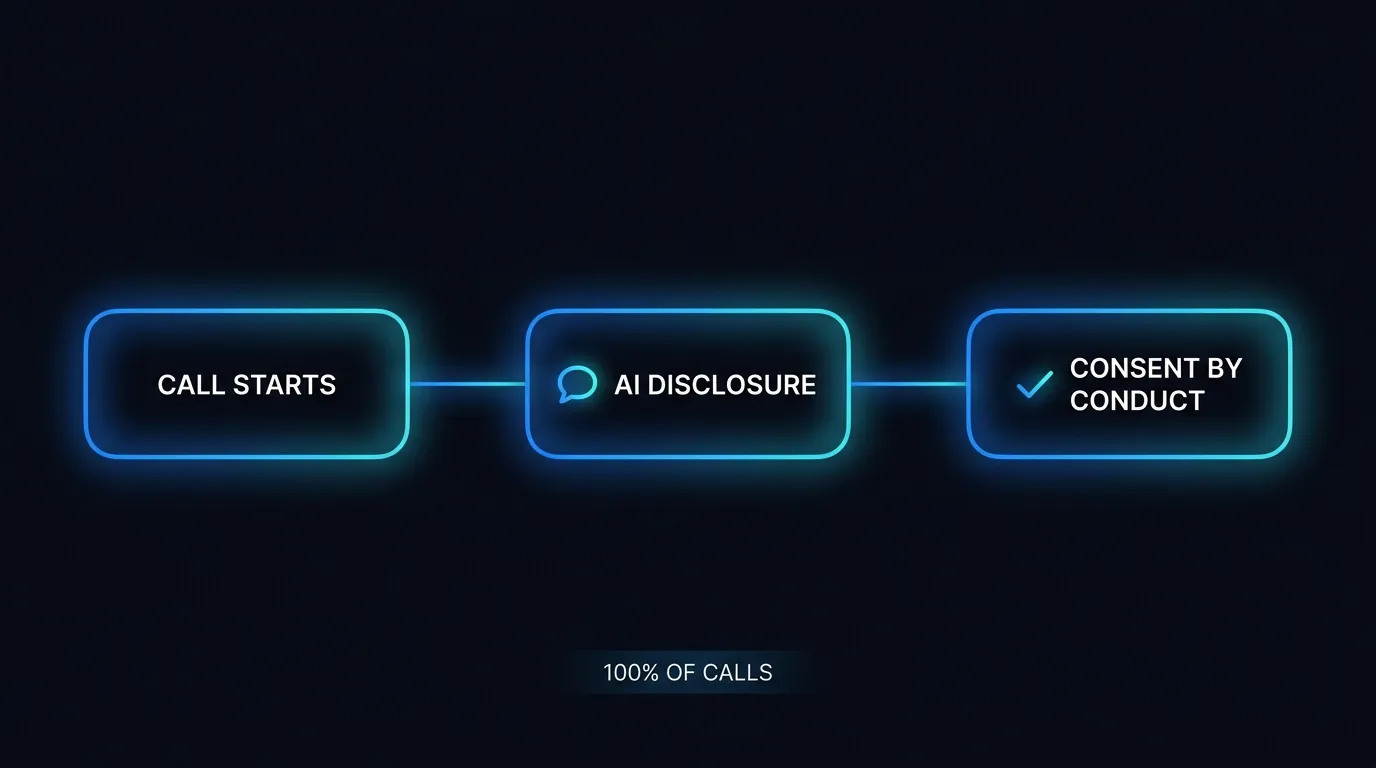
A scripted opening line fires on 100 percent of calls, clearing the strictest all-party state.
What is the difference between one-party and two-party consent?
One-party consent means one person on the call, usually you, needs to agree to the recording. Two-party, or all-party, means everyone does. NZ runs effectively one-party. Several Australian states run all-party for private conversations, which is why your disclosure line matters so much.
The practical gap is small once you disclose. If the agent says it is recording and the caller continues, you have everyone's agreement. That is consent by conduct, and it holds up under all-party rules. The trick is making the disclosure clear, early, and on every call without exception.
A quick warning. Do not import United States law here. American two-party-state statutes do not apply to a New Zealand or Australian business. We see operators panic over Californian recording law that has no bearing on a clinic in Hamilton or a builder in Geelong.
Worried about which state rule applies to you?
Our guide to call recording consent across NZ and Australia shows the one rule that clears every state at once.
How does recording disclosure work on an AI call?
The agent says it at the top of the call, before anything sensitive. It states that the caller is speaking with an AI assistant and that the call is recorded for quality and accuracy. That one sentence does two jobs at once. It meets the AI disclosure expectation and the recording consent bar together.
Because the agent reads from a script, the disclosure fires on 100 percent of calls. A human receptionist forgets on a busy Monday. The agent never does. Every call carries the same line, in the same place, with no exceptions and no bad days.
We bake this into the build, not the training. It is a fixed opening, not a suggestion the agent might skip when it is rushed. You can read more on why we put the AI line on every single call and never hide it.
Do you need consent to record for quality or training?
In most Australian states you need it, so we always get it. NZ is more relaxed, but we disclose anyway because it is good practice and it protects you later. The safe rule is simple. Disclose recording for quality or training on every call, in every market, and never assume the relaxed rule.
Quality and training are legitimate reasons to keep recordings, and callers accept them when you are upfront. The problem is never the reason. It is silence. A recording kept without disclosure is the one that turns into a complaint to the regulator months later.
Disclosing also makes your data cleaner. When callers know they are recorded, the conversation stays on the record properly, and your privacy compliance position across both countries is something you can actually defend.
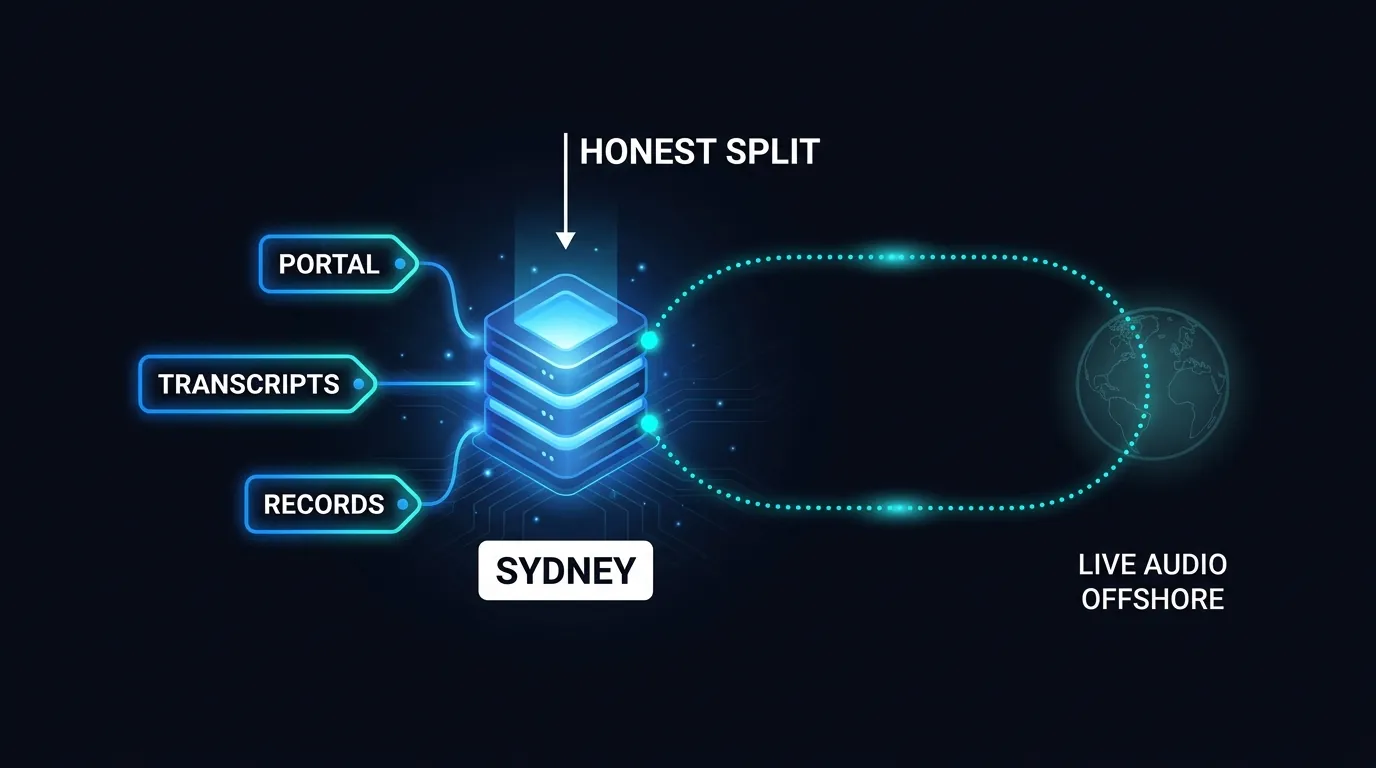
Portal, transcripts, and structured records sit in Sydney. Live audio is processed offshore during the call.
Where are the recordings stored, and who can access them?
Your portal, transcripts, and structured call records sit on our servers in Sydney. Live audio is processed offshore while the call is happening, then the records land back in Sydney. We are honest about that split. We do not claim every byte stays inside Australia, because the live audio leg does not.
Access is restricted to your team and the people you authorise. Recordings are not a public asset, and they are not shared around. For NZ businesses, this Sydney residency satisfies the Privacy Act 2020 expectations on cross-border handling when you disclose it to callers.
If you want the deeper technical picture, we cover how call data is stored and protected and our approach to retention and zero-retention options separately. The short version. You control how long recordings live, and you can shorten that window.
What should you tell callers before you record?
Tell them three things, in one short line, at the very start. One, they are speaking with an AI assistant. Two, the call is being recorded. Three, the reason, usually quality and accuracy. That single disclosure satisfies AI transparency and recording consent across NZ and every Australian state at once.
Keep it human and brief. A long legal paragraph makes people hang up. One clear sentence, delivered warmly, keeps the caller comfortable and keeps you compliant. Then the agent gets on with booking the job or answering the question.
That is the whole game. Disclose early, store records in Sydney, give people access controls, and you stay clean in both countries. The economics help too. The agent records and transcribes every call at about 80 cents a minute, billed by the second, with an average answered call near 30 seconds.
Get recording right in both countries.
See how we handle security and privacy for AI voice agents end to end, from disclosure to Sydney storage.
Frequently Asked Questions
Is one-party consent enough to record a call in New Zealand?
Yes. New Zealand is effectively single-party. Because your agent is a party to the call, you can lawfully record it under the Crimes Act 1961. You still need to handle the recording responsibly under the Privacy Act 2020 and disclose that an AI is on the line. But you do not need separate permission from the caller.
Do I need consent to record calls in every Australian state?
In several states, yes. Recording law in Australia is state by state, set by each Surveillance Devices Act. Some states allow recording a conversation you are part of. Others require all parties to agree. We solve it by disclosing recording at the start of every call, which satisfies the strictest all-party states. Check the rules with the OAIC.
Does HIPAA apply to recording calls in NZ or Australia?
No. HIPAA is United States law and does not apply to a New Zealand or Australian business. For health data, you follow the Health Information Privacy Code 2020 in NZ and the Australian Privacy Principles in Australia. Disclose recording, keep health records secure, and limit access to authorised staff.
How does the AI tell callers the call is recorded?
The agent reads a fixed opening line on every call. It states the caller is speaking with an AI assistant and that the call is recorded for quality and accuracy. Because it is scripted into the build, it fires on 100 percent of calls, unlike a human receptionist who forgets on a busy day.
Where do my call recordings actually live?
Your portal, transcripts, and structured call records sit on our Sydney servers. Live audio is processed offshore during the call, then the records land back in Sydney. We never claim every byte stays in Australia. You control retention windows and who on your team can access the recordings.
What happens if I record without disclosing?
You risk a complaint to the Office of the Privacy Commissioner in NZ or the OAIC in Australia, and in all-party states you may breach the Surveillance Devices Act. The fix is free and simple. Disclose recording on every call. One short line at the start clears the bar in both countries.
Leonardo Garcia-Curtis
Founder & CEO at Waboom AI. Building voice AI agents that convert.
Ready to Build Your AI Voice Agent?
Let's discuss how Waboom AI can help automate your customer conversations.
Book a Free Demo