A receptionist in Auckland answers a call at 7pm. The caller leaves a name, a number, and a reason. That conversation becomes data, and AI voice agent data residency is the question most buyers never think to ask. Where does that recording go? Where does the transcript sit? We get asked this every week, and the honest answer has two halves.
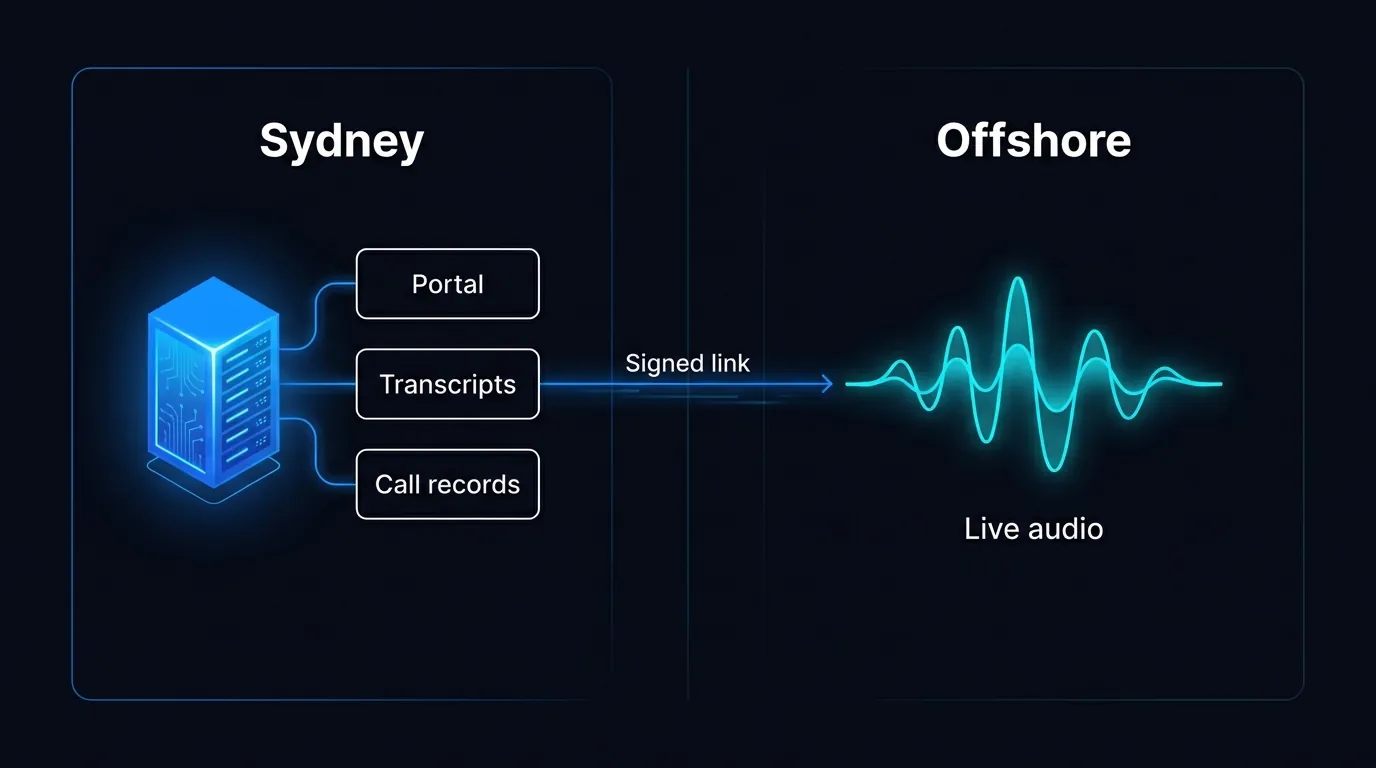
The honest answer is a split. Your portal, your transcripts, and your structured call records sit on our Sydney servers. The live audio is processed offshore while the call is happening. Anyone who tells you all of it stays in one country is either confused or selling you a sticker.
This article walks the real map. Where the data lives, what each half means for your customers, and what you can truthfully say when a caller asks where their voice went. If you want the full security picture, start with our AI voice agent security overview.
Where does your AI voice agent call data actually live?
Your AI voice agent data residency splits across two places. The portal, transcripts, and structured call records live on our Sydney servers. The live audio gets processed offshore in real time while the call runs. The recording file sits with our voice infrastructure partner, and the portal stores only a signed link to it.
Picture a single call. A plumber in Brisbane misses a ring at 6am. The agent answers, books the job, and hangs up after 90 seconds. That call costs about $1.20 at 80 cents a minute.
In that 90 seconds, the caller's voice travels to an offshore processor that turns speech into text and text back into speech. That is the live audio half. The moment the call ends, the structured result lands in Sydney. The booking, the transcript, the caller's number, the tags.
So two halves. Live audio processed offshore during the call. The durable record stored in Sydney after it. Both are real. Pretending otherwise is the first sign of a vendor who has not read their own architecture.
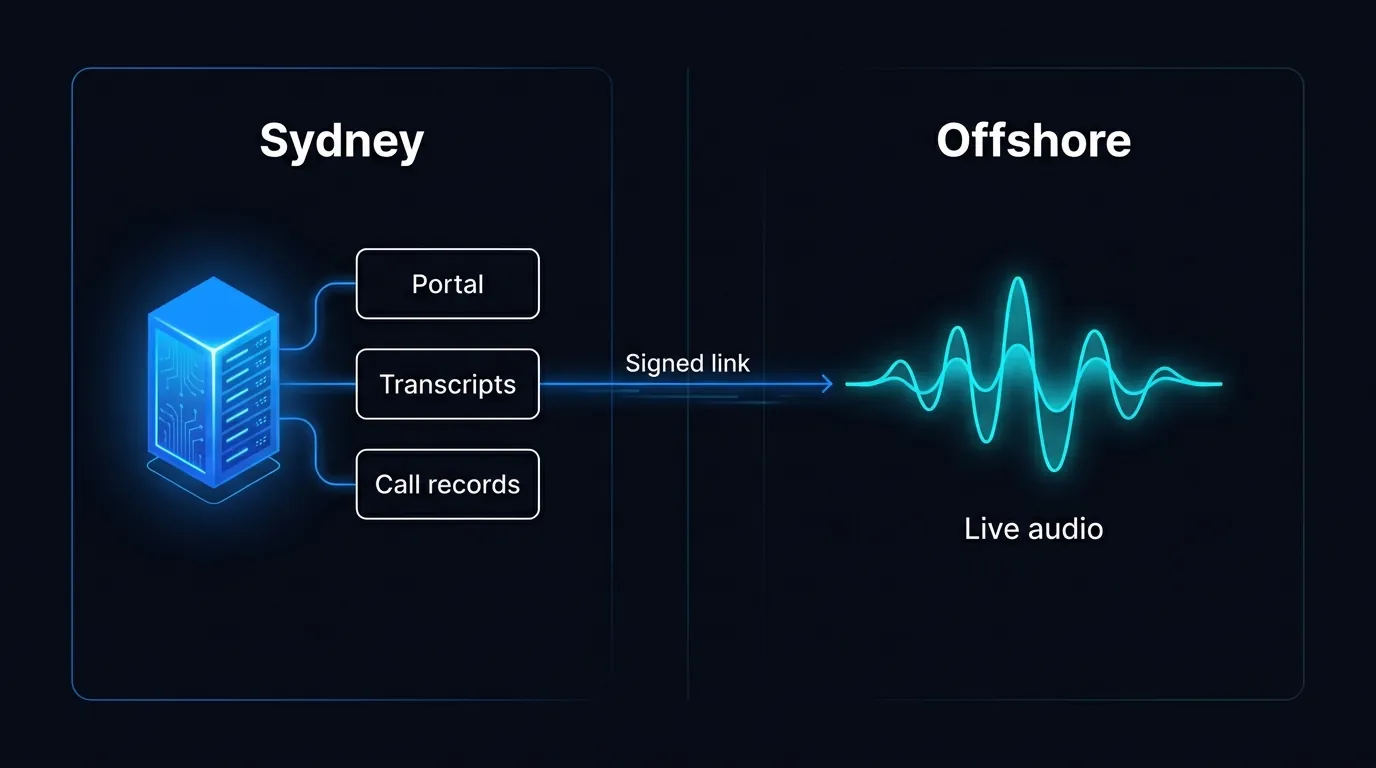
Two halves of one call: live audio processed offshore, durable records stored in Sydney.
What is the honest onshore and offshore split?
The split is simple once you see it. Onshore in Sydney sits everything durable: the portal you log into, every transcript, every structured call record, and the signed link to each recording. Offshore sits the live audio processing that happens only while a call is connected. We meet cross-border accountability requirements through documented arrangements with our voice infrastructure partner.
Think of it like a courier. The parcel moves through a sorting centre in another city for a few minutes. The delivery record, the address, the signature, all of that lives in your filing cabinet at home.
The live audio is the parcel in transit. Speech to text, text to speech, the model that decides what the agent says next. That work needs serious compute, and that compute runs offshore in real time.
The durable record is what stays. Transcripts, call outcomes, caller numbers, and booking data all rest on our Sydney servers under our control. That is the part you query, export, and report on.
This matters because the two halves carry different risk. Live audio exists for seconds and is not the thing a regulator asks about months later. The stored record is what gets requested, audited, and deleted. That part is onshore.
Why should you distrust an "all data stays in Australia" claim?
Distrust it because no voice AI runs end to end inside one country today. The heavy speech models that make an agent sound human run on offshore infrastructure. A vendor claiming all data stays in Australia is either hiding the live audio path or does not understand their own stack. Either way, you cannot verify a claim that is not true.
Here is the tell. Ask any provider one question. Where is the live audio processed during the call? If they say Australia and nothing else, push harder.
The real speech engines that produce natural voice and fast responses sit offshore. We lionise an 800 millisecond first response because that speed comes from serious offshore compute. You cannot get that from a small onshore box and pretend it all stayed home.
A claim you cannot check is worse than an honest split you can. When a buyer hears all data stays in Australia, they relax. Then a customer complaint forces a real answer, and the gap between the pitch and the architecture becomes the story.
We would rather lose a deal on honesty than win one on a sticker. The split we describe is the one we can stand behind in front of the Privacy Commissioner. Read more in our piece on zero-retention data handling for voice agents.
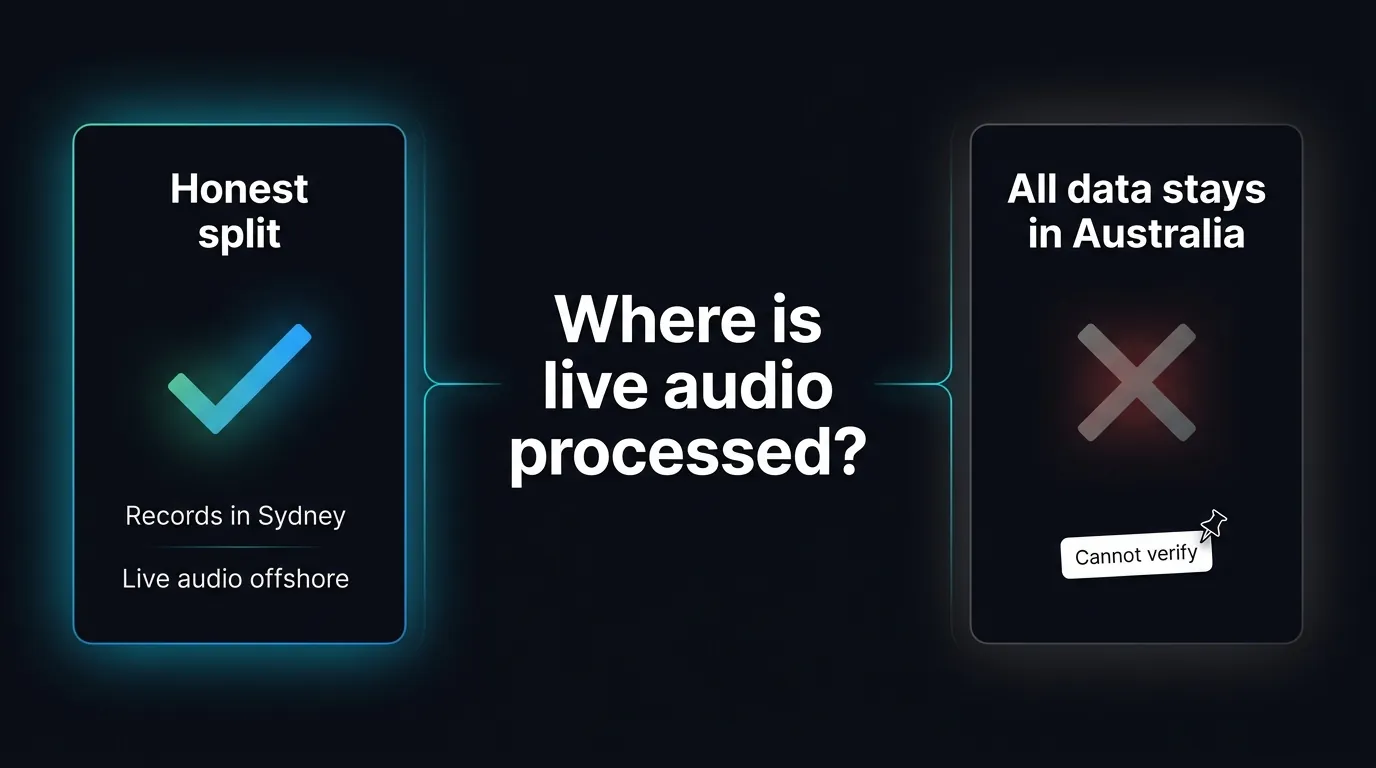
One question separates an honest provider from a sticker: where is the live audio processed?
What sits in Sydney, and what is processed offshore?
In Sydney sit the portal, all transcripts, structured call records, caller numbers, booking outcomes, and the signed link to each recording. Processed offshore is the live audio while a call is connected: speech to text, the response model, and text to speech. The recording file itself lives with our voice infrastructure partner, not in your portal.
Let me list it plainly so you can repeat it to a customer.
So when you open a call in the portal, you read a transcript stored in Sydney. If you click play, you follow a signed link to a recording held by our partner. Two different stores, one clean view.
This separation is deliberate. The data you report on stays under our Sydney control. The heavy audio work stays where the compute is. Neither half pretends to be the other.
Want the full residency map for your account?
We walk every buyer through exactly where their call data sits before they go live. See the detail on our voice agent security and data residency page.
Does this meet the Privacy Act 2020 and the Australian Privacy Principles?
Yes, when handled the way we handle it. The NZ Privacy Act 2020 and the 13 Australian Privacy Principles do not ban offshore processing. They require accountability for data sent across a border. We meet cross-border accountability requirements through documented arrangements with our voice infrastructure partner, and the durable record stays onshore in Sydney.
Both laws care about the same thing. You stay responsible for personal data even when a third party touches it. The Australian Privacy Principles spell this out for cross-border disclosure. The NZ Privacy Act 2020 does the same through its information privacy principles.
So the test is not did the audio leave the country. The test is can you account for it. We can. The offshore processing runs under documented arrangements, the audio is transient, and the lasting record sits in Sydney where you can produce it.
Disclosure is part of compliance too. We disclose on every single call that the caller is speaking with an AI. No pretending the agent is a person.
You can read the NZ rules direct from the source at the Office of the Privacy Commissioner, and the Australian principles at the OAIC. For a deeper walk through the NZ side, see our NZ Privacy Act 2020 compliance guide.
What do you say when someone asks where the data goes?
Tell them the truth, because the truth holds up. Say the durable record of their call, the transcript and the booking, is stored on Australian servers in Sydney. Say the live voice processing happens offshore for a few seconds while the call runs. Say they are speaking with an AI, disclosed on every call. That script never breaks under a follow-up question.
A customer rarely asks where my voice goes. When they do, you want an answer that survives the second question.
Here is a line you can use. "Your call is handled by an AI, your record is stored on our Australian servers, and the live voice processing runs offshore for the few seconds we are talking." Clean. True. Checkable.
Compare that to all your data stays in Australia. The moment a sharp customer asks how the AI voice works so fast, that claim cracks. The honest split does not. It is the same answer no matter who asks.
This is also why disclosure on every call matters. A caller who knows they are talking to an AI trusts you. So does one who gets a straight answer about their data. For the broader privacy picture across both countries, read our NZ and Australia voice AI privacy guide.
How is a recording stored and deleted?
A recording is held by our voice infrastructure partner, and your portal stores only a signed link to it, never the file. The transcript and structured record sit on our Sydney servers. When you ask us to delete a recording or a record, we action it in 10 minutes, and the signed link stops resolving.
Walk it through. The call ends. The transcript and outcome land in Sydney. The audio file rests with our partner, and your portal gets a signed link that points to it.
When you click play, the link opens the recording for you. When you delete, two things happen. The Sydney record goes, and the link to the recording stops working, so the audio is no longer reachable from your account.
Delete in 10 minutes is a real claim, not a marketing one. Ask for it and we do it. That speed matters under the Notifiable Data Breaches scheme, where a fast response is the difference between a contained event and a reportable one.
For the mechanics of what a call record actually contains, see our breakdown of what sits inside your call data.
Run the honesty test on any voice vendor.
Ask where the live audio is processed and how fast a record gets deleted. Our answers are on the Waboom AI security page, or see how the agents work on our AI voice agents overview.
Frequently Asked Questions
Does my call data stay in New Zealand or Australia?
Your durable records do. Transcripts, structured call records, caller numbers, and booking data sit on our Sydney servers. The live audio is processed offshore for the few seconds a call is connected, then the lasting record lands onshore. We do not claim all data stays in one country, because no voice AI works that way today.
Why is the live audio processed offshore?
Because the speech models that make an agent sound human and respond in about 800 milliseconds need serious compute that runs offshore. The audio is transient. It exists only while the call is live, then the structured record is stored in Sydney. We account for the cross-border step through documented arrangements with our voice infrastructure partner.
Is offshore processing allowed under the Privacy Act?
Yes. The NZ Privacy Act 2020 and the Australian Privacy Principles do not ban cross-border processing. They require you to stay accountable for the data. We meet that through documented arrangements with our voice partner. The durable record stays in Sydney. We disclose on every call that the caller is speaking with an AI.
How fast can you delete a call recording?
We action a delete in 10 minutes. The Sydney record is removed and the signed link to the recording stops resolving, so the audio is no longer reachable from your account. That speed supports a fast response under the Notifiable Data Breaches scheme, where containment time changes the outcome.
Where is the actual recording file stored?
The audio file is held by our voice infrastructure partner. Your portal never stores the file. It stores a signed link that points to the recording, so you can play it from your account without the audio living in the portal. Delete the record and that link stops working.
What should I ask a voice AI vendor about data residency?
Ask one question first. Where is the live audio processed during the call? If they say all data stays in Australia and nothing else, push harder. An honest provider will tell you the durable record is onshore and the live audio runs offshore under documented arrangements. A claim you cannot verify is worse than a split you can.
Leonardo Garcia-Curtis
Founder & CEO at Waboom AI. Building voice AI agents that convert.
Ready to Build Your AI Voice Agent?
Let's discuss how Waboom AI can help automate your customer conversations.
Book a Free Demo