
What does an AI voice agent do for a veterinary clinic?
An AI voice agent for vets answers every call, books and reschedules appointments, and routes anxious-owner and after-hours calls to the right place. It never gives clinical advice. It greets the caller, confirms it is an AI, takes the pet and owner details, and books straight into your calendar.
Think about a Tuesday at 9am. Three lines ringing. A walk-in at the counter. A nurse mid-consult.
The agent picks up line two and three while your team handles the room. No voicemail. No caller hanging up to try the clinic down the road.
Here is what it does on a normal day.
It does not diagnose. It does not dose. It does not tell an owner whether the chocolate the dog ate is dangerous. That call goes to a nurse or vet, which we cover below. The full vertical setup lives on our AI voice agent for veterinary clinics page.
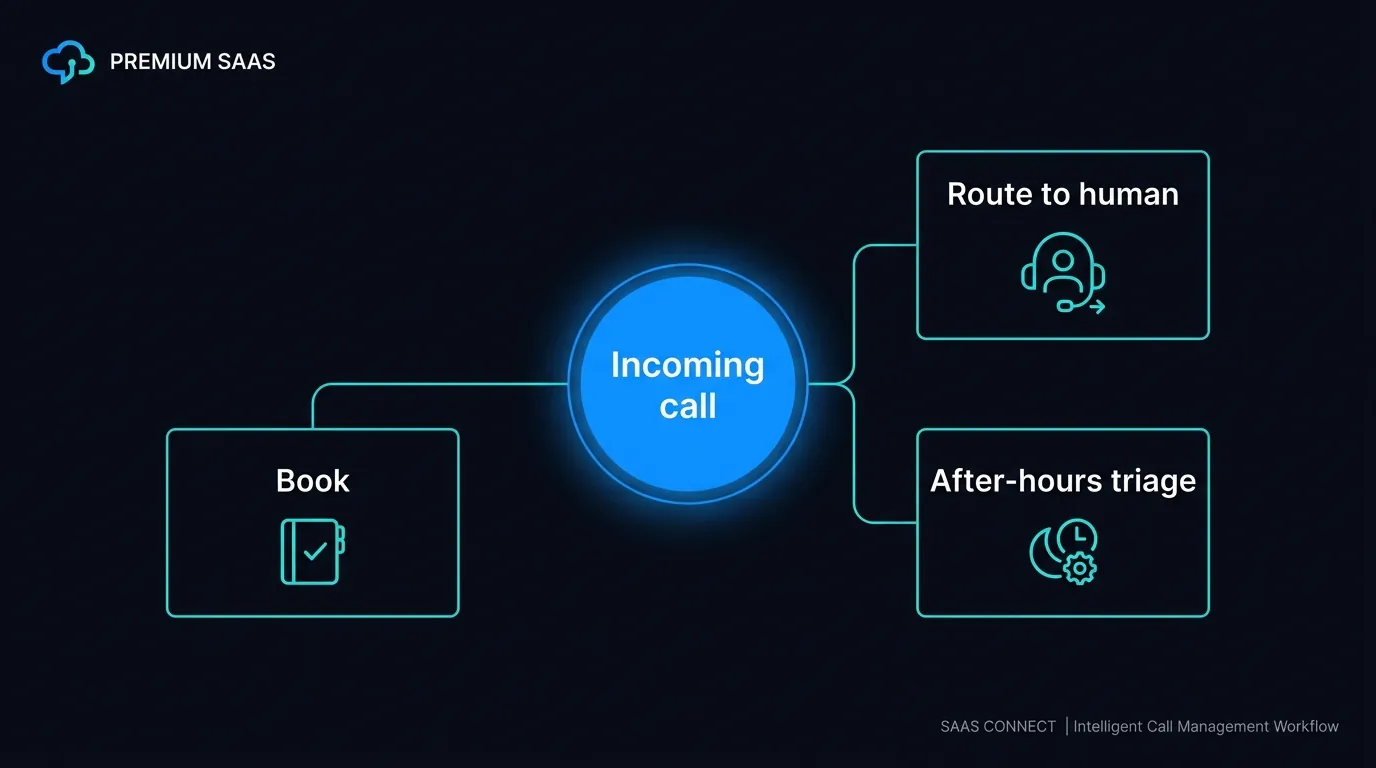
Every call lands in one of three lanes: book, route to a human, or triage after hours.
Why does an AI voice agent for vets beat a drowning front desk?
An AI voice agent for vets wins because call volume spikes in tight windows. One person cannot answer three lines while a dog is lifted onto the scale. Mornings and the hour before close are brutal. Every missed call is a booking that walks.
A busy small-animal clinic can take well over 100 calls a day. Most land between 8 and 10am and again from 4 to 5pm. Your receptionist is also checking in patients, taking payment and calming a cat in a carrier.
So calls go to voicemail. Owners do not leave voicemails for vets. They ring the next clinic.
The agent fixes the overflow, not the person. Your receptionist stays. The agent takes line two and three so nothing rings out. We wrote more on the overflow maths in our guide to AI receptionist appointment booking.
How does it book and reschedule appointments?
It books by reading your live calendar, offering real open slots, and writing the appointment back the moment the owner agrees. Reschedules and cancels work the same way. The owner gets a text confirmation in seconds, so no double-bookings and no guesswork.
A booking call sounds like this. The agent asks the pet name, the owner name, the reason for the visit, and the preferred day. It checks the calendar. It offers two real times.
It books the one the owner picks. It reads the time back. It sends the text.
For a standard consult that is a 60 to 90 second call. At about 80 cents a minute billed by the second, that is roughly 80c to $1.20. A part-time receptionist costs $28 to $35 an hour before KiwiSaver, ACC and holiday pay.
The agent handles the routine bookings. Your team handles the complex ones and the room.
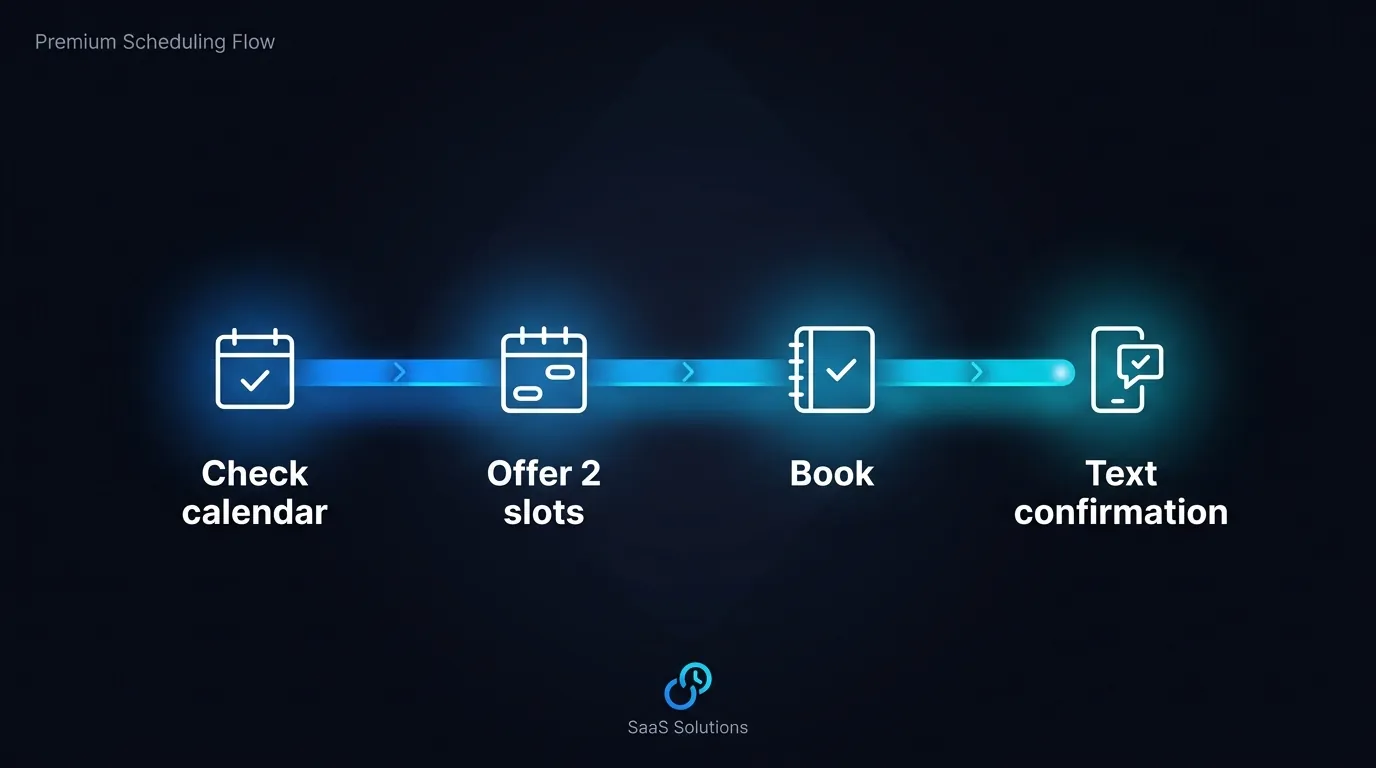
A standard booking runs 60 to 90 seconds and ends with a text the owner can keep.
Stop losing the 9am rush to voicemail.
See how a clinic agent books, reschedules and triages on our AI voice agent for vets page.
How does it triage an after-hours pet emergency?
It triages by urgency, not by diagnosis. It asks a few plain questions, then routes. A possible emergency goes straight to your on-call vet or your nominated emergency clinic. A non-urgent question gets a callback booked for the morning. It never tells an owner what is wrong with the animal.
After hours is where owners panic. A dog that ate something. A cat that has not eaten in two days. A rabbit breathing oddly.
The agent confirms it is an AI and takes the owner and pet details. Then it asks the urgency questions you script. Bleeding, collapse, difficulty breathing, suspected poisoning. Any of those and it routes to the on-call number or the emergency centre you nominate.
It does not say the words it is fine or it is serious. That is a clinical judgement and it belongs to a vet. Our piece on why voice AI agents still need humans walks through where we draw that line.
For everything non-urgent, it books the first morning slot and texts the details. See our after-hours receptionist guide for how the routing is set up.
How does it keep owner and payment data private?
It keeps data private with an honest residency split and a short retention rule. Your portal, transcripts and call records sit on servers in Sydney. The live audio is processed offshore while the call happens. We do not claim all your data stays in Australia, because it does not.
Owner records and pet histories are personal information. In New Zealand that sits under the Privacy Act 2020 and the Office of the Privacy Commissioner. In Australia it sits under the Privacy Act 1988, the 13 Australian Privacy Principles, and the OAIC.
The agent does not need card numbers to book a consult. When payment matters, we route to your existing payment process rather than reading card details aloud.
Our default deletes the audio quickly and keeps the structured booking, not the raw recording. The agent also tells callers it is an AI on every call. For the full rundown read our note on the NZ Privacy Act and AI voice agents.
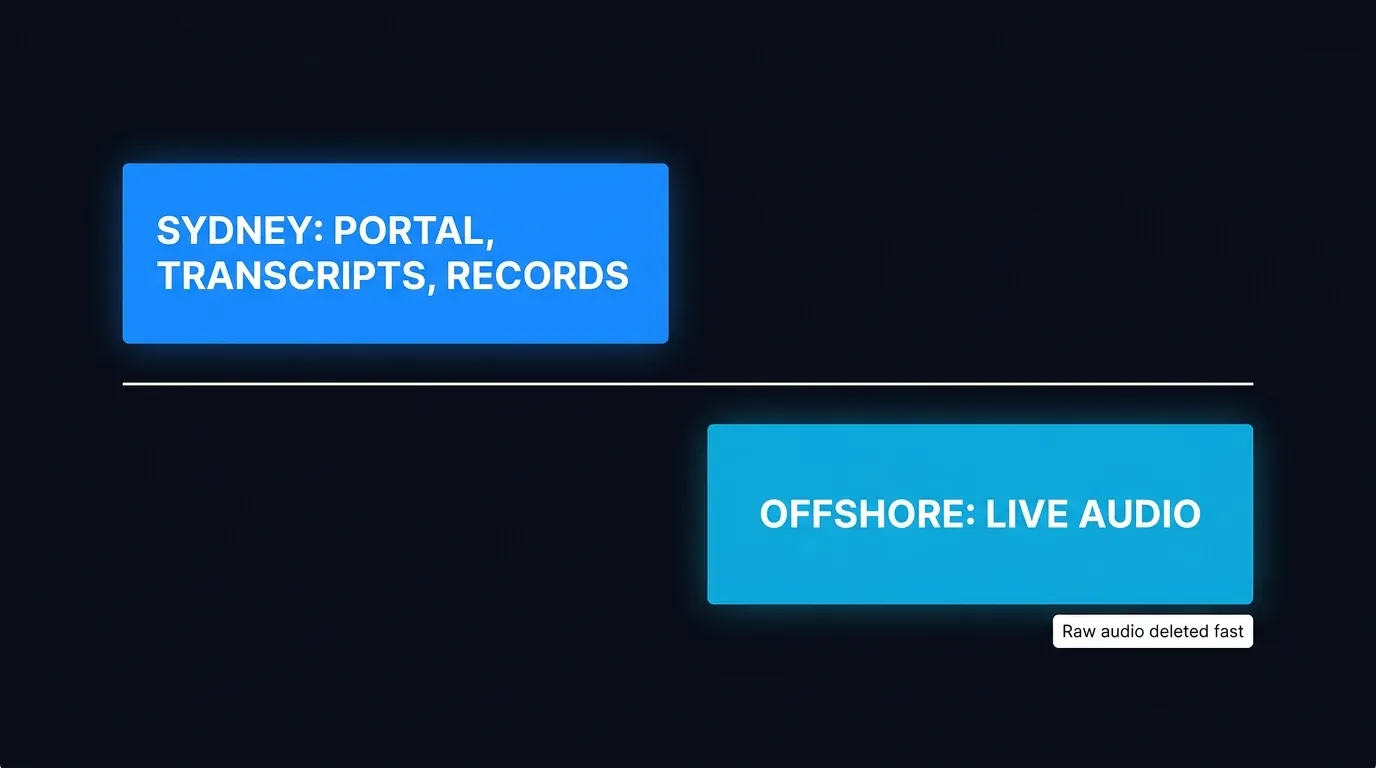
Portal and records in Sydney, live audio offshore, raw recordings deleted fast.
When should a call reach a vet or nurse?
A call should reach a human the moment it stops being routine. Any clinical question, any suspected emergency, any distressed owner, any complaint. The agent is built to hand off fast, not to hold the line. Routing rules are yours to set.
We set the handoff triggers with you during onboarding. Typical triggers look like this.
When a trigger fires, the agent routes to your nurse line, your on-call vet, or your emergency partner. It passes the pet name and the reason so the human starts informed. This is the same pattern we use for an AI receptionist in a medical clinic.
What does it cost a NZ or AU clinic?
It costs about 80 cents a minute, billed by the second, in NZD or AUD. A typical booking call runs 60 to 90 seconds, so roughly 80c to $1.20. A short answered call averaging 30 seconds is about 40c. There is no salary, no roster gap and no sick days.
Compare that to a part-time front-desk hire at $28 to $35 an hour before KiwiSaver or super, ACC, and holiday pay. The agent does not replace your receptionist. It absorbs the overflow and the after-hours window that you cannot staff economically.
Most clinics start with overflow and after-hours, measure the booked appointments, then widen the agent's hours. For a full cost breakdown see our guide on how much an AI receptionist costs.
You can also forward only your unanswered calls to the agent. Our guide on forwarding calls to an AI receptionist shows the exact setup. If you want the broader inbound picture first, read how an AI agent handles inbound calls.
Work out the numbers for your clinic.
Start with overflow and after-hours on our AI voice agent for vets page, then widen the hours once it pays.
Frequently Asked Questions
Does the AI voice agent give clinical advice to pet owners?
No. The agent never diagnoses, doses or judges severity. It takes details and routes clinical questions to a nurse or vet. It handles bookings, reschedules and after-hours triage by urgency only. Any medical judgement stays with your qualified team, every time.
Will pet owners know they are talking to an AI?
Yes. The agent confirms it is an AI in the opening line of every call. This is part of how we keep you compliant under the NZ Privacy Act 2020 and the Australian Privacy Principles. Owners still get a fast, accurate booking without waiting on hold.
Where is my clinic and owner data stored?
Your portal, transcripts and call records sit on servers in Sydney. The live audio is processed offshore during the call. Our default deletes the raw audio quickly and keeps only the structured booking. We never claim all data stays in Australia, because the live audio does not.
Can it book straight into my existing calendar?
Yes. The agent reads your live calendar, offers only real open slots, and writes the appointment back instantly. Reschedules and cancels work the same way. The owner gets a text confirmation in seconds, so you avoid double-bookings and the morning phone crush at reception.
How much does it cost for a small-animal clinic?
About 80 cents a minute billed by the second, in NZD or AUD. A booking call runs 60 to 90 seconds, so near 80c to $1.20. There is no salary, ACC, KiwiSaver or holiday pay. Most clinics start with overflow and after-hours only.
What happens with a real after-hours emergency?
The agent asks your scripted urgency questions, then routes a suspected emergency straight to your on-call vet or nominated emergency clinic. It passes the pet name and reason so the human starts informed. It never tells the owner what is wrong. Non-urgent calls get a morning callback booked.
See this service for the full detail.
Leonardo Garcia-Curtis
Founder & CEO at Waboom AI. Building voice AI agents that convert.
Ready to Build Your AI Voice Agent?
Let's discuss how Waboom AI can help automate your customer conversations.
Book a Free Demo

