
Most owners ask us one thing first. What will this actually cost me each month? Fair question. A voice agent that answers your phones is a usage tool, not a fixed seat. So the bill moves with your call volume. This guide shows you how to forecast your AI voice agent monthly cost in NZD or AUD before you sign anything. No invoice surprises. No vague quote you can't check.
We run the numbers the same way for every client. Talk minutes times a per-minute rate, plus a few one-off setup costs. Once you know your real call volume, the maths is boring and predictable. That is the point.
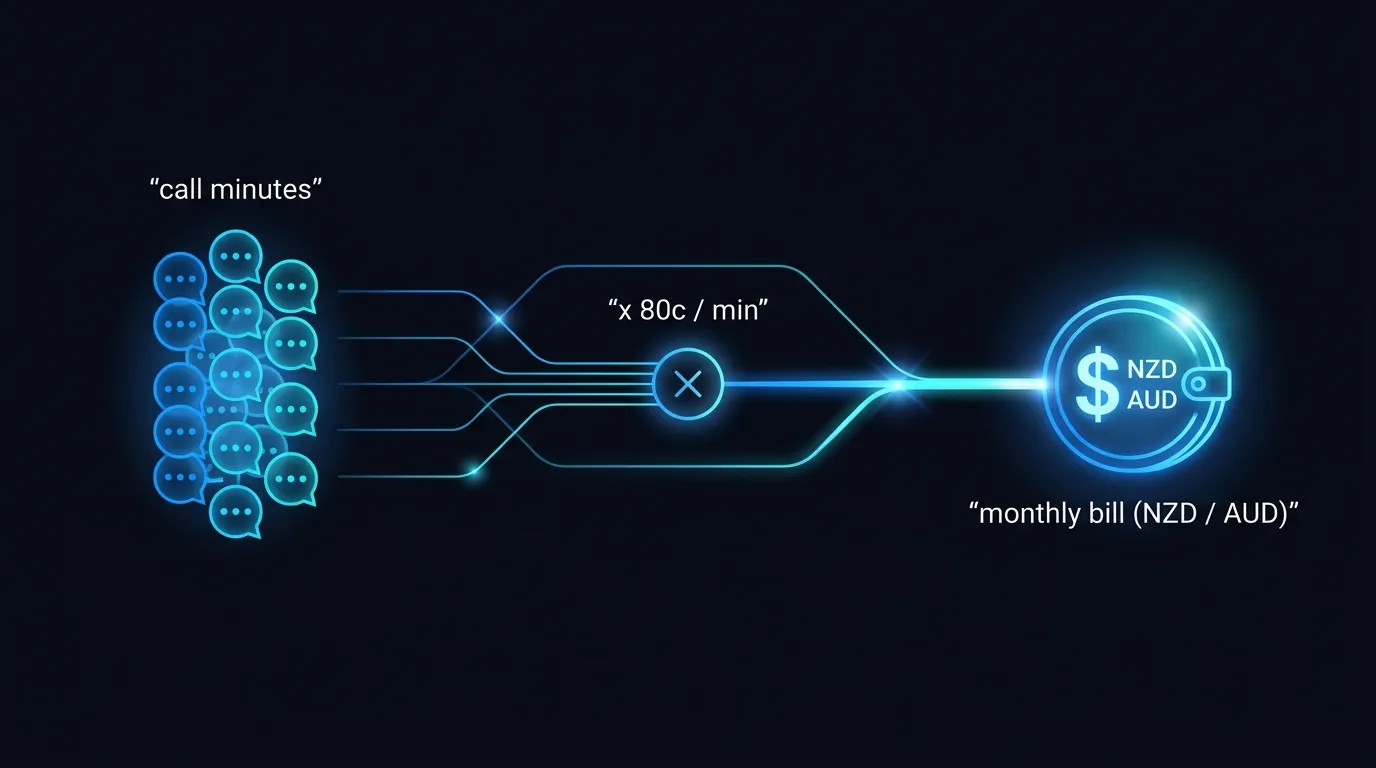
Your monthly bill is just minutes times a rate, so you can forecast it before you sign.
How do you forecast a monthly AI voice agent bill?
You forecast it from minutes, not seats. Count your monthly inbound calls and outbound dials, multiply by a realistic call length, then multiply total minutes by about 80 cents a minute. Add any flat platform fee. That total is your AI voice agent monthly cost, and it tracks your volume up or down.
The reason this works is simple. Our platform bills by the second, not in fixed blocks. A short call costs less than a long one. So your bill is just the sum of every conversation the agent had.
Think of it like power. You pay for what you use, metered. A quiet month costs less. A busy month costs more. There is no penalty for either.
We give you the rate and the inputs. You plug in your own numbers. That keeps the forecast honest, because nobody knows your phones better than you do. For the full rate card, see our AI voice agent pricing page.
What inputs do you need to estimate it?
You need four inputs. Monthly inbound call count, monthly outbound dial count, average call length in minutes, and the per-minute rate of about 80 cents. With those four numbers you can build the whole forecast on the back of a napkin.
Start with inbound. Look at your phone bill or your call log. How many calls hit your main line in a normal month? Fifty? Three hundred? Use last month as your baseline.
Then outbound, if you do any. Lead follow-up, callbacks, reminders. Count the dials you plan to make, not the conversations you hope to land.
For call length, be realistic. An answered inbound enquiry runs about a minute or two. A quick outbound check-in can be 30 seconds. Pick a sensible average per call type. Our breakdown of what sits inside the cost per minute shows where the rate comes from.
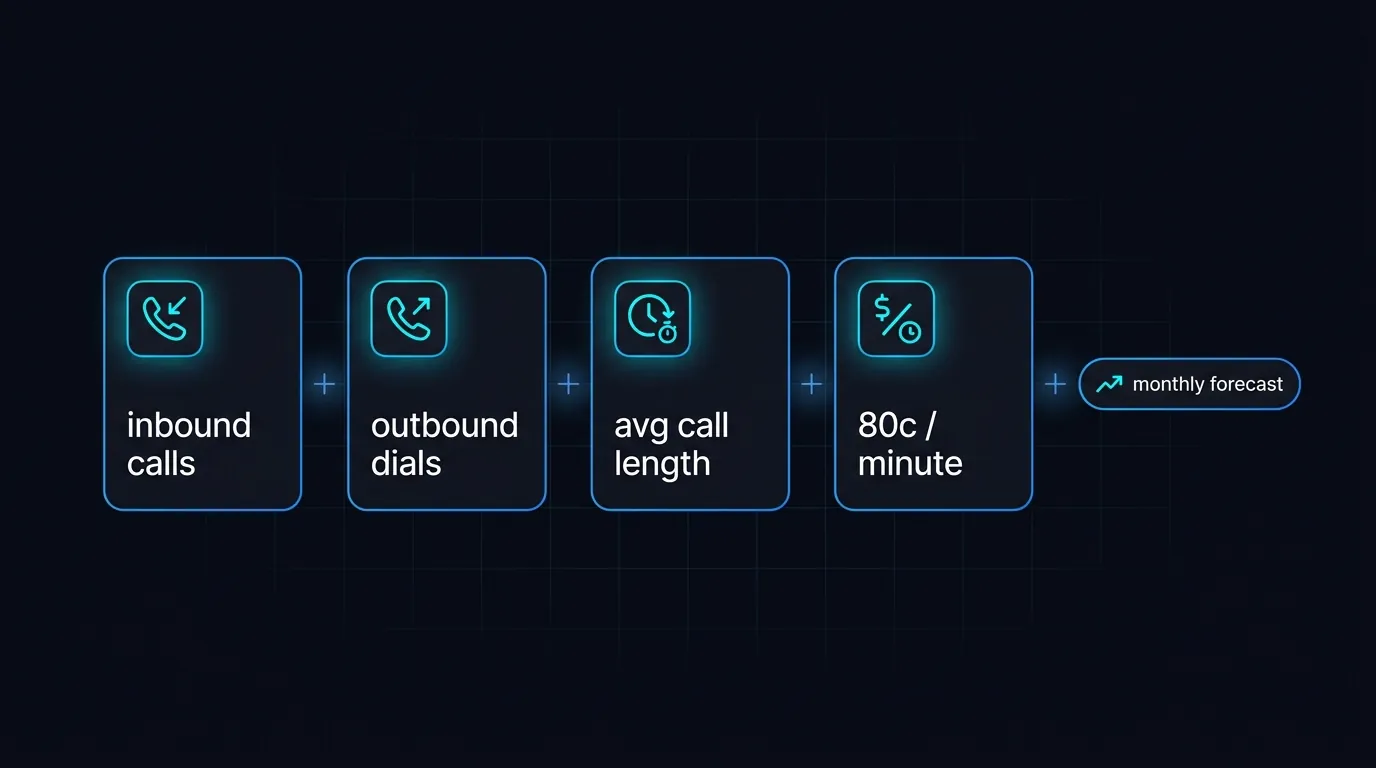
Four inputs are all you need: inbound calls, outbound dials, average length, and the per-minute rate.
How does about 80 cents a minute become a monthly number?
You convert calls into minutes, then minutes into dollars. Multiply your call count by your average call length to get total minutes. Multiply total minutes by 80 cents. That single figure is your usage cost for the month, before any flat fee.
Here is a worked example. Say you get 200 inbound calls a month at 1.5 minutes each. That is 300 minutes. At 80 cents a minute, that is about 240 dollars in talk time.
Now add outbound. Say 200 dials a month. Connect rates run 47 to 65 percent, and about 20 to 25 percent of dials become a real one-minute-plus chat. A 200-dial campaign lands around 100 dollars NZD in our experience.
So your usage is roughly 240 plus 100, about 340 dollars. Add your platform fee on top. That is your forecast. We walk through the dial maths in detail in our 200-dial campaign cost guide.
Want the number for your phones, not a generic example?
Send us your monthly call volume and we will build the forecast with you. Start on our AI voice agent pricing page.
What does a typical small-business month cost?
A small business with steady phones usually lands a few hundred dollars a month in usage. Take a clinic or trades firm with 150 to 250 inbound calls a month. At a minute or two each, that sits around 180 to 400 dollars in talk time. Add a flat fee and you have a tidy, predictable number.
The average answered call across our clients runs about 30 seconds, which is roughly 40 cents. So even a busy month rarely shocks anyone.
Compare that to a part-time receptionist at 28 to 35 dollars an hour before KiwiSaver or super, ACC and holiday pay. Twenty hours a week is well over 2,000 dollars a month, and they sleep.
The agent answers every call, day and night, for the price of the minutes it talks. That is the swap most owners are weighing up. Our full AI receptionist cost breakdown runs the comparison in depth.
How do inbound and outbound differ on cost?
Inbound is demand-led and cheap per call. Outbound is volume-led and you control the spend. Inbound only costs you when someone rings, so the bill follows real enquiries. Outbound costs you per dial attempt, so you set the budget by deciding how many dials to make.
Inbound is the easy one to forecast. Look at last month's call count, apply your average length, done. It scales with your business, not your ambition.
Outbound is a lever you pull. Want more leads? Make more dials. A Sydney agent we ran produced 141 vendor leads in 90 days at 32.74 dollars per seller. A Christchurch developer booked viewings at 7.12 dollars each.
Both are priced the same way, by the minute. The difference is who starts the call and how much control you have over the count. See how this scales to 10,000 calls in Australia for the big-volume picture.
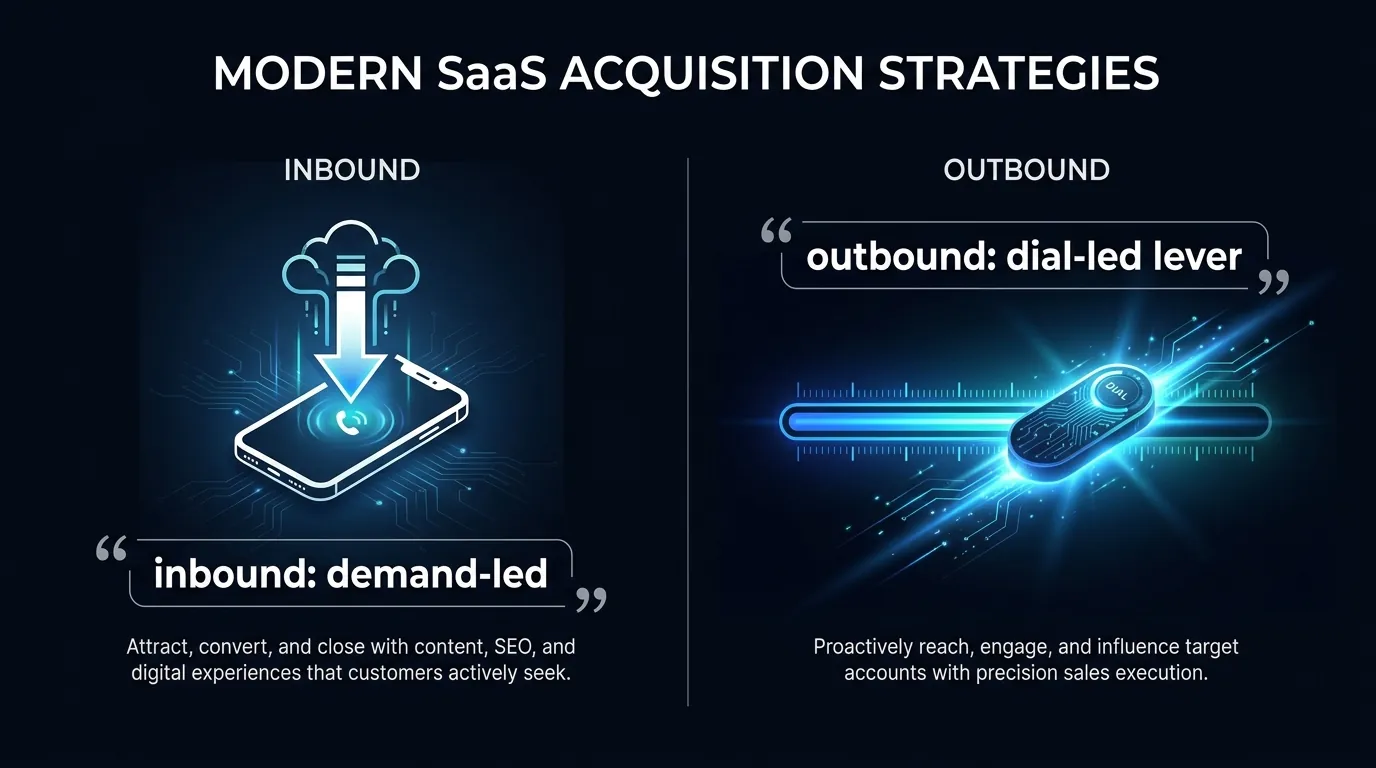
Inbound follows real demand; outbound is a budget lever you control by dial count.
What pushes the bill up?
Three things push it up. More call volume, longer average calls, and heavy outbound campaigns. None of them are hidden. Each one shows up directly in your minute count, so you can see it coming and decide if the extra spend is worth it.
Long calls are the quiet one. If your agent handles complex bookings or detailed FAQs, calls stretch out. A two-minute average instead of one doubles your inbound talk cost.
Big outbound pushes are the loud one. A 1,000-dial month costs about five times a 200-dial month. That is fine if the leads pay for themselves, which they usually do.
Seasonality matters too. A plumber in winter or a retailer in December will see busier months. Forecast for your peak, not your average, so the invoice never surprises you.
How do you sanity-check a vendor quote?
Ask for the per-minute rate and whether billing is by the second. Then ask what is flat and what is usage. If a quote hides the rate, bundles everything into one number, or quotes a suspiciously low cents-per-minute with fees buried elsewhere, push back. A clear quote always shows minutes times rate plus a named flat fee.
Watch for rounding. Per-minute billing in 60-second blocks can quietly double the cost of short calls. We bill by the second so a 30-second call costs for 30 seconds.
Watch for setup and number fees too. They should be one-off and stated up front, not drip-fed.
If a number looks too cheap to be real, it usually is. The honest forecast is the one you can rebuild yourself from your own call log. Compare quotes against our open 2026 NZ and AU pricing, or see the whole platform on our AI voice agents overview.
No surprises on the invoice.
We quote minutes times a clear rate plus a named flat fee, nothing buried. See it all on our AI voice agent pricing page.
Frequently Asked Questions
Is the AI voice agent monthly cost fixed or does it change?
It changes with your call volume, because billing is usage-based at about 80 cents a minute by the second. A quiet month costs less, a busy month costs more. You can forecast it tightly from your inbound and outbound counts, and there is no fixed seat fee inflating a slow month.
Where does my data live and is it compliant?
Your portal, transcripts and structured call records sit on our Sydney servers. Live audio is processed offshore under documented arrangements with our voice infrastructure partner. We meet the NZ Privacy Act 2020, overseen by the OPC. We also meet the AU Privacy Act 1988 and its 13 Australian Privacy Principles, overseen by the OAIC. Breaches are handled under the Notifiable Data Breaches scheme.
Does the agent tell callers it is an AI?
Yes. The agent discloses that it is an AI assistant on every call. That keeps you on the right side of the NZ Privacy Act 2020 and the Australian Privacy Principles. Callers also respond better when they know what they are talking to. Transparency is built in, not bolted on.
How fast can I delete a customer's data?
We can delete a customer's records within 10 minutes of a verified request. Transcripts and structured records on our Sydney servers are removed. The request is logged. That helps you meet your obligations under both the NZ Privacy Act 2020 and the Australian Privacy Principles without a drawn-out support ticket.
What is the cheapest way to keep my bill low?
Keep calls focused and only run outbound campaigns that pay for themselves. Tight call flows mean shorter calls and lower minute counts. On outbound, a 200-dial campaign costs about 100 dollars NZD. It should return leads worth more than the spend, or you trim the list. Usage billing rewards efficiency directly.
Can I cap my monthly spend?
Yes. Because outbound is dial-led, you control it by setting how many dials run each month. Inbound follows real demand, so it is naturally bounded by your actual call volume. Between the two you can forecast a ceiling and stick to it, with no surprise overage on the invoice.
Leonardo Garcia-Curtis
Founder & CEO at Waboom AI. Building voice AI agents that convert.
Ready to Build Your AI Voice Agent?
Let's discuss how Waboom AI can help automate your customer conversations.
Book a Free Demo

