
You hand a writer a blank page and hope the agent sounds like your front desk. It rarely does on the first try. A good AI phone script is short, local, and honest, and it does one job per call. Here is how we build one that sounds like a real person in New Zealand or Australia.
What makes a good AI phone script?
A good AI phone script gives the agent a clear persona, a local accent, and a single job per call. It opens by disclosing the caller is speaking with an AI. It answers the top five questions a customer actually asks. Everything else is guardrails. You write less than you think.
Most scripts fail because they read like a brochure. The owner hands the writer a blank page. The agent ends up sounding like a press release at 8am. We start the other way. We pull your last 50 calls and write down what people really say. Then the script becomes a set of answers, not a speech.
The job per call matters more than the words. One agent books viewings. Another qualifies a lead. A third takes a message after hours. Mix three jobs into one script and the agent wanders. A focused script is the difference between a Christchurch developer booking viewings at $7.12 each and a flat conversation that goes nowhere.
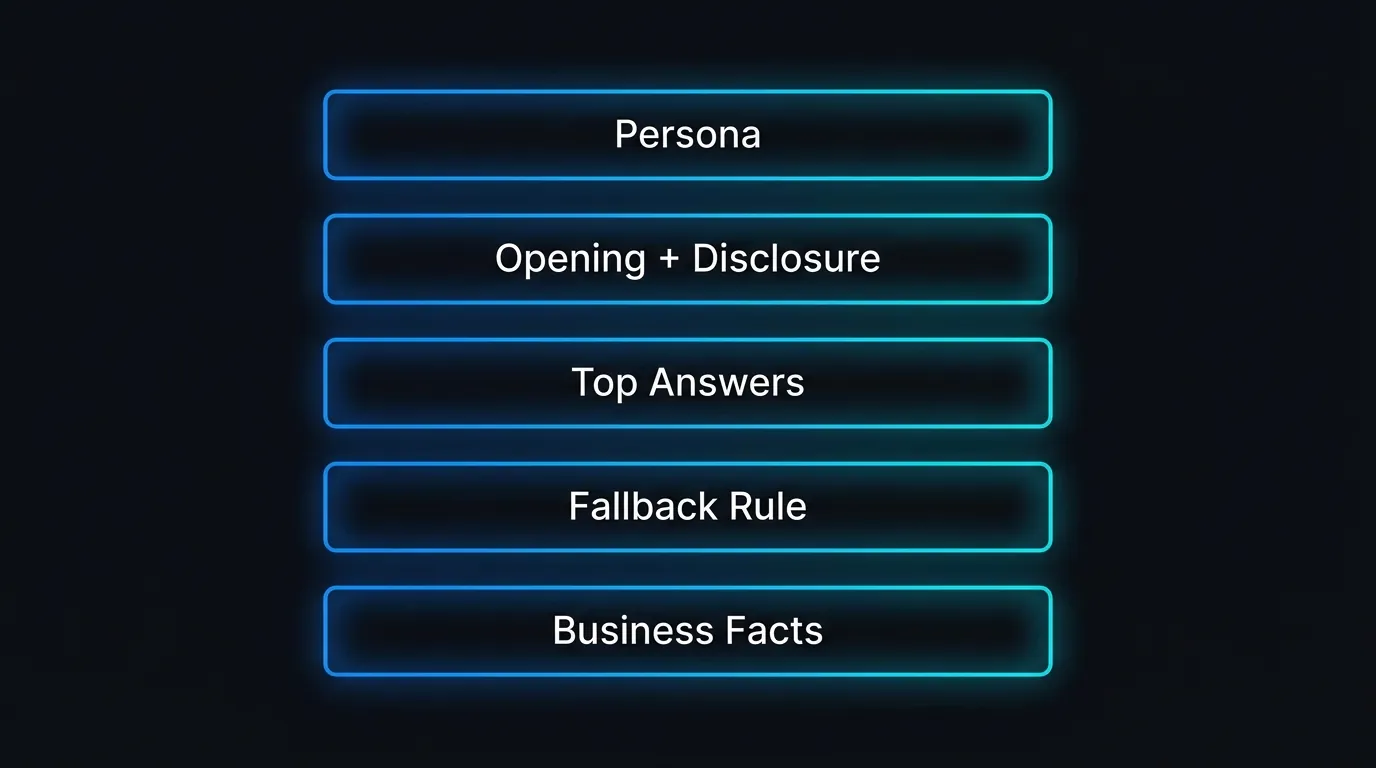
A good script is five parts: persona, opening with disclosure, top answers, fallback rule, and your business facts.
See how this fits a full agent on our AI voice agents overview.
How do you set the persona and tone?
Pick one named persona with a job title, a tone, and three things it will never do. Write it in five lines, not five pages. The agent should sound like one real person on your front desk, not a committee. We test the persona by reading it aloud and asking if it sounds like someone we would hire.
Tone is set by example, not adjectives. Saying "be friendly and professional" tells the agent nothing. We give it three sample replies in your house style. Warm, short, on brand. The agent copies the pattern. That single move fixes most of the robotic feel people complain about.
Keep the persona consistent across every channel. The voice on the phone, the tone in a text follow-up, and the booking confirmation should match. A split personality reads as a scam. One agent, one voice, every touch. That consistency is what makes 141 leads in 90 days feel like one trusted contact, not a call centre.
For the deeper build, read our guide on a localised persona with a NZ accent and how to make an AI voice agent sound human.
Why does a local NZ or AU accent matter?
A local accent matters because trust is decided in the first three seconds. A Kiwi or Australian caller relaxes when the voice sounds like home. A foreign accent reading a NZ address makes people hang up. We pick a local voice and load a pronunciation dictionary for place names, suburbs, and your brand.
Pronunciation is where most scripts quietly break. Otorohanga, Paraparaumu, and Woolloomooloo are not phonetic to a generic voice. We phrase-map every name you use so the agent never butchers a suburb. One mangled place name and the caller stops believing the agent knows the area.
Accent is not just the voice file. It is the words. Kiwis say "keen", "sweet as", and "book you in". Australians say "no worries" and "give us a bell". We write to the local ear, not American defaults. Small choices, big difference in how human it lands.
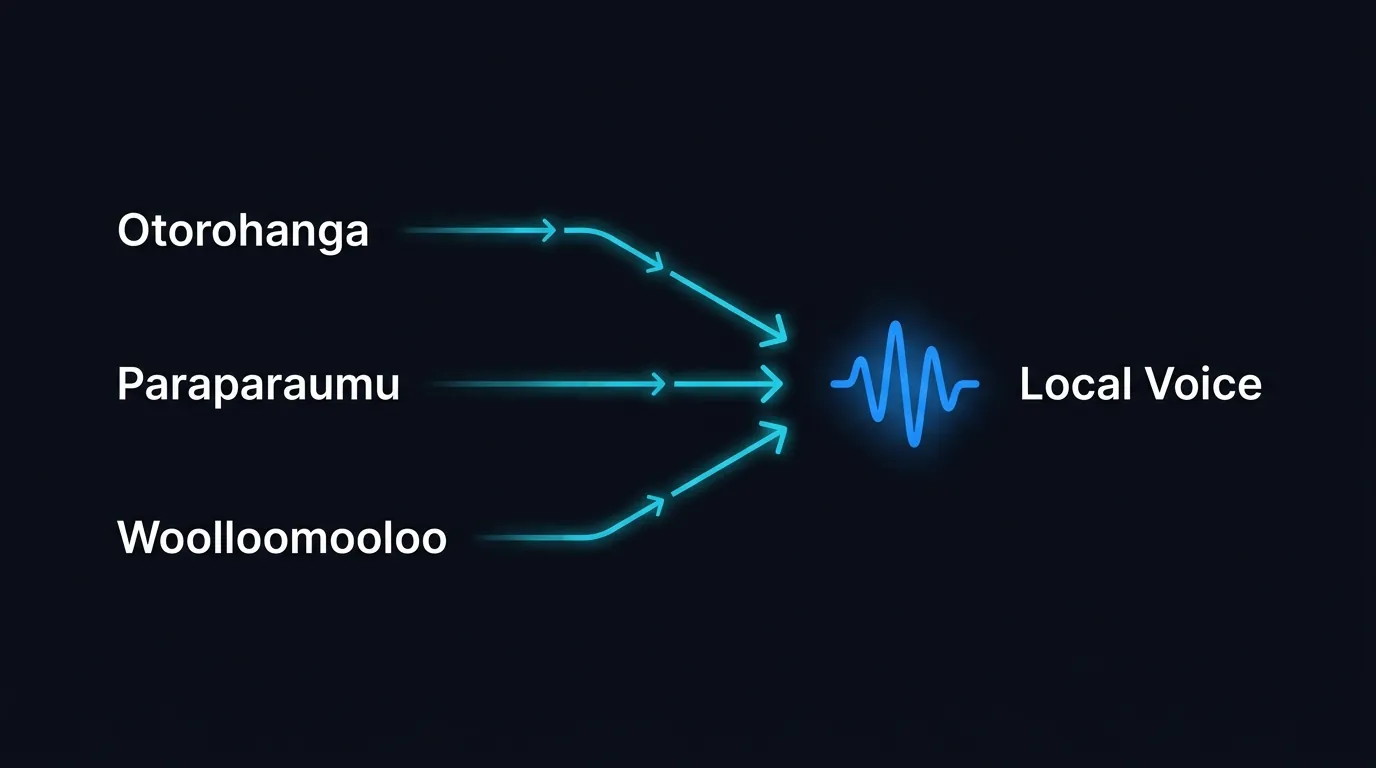
A pronunciation dictionary maps tricky suburb and brand names so the agent never butchers a local place name.
We go deeper on this in our pronunciation dictionary guide.
How should the script open the call and disclose the AI?
Open with a short greeting, the business name, and a plain disclosure that the caller is speaking with an AI. We do this on every call, not just the first. It takes four seconds and it is the law-friendly, trust-building move. Hiding it backfires the moment a customer suspects.
The opening line does three jobs. It names you, it sets the persona, and it discloses. "Hi, you have reached Bright Plumbing, you are speaking with our AI assistant, how can I help?" That is it. No long script, no fake small talk. Customers want their answer, not theatre.
Disclosure protects you under the NZ Privacy Act 2020 and the Australian Privacy Principles. It also lifts trust. People forgive an AI that owns up. They do not forgive one that pretends. We treat the disclosure as a feature, not a disclaimer buried in the fine print.
Want this built, not just written?
We script, voice, and test the whole thing for you. See how it runs on our AI voice agents page.
More on getting the opening right in our AI disclosure on every call guide.
How do you handle the questions you cannot predict?
You cannot script every question, so you script the boundaries instead. The agent answers what it knows from your business facts, and for anything outside that it offers to take a message or book a callback. It never guesses a price or a policy. Guessing is how an agent invents a refund you never offered.
We give the agent a tight set of facts and a hard rule: no facts means no answer. When a caller asks something off the map, the agent says it will have a human follow up, then captures the detail. This single rule stops the hallucinations that make AI agents dangerous.
The fallback should still feel warm. "I want to get that exactly right, so I will have Sarah call you back within the hour." The caller gets a clear next step. You get a clean lead instead of a wrong answer. The unknown question becomes a booked callback, not a complaint.
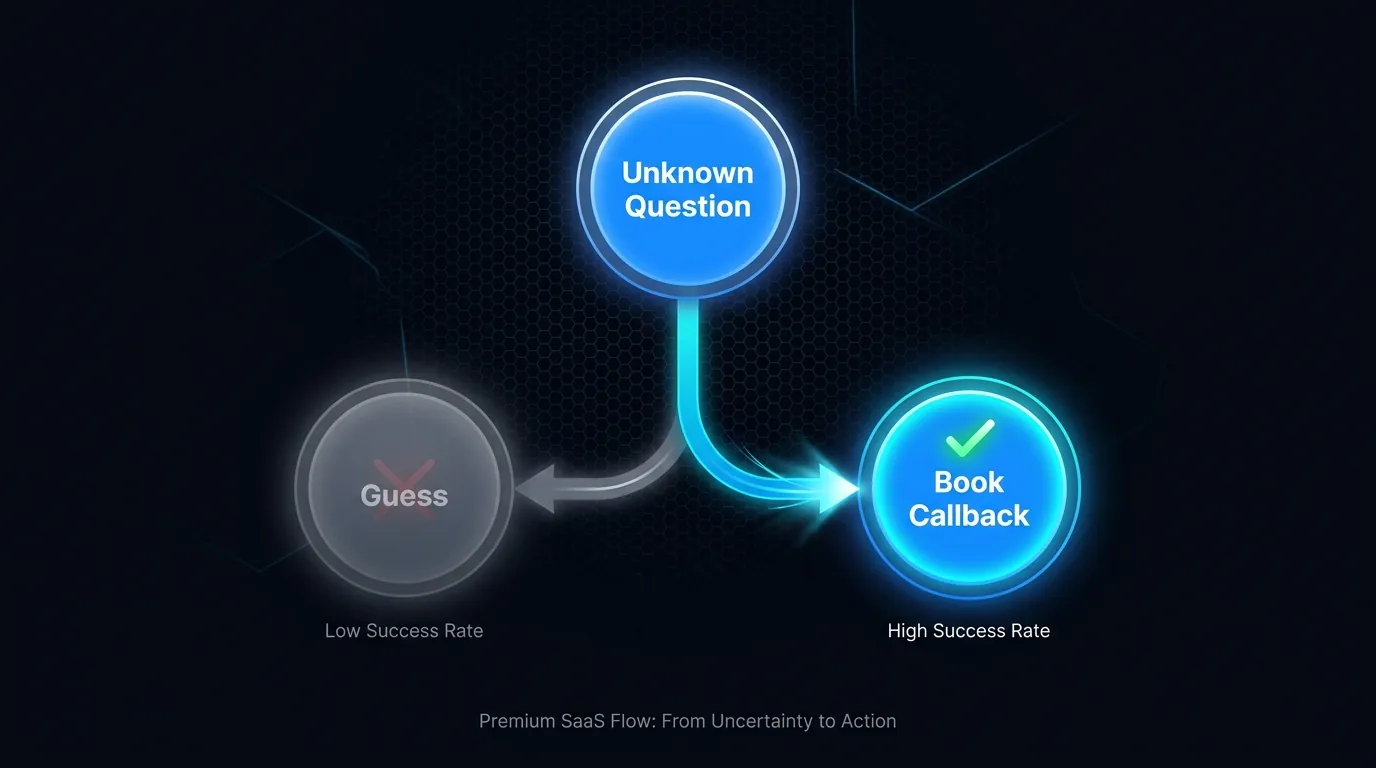
When a question falls outside the facts, the agent books a human callback instead of guessing.
This is the heart of the safety story in our guide to stopping AI voice agent hallucination.
How do you keep it short and natural?
Keep it short by writing the way people talk, not the way people write. The average answered call runs about 30 seconds, so every line earns its place. We cut filler, ban jargon, and read the whole script aloud. If a sentence trips the tongue, it goes.
Natural means contractions, short sentences, and one idea per line. "We are open till five" beats stiff corporate phrasing. We also add small human touches. A "no worries", a brief pause, a confirmation read-back. The agent sounds like a person having a chat, not a menu.
Length is a cost lever too. At about 80 cents a minute billed by the second, a tight one-minute call costs roughly $1. A rambling script doubles your minutes for no extra bookings. Short is cheaper, and short converts. We trim until the call does its one job and ends.
How do you test and improve the script?
You test by listening to real calls, not by guessing. We run a small batch first. Around 200 dials on outbound, or the first week of inbound. Then we read every transcript and mark where callers got confused, where the agent stalled, and where it nailed it. Then we rewrite those exact lines.
Testing is cheap. A 200-dial outbound batch costs about $100, and connect rates run 47 to 65 percent. That gives you dozens of real conversations to learn from in a day. We change one thing at a time so we know what moved the result. Guesswork gets replaced with evidence.
Improvement never really stops. We review transcripts weekly for the first month, then monthly. A Sydney sales agent reached 141 vendor leads at $32.74 each only after three script passes. The first draft is never the best draft. The calls tell you what to fix.
Your script should sound like your front desk.
We write it, voice it local, and tune it from real transcripts. Start on our AI voice agents page.
Frequently Asked Questions
Do I need a different script for inbound and outbound calls?
Yes. Inbound callers already want something, so the script answers fast and books. Outbound callers did not ask you to ring, so the script earns the first ten seconds with a clear reason and a quick disclosure. Same persona, different opening and pacing. We write them as two scripts that share one voice.
How long should an AI phone script be?
Shorter than you expect. The core is a persona, an opening with disclosure, your top five answers, and a fallback rule. That fits on two pages. Most of the length lives in your business facts, not the dialogue. The average answered call runs about 30 seconds, so the spoken part stays tight.
Will the AI sound like a robot?
Not if the script is written for the ear. We use contractions, short lines, a local accent, and sample replies in your house style. We read every line aloud and cut anything that trips. The goal is one real-sounding person on your front desk, and most callers cannot tell.
Is it legal to use an AI to answer calls in NZ and Australia?
Yes, with disclosure. We tell every caller they are speaking with an AI, which keeps you onside with the NZ Privacy Act 2020 and the Australian Privacy Principles. We also handle data carefully: transcripts and structured call data sit on our Sydney servers. Disclosure plus clean data handling keeps you compliant and trusted.
How much does it cost to test a script properly?
Less than a coffee round for the team. Calls run about 80 cents a minute billed by the second, so a tight call costs around $1. A 200-dial outbound test costs roughly $100 and gives you dozens of real conversations to learn from. You improve fast without burning budget.
How many revisions does a script usually need?
Three to four before it hums. The first draft is a guess. The second fixes the obvious stumbles. The next two sharpen the lines that lose callers. A Sydney sales agent hit 141 leads at $32.74 each only after several passes. Plan for iteration, not perfection on day one.
See our approach to voice AI security and compliance.
Leonardo Garcia-Curtis
Founder & CEO at Waboom AI. Building voice AI agents that convert.
Ready to Build Your AI Voice Agent?
Let's discuss how Waboom AI can help automate your customer conversations.
Book a Free Demo

