
You have four ways to get an AI phone number for your voice agent. Buy a fresh +64 or +61 number, port your existing one across, forward your current line, or bring your own VoIP or SIP trunk. Most NZ and AU businesses start by forwarding. It takes minutes and risks nothing.
This is the practical setup guide. If you want the bigger picture first, our overview of how AI voice agents answer your phone covers what the agent actually does once a call lands.
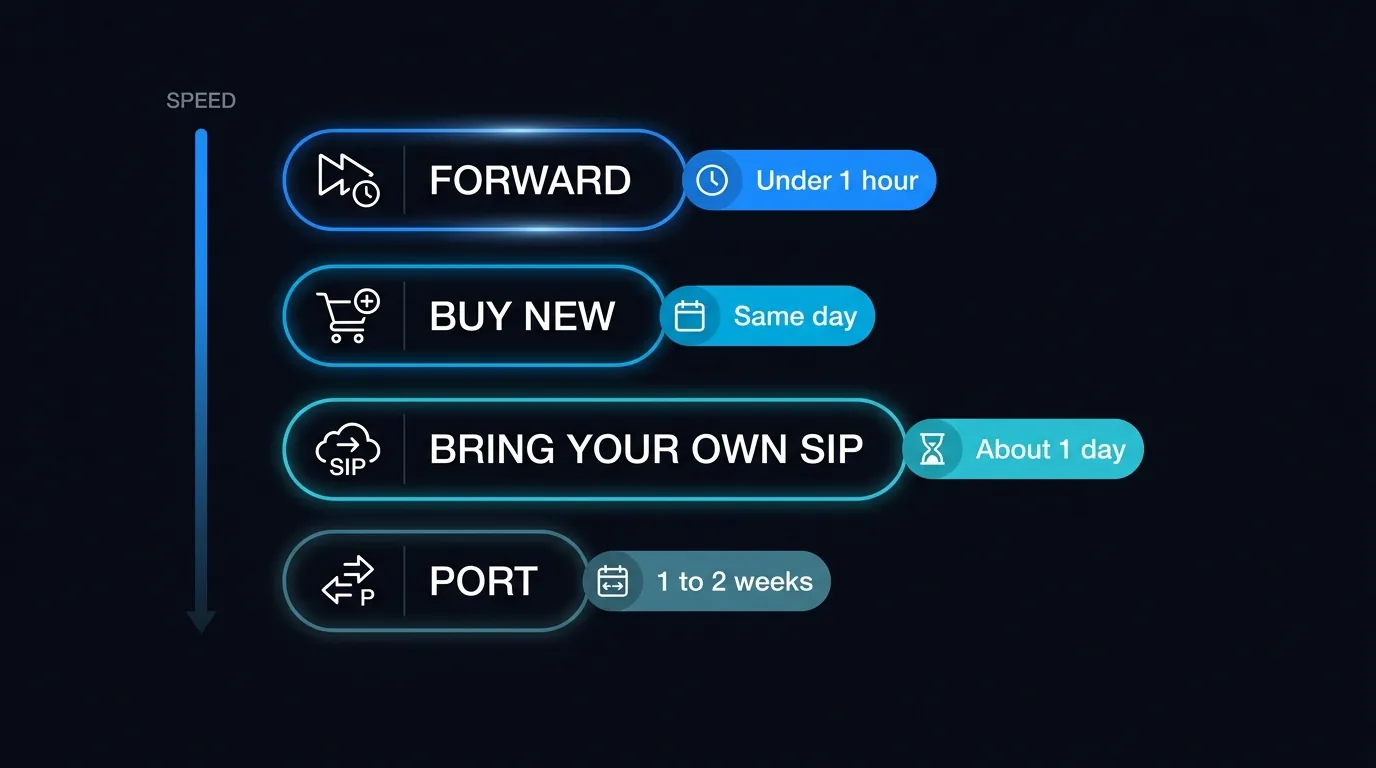
The four ways to put an AI agent on a phone number, ordered from fastest to set up.
What are your options for an AI voice agent phone number?
You have four routes to an AI phone number. Buy a brand new local number, port your existing number to us, forward your current line to a new number, or connect your own VoIP or SIP trunk. The fast one is forwarding, because it leaves your real number untouched.
A buy is the cleanest. We provision a fresh +64 or +61 number and point it at the agent. You are answering calls the same afternoon. Good for a new location, a campaign line, or a second number you want to test before you commit anything important.
A port moves your existing number onto our platform so the agent answers it directly. No forwarding hop, no second number. The trade is time, because a port runs through your current carrier and that can take a week or two.
Forwarding is the middle ground. You keep your number where it is and send unanswered calls to a new agent number. Bring your own VoIP or SIP is for businesses that already run a phone system and want to keep it.
Should you buy, port, or forward a number?
Forward first, port later. Forwarding lets you trial the agent on your real number this week with zero downtime and no carrier paperwork. Once you trust the pickup, port the number so the agent owns it outright. Buying a fresh number suits a brand new line or a campaign you want to measure on its own.
Here is the rule we give every client. If the number is new or disposable, buy it. If the number is precious and printed on ten years of vans, do not touch it yet. Forward it.
Forwarding carries one cost worth knowing. Some carriers add a small per minute forwarding fee on top of the roughly 80 cents a minute the agent costs. On a 30 second answered call that is around 40 cents of agent time, so the forwarding margin is tiny. Still, check your plan. Our breakdown of what an AI receptionist actually costs lays the talk time out in full.
Porting is the end state for most. Once the number lives with us, every call hits the agent directly with no carrier in the middle. That removes the forwarding fee and shaves the milliseconds a forward adds before the agent can even start talking.
How does forwarding your existing line work?
Forwarding sends calls your line cannot answer to a new agent number. You dial a short code on your phone, or flip a setting in your carrier portal, and unanswered calls roll to the agent. Your printed number never changes. Setup is usually under ten minutes.
Most businesses use conditional forwarding. Calls ring your desk first. Only the ones you miss after five or six rings divert to the agent. The receptionist still grabs what she can. The agent mops up the overflow at 6pm on a Friday when nobody is left to pick up.
You can also forward everything. A solo sparky on the tools all day sends every call straight to the agent. A ringing phone in a roof cavity is a lost job anyway. We walk you through the exact codes for your carrier.
The deeper guide to this lives in our piece on diverting your line to an AI receptionist. It covers the dial codes carrier by carrier. Start there if forwarding is your route.
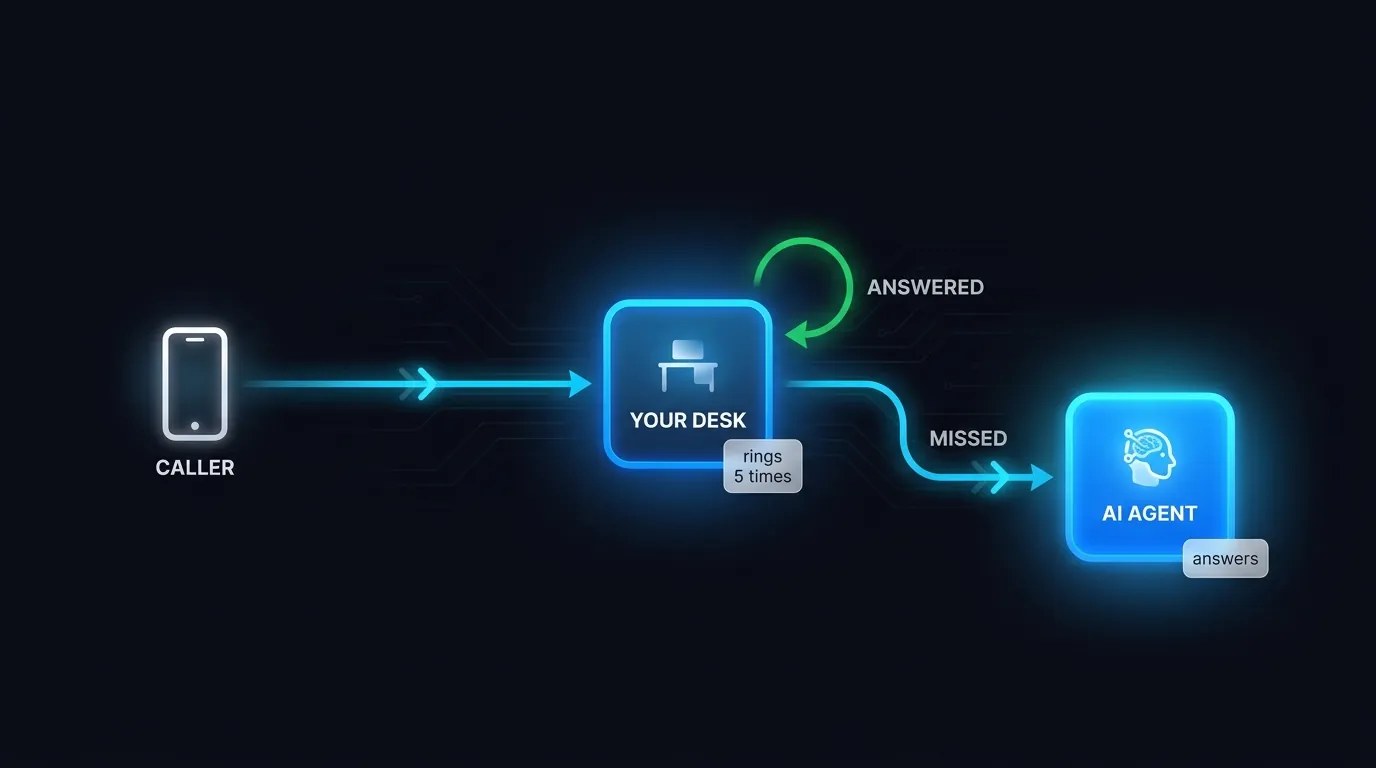
Conditional forwarding lets your team answer first and the agent catch only the misses.
Can you bring your own VoIP or SIP line?
Yes. If you already run a VoIP phone system or a SIP trunk, we connect the agent to it directly. Your numbers, your provider, your call routing stay where they are. The agent simply becomes one more extension that answers when your team cannot.
This suits clinics and trades that have invested in a hosted PBX and do not want to rip it out. We take your SIP credentials, register the agent as a destination, and route the calls you choose. Reception keeps the phones they know.
The win is no migration. Nobody learns a new system, nobody reprints anything. We tested this with a multi site operator and the agent was live on their existing trunk inside a day. If you want the detail, our guide on a VoIP system feeding an AI voice agent walks through the missed call recovery side.
One honest note on data. Your portal, your transcripts, and your structured call records sit on our Sydney servers. The live audio is processed offshore while the call is happening. We say that plainly so you can answer your own compliance questions.
Not sure which route fits your business?
Tell us your current setup and we will pick the fastest path. See how the agent handles a live call on our voice agent overview.
Local +64 or +61, or a toll-free 0800 or 1800 number?
Pick a local number. A +64 mobile or city number, or a +61 local number, gets answered far more often than an 0800 or 1800 line. Toll-free numbers read as sales or debt collection to most Kiwis and Aussies. So they go to voicemail or get declined outright.
Toll-free had its day when callers paid for the call. They do not anymore. A mobile call to an 0800 number is free on nearly every plan. The only thing the toll-free prefix signals now is a faceless call centre.
There is a real cost difference too. The agent bills around 80 cents a minute either way. A 200 dial outbound campaign on local numbers runs about 100 dollars and connects at 47 to 65 percent. Run that same campaign off a toll-free number and your connect rate drops, so you pay the same and reach fewer people.
For inbound, local wins on trust. Someone calling a plumber wants a number that looks like a plumber, not a 1800 hotline. Use a number with your own city area code where you can. Our NZ inbound receptionist setup shows how a local number plus a sub second pickup turns a ringing phone into a booking.
Why do Kiwis and Aussies screen unknown and toll-free calls?
Because they have been trained to. Years of scam calls, spoofed numbers, and pushy call centres mean most people let unknown numbers ring out. Toll-free prefixes and odd international strings get screened hardest. A local number that matches their region is the one they answer.
Phone screening tools make this worse for bad numbers. New screening features hold unknown callers at the door and make them state their name before the phone even rings. A number flagged as spam, or a toll-free line, rarely clears that gate. We dig into this in our piece on pickup rates under new call screening.
This is why the prefix you choose is not cosmetic. We have also written about what to do when an agent number gets spam flagged. A number nobody answers is money you lit on fire. A 200 dial campaign that connects at 30 percent instead of 60 wastes half your spend.
The fix is boring and it works. Use a local number, warm it gradually, register it properly, and disclose that the caller is speaking with an AI on every call. Trust compounds. Spam flags compound faster.
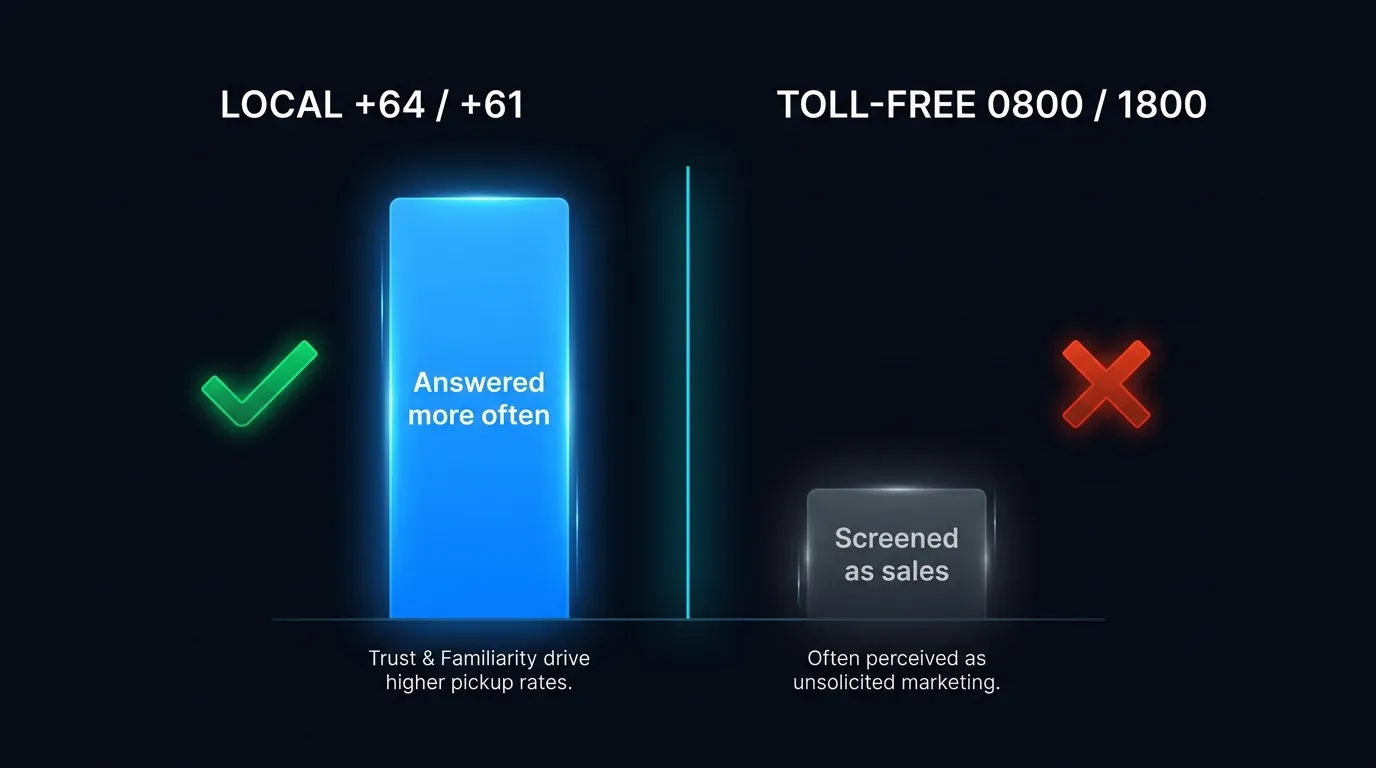
Local numbers clear screening and get answered. Toll-free prefixes mostly do not.
How long does getting set up actually take?
Forwarding goes live in under an hour. Buying a fresh local number is same day. A SIP or VoIP connection is usually a day. A full number port is the slow one at one to two weeks, because it runs through your existing carrier on their timeline.
The part that actually decides whether calls work is not the number. It is how fast the agent starts talking when someone picks up. On a cold call, a sub second first response is make or break. A long silent gap and the caller hangs up before the agent says a word.
So we tune that opening first. The number is plumbing. The first second of the conversation is the product. We get the agent answering in under a second, then we sort out which number type carries those calls.
Once you have picked a route, the rest is us. We provision or port, wire the agent, set the disclosure, and test it with live calls before you trust it with real customers. You can have a working AI receptionist taking calls this week.
Get a number answering this week.
We handle the buy, the port, or the SIP connection, and tune the agent to pick up in under a second. Start on our AI voice agent page.
Frequently Asked Questions
Can I keep my existing business number?
Yes. You have two ways. Forward your existing number to the agent and keep it where it is, which goes live in under an hour. Or port the number onto our platform so the agent answers it directly, which takes one to two weeks. Most clients forward first, then port once they trust it.
Do I need a separate number for the AI agent?
Only if you forward. Forwarding needs a new agent number to send unanswered calls to. We provision that for you. If you port your number or connect your own SIP trunk, the agent answers your existing number directly. A fresh number is also handy for measuring a single campaign on its own.
Is an 0800 or 1800 number worth it for my AI agent?
Usually no. Toll-free numbers get screened heavily, because Kiwis and Aussies read them as sales or scam calls. Pickup drops and you pay the same roughly 80 cents a minute to reach fewer people. A local +64 or +61 number with your own area code gets answered far more often, especially on inbound.
How much does the phone number itself cost?
The number is a small monthly line item, usually a few dollars. The real cost is the talk time. That runs about 80 cents a minute billed by the second in NZD or AUD. An average answered call near 30 seconds is around 40 cents, and a one to two minute booking is roughly one to two dollars.
Will callers know they are talking to an AI?
Yes. The agent discloses that the caller is speaking with an AI at the start of every call. That is not just polite, it is the right thing to do. Plain disclosure also builds more trust than trying to pass the agent off as a person. It keeps you onside with how people expect to be treated.
Can the AI agent work with my current phone system?
Yes. If you run a VoIP system or a SIP trunk, we register the agent as a destination on your existing setup. We route the calls you choose to it. Nothing gets ripped out and your team keeps the phones they already use. The agent simply answers when your people cannot.
Leonardo Garcia-Curtis
Founder & CEO at Waboom AI. Building voice AI agents that convert.
Ready to Build Your AI Voice Agent?
Let's discuss how Waboom AI can help automate your customer conversations.
Book a Free Demo

