Imagine a Christchurch real estate agent on a Tuesday morning. Coffee. The first email of the day lands in his inbox.
It is from the Waboom Portal. Subject: "Yesterday's campaign report". He opens it expecting a wall of dial-counts. Instead, the headline reads:
Yesterday: 87 outcomes for $832 of spend
Call Passed to You: 43 at $2.27 each · Got Email: 23 at $2.32 each · 6-month reminder: 15 at $1.60 each
That email is the agentic platform doing what most outbound platforms still cannot. Translating noise into language a human can actually use. Below is the story of three things our AI voice agents now do, what each one is learning while you sleep, and what changes for your business when they do.
1. The agent learns what each outcome costs you
The old way: "You spent $832 on 2,190 calls." True. Useless. You cannot quote that to a board meeting. You cannot decide whether to spend more next month. You cannot tell your wife at dinner what the day produced.
The new way: the AI tags every call (Call Passed to Rep, Got Email, 6-Month Reminder, DNC Request, Bad Number). You flag the ones that matter to your bottom line. The portal does the maths.
Yesterday's campaign for the Christchurch agent looked like this:
| What the agent did | Times | Spend | Cost each |
|---|---|---|---|
| Passed a qualified seller to the agent | 43 | $97.81 | $2.27 |
| Captured an email for follow-up | 23 | $53.46 | $2.32 |
| Booked a 6-month check-back | 15 | $24.00 | $1.60 |
| "Send me an email" | 4 | $10.71 | $2.68 |
| "Call back today" | 2 | $5.79 | $2.90 |
| Total tracked outcomes | 87 | $831.99 | . |
Read that top row again. Forty-three qualified sellers passed live to the senior agent at $2.27 each. Total cost of those leads: under $100. The senior agent's commission on a single Christchurch listing covers the next twelve months of that line item.
Operational tags like Bad Number and Rang Out stay out of the report. They are not outcomes. The headline numbers stay clean.
The shift is not in the maths. The shift is in the language. "We made calls" becomes "we got 43 qualified leads at under $100 total." A real-estate agent can use the second sentence in a board meeting. The first one bores everyone.
2. The agent learns when your prospects pick up
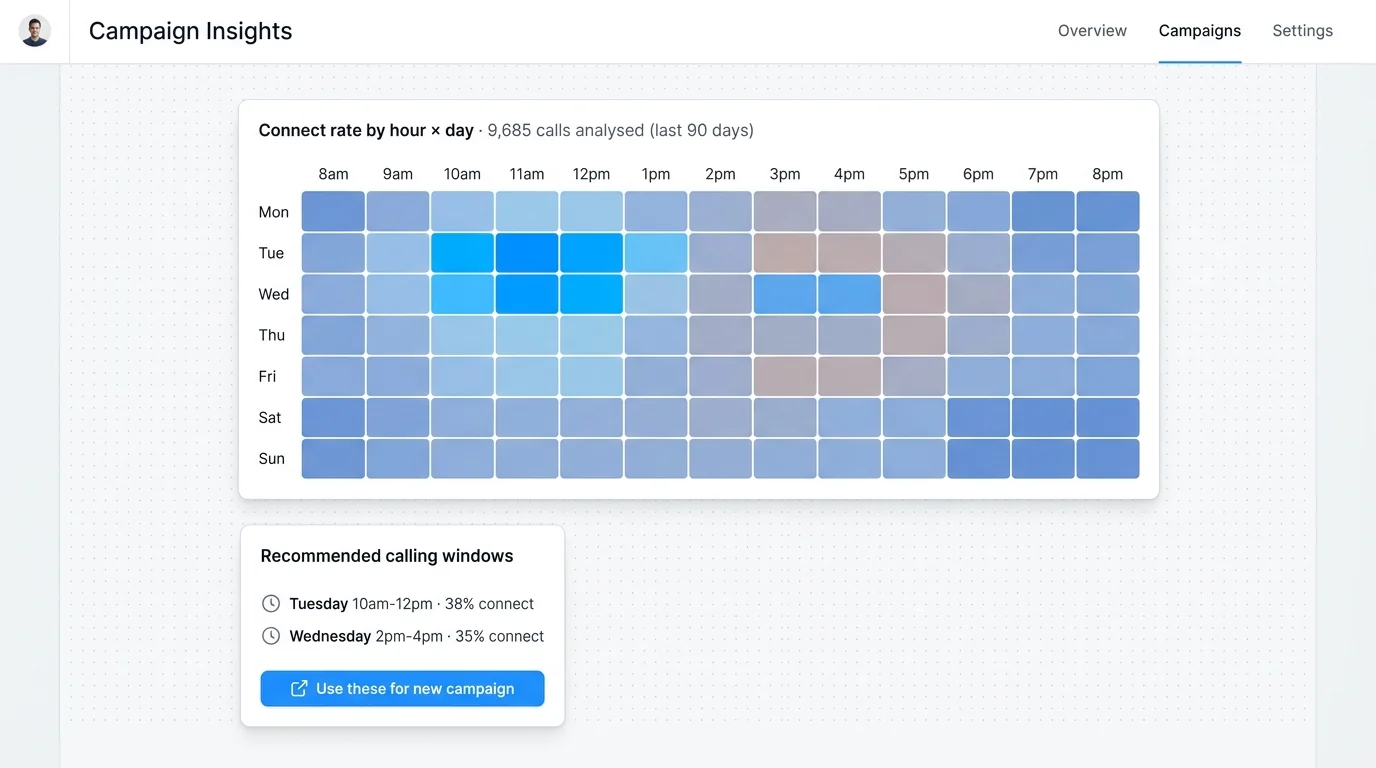
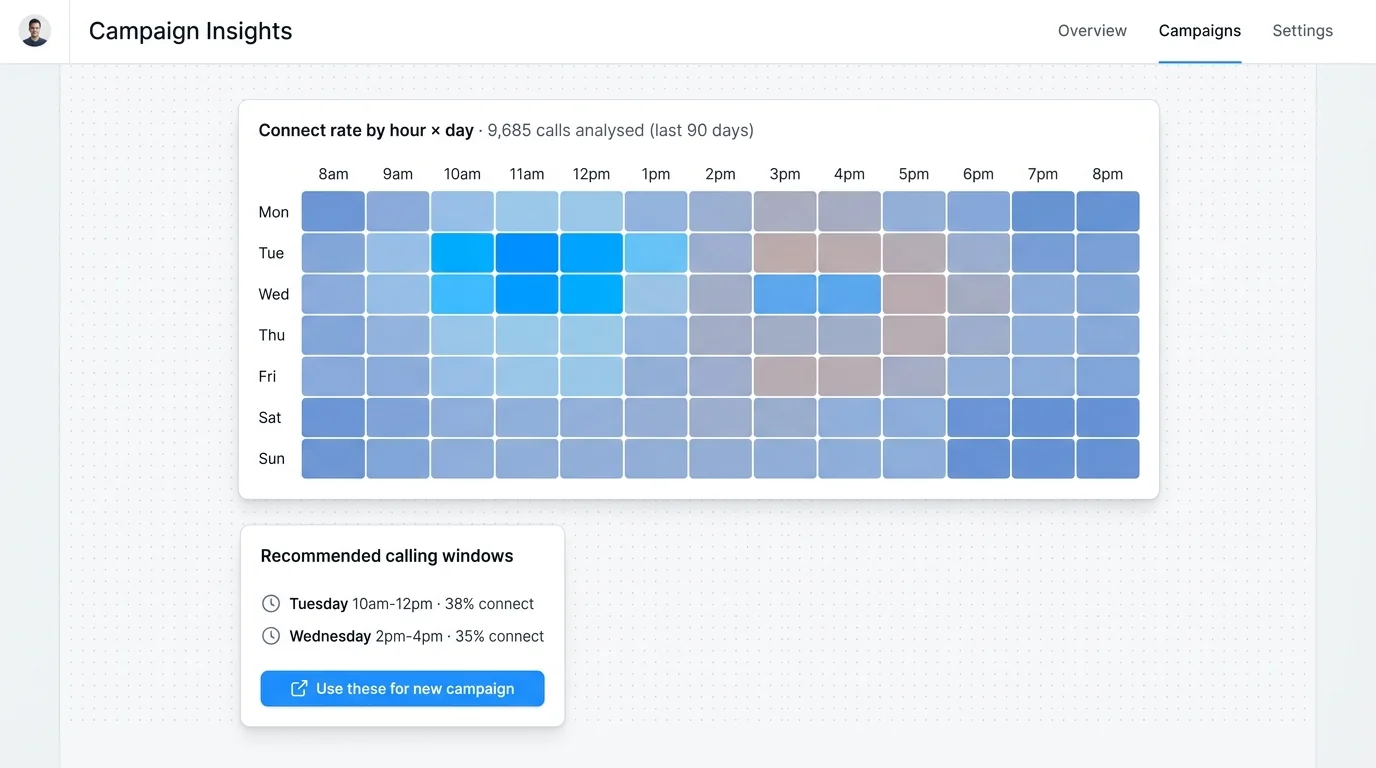
Every Waboom voice agent quietly recomputes its own best calling hours overnight. Looks at the last 90 days of its own calls. Notices that Tuesday 10am to 12pm is reliably the gold zone. That Friday 4pm is a bin fire.
You see this two ways.
| Hour bucket | What the agent does |
|---|---|
| Top quartile (best hours) | Dials about 30% faster. Pushes through the proven window. |
| Middle 50% | Default cadence. |
| Bottom quartile (slow hours) | Slows down. Saves your minutes for the productive ones. |
What it means for your day: same list, same script, fewer wasted minutes. The Christchurch agent does not do anything different. The platform just dials harder when the phones are most likely to be answered.
There are guardrails. Each phone number has a weekly call-cap so nobody gets pestered. Daily limits per agent. Anti-spam cooldowns. The dialler can lean into a good hour but it cannot break the boundaries you set or the rules a regulator cares about.
3. The agent learns what your callers keep asking
Here is the bit that delights people the most.
Every connected call gets analysed for the questions the caller asked. The portal stacks those up across the campaign and tells you the top five. Last month, for a real-estate prospecting agent, the list looked like this:
| Question | How many people asked |
|---|---|
| How much is the deposit? | 47 |
| When is the open home? | 23 |
| Is there parking? | 18 |
| Can my dog come? | 11 |
| What schools are in zone? | 9 |
Forty-seven people asked about the deposit. Probably worth telling the agent the answer, right?
So you do. You add the deposit answer to the agent's knowledge. Next campaign, the AI handles all 47 of those questions cleanly. The senior agent never sees them. Every transferred call now has a higher chance of being a real conversation about a real property, not a recap of FAQs.
Same loop for marketing. If 47 people are asking the same question on the phone, that question is missing from your listing or website. Fix the listing. Fewer questions next time. Calls get shorter and sharper.
This is the smartest part of the platform. The AI does not just answer calls. It tells you what your prospects are confused about. You teach it the answer. The next campaign is sharper.
4. What changes for the agent's business
Three things the Christchurch agent now experiences differently.
The platform does not replace him. It removes the tax on his time so the part of his job that creates the moat gets his full attention.
5. Honest framing on what this is not
Three things, because we do not want anyone walking in with the wrong expectations.
What it is: every call you make is now feeding back into a smarter version of the same agent. The cost-per-outcome shows you what you are buying. The peak-time learning shows you when to dial. The question-frequency loop shows you what your prospects do not yet understand. None of it requires you to have a data team. None of it requires you to know what a JSONB cache is. It just shows up in your inbox at 7am.
The Christchurch agent's morning has not got worse. The reports got better. And the agent calling for him next Tuesday is measurably sharper than the one that called yesterday.
See the full product on the AI Sales Agent pillar
The pillar covers what the agent does end to end. Dial, qualify, book, email, PDF, warm transfer, CRM write-back, compliance overlay. Plus the agentic platform features above.
AI Sales Agent pillar · 2026 NZ benchmarks · Peak-times data · Talk to us
For context on the wider category, see how AI voice agents work for local businesses.
Leonardo Garcia-Curtis
Founder & CEO at Waboom AI. Building voice AI agents that convert.
Ready to Build Your AI Voice Agent?
Let's discuss how Waboom AI can help automate your customer conversations.
Book a Free Demo