
By 8:35am the office line is a wall of hold music. One parent is reporting a sick child. Another wants to know about Year 9 enrolment. A third is asking about the bus. Your front-office staff member has two ears and one phone. Everyone else waits, or hangs up and tries the app, or just turns up at the counter.
This is the problem an AI voice agent for schools solves. It answers every line at once, logs the absence into your roll, and routes the urgent calls to a person. No voicemail backlog at 10am. Here is how it works for NZ and AU schools, and what it costs.
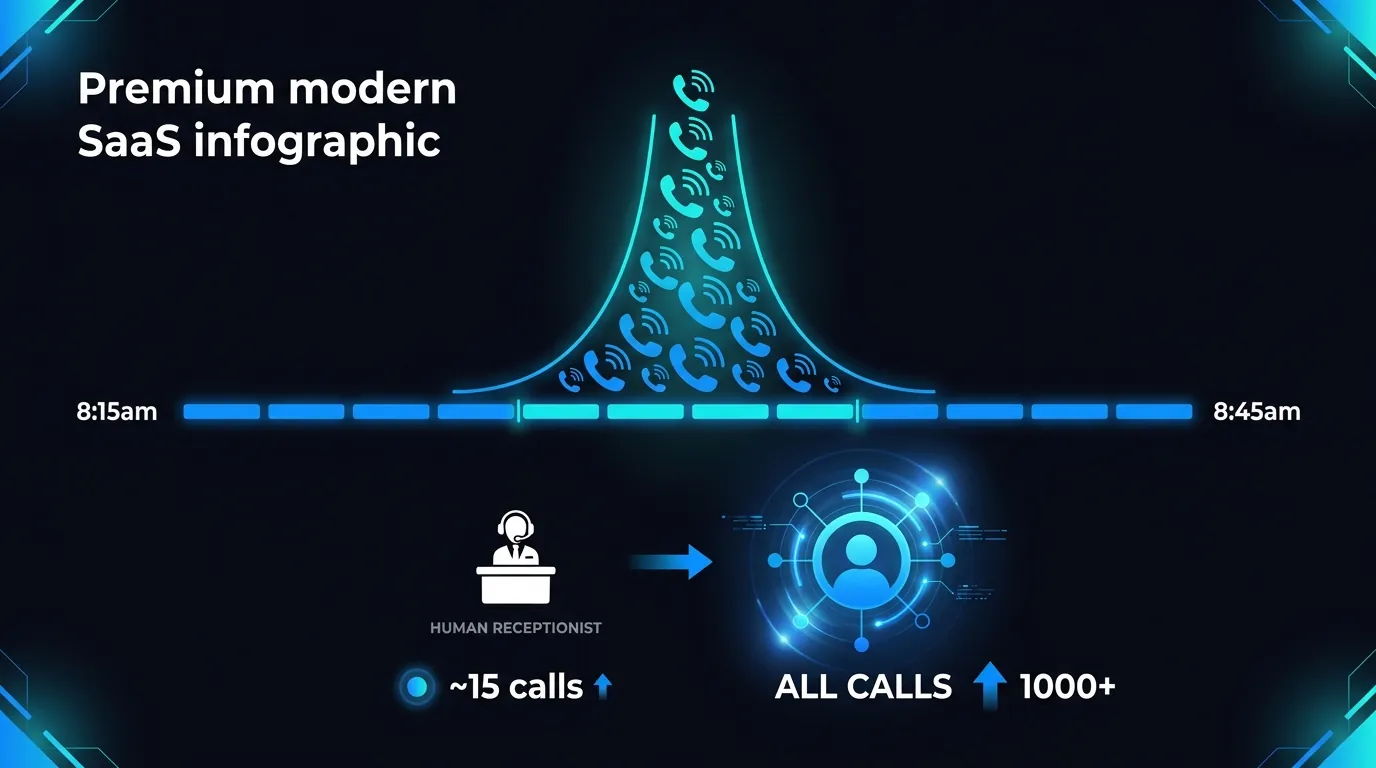
The 8:15am to 8:45am absence spike: one receptionist clears about 15 calls, the agent clears all of them.
What does an AI voice agent do for a school?
An AI voice agent for schools answers every call, logs the absence, and routes anything urgent to a person. It runs the repetitive front-office work that swallows your mornings. Absence reports, enrolment questions, term-date queries, lost property. It does this on every line at once, billed by the second.
The agent picks up instantly. It greets the caller, states plainly that it is an AI assistant, and asks how it can help. For an absence it captures the child's name, the room or year level, the reason, and the expected return date. It writes that straight into your record system. No sticky notes.
This is the same inbound capability we run across other sectors. See our AI voice agents hub for the full picture of what the agent handles.
Why does the morning absence rush break a school office?
The morning rush breaks the office because demand spikes into a 30-minute window and one person cannot answer eight lines. Between 8:15am and 8:45am a primary school can field 50 to 80 absence calls. One receptionist clears maybe 15 in that window. The rest hit hold or voicemail.
This is a queue problem, not a staffing failure. Your office person is excellent. They are also one human. When the calls stack, abandonment climbs, and the unlogged absences become a roll-marking scramble at 9am. We dug into that abandonment problem in our guide on cutting call abandonment with a voice agent.
Stop losing absence calls to hold music.
An inbound AI receptionist answers every line on the first ring, even at the 8:35am peak.
How does it log an absence and update the roll?
The agent captures the absence details, confirms them back to the parent, and writes a structured record into your system. It logs student name, year or room, reason, and return date in one pass. The format is consistent every time, so your roll updates cleanly.
Here is the flow. Parent calls. Agent greets and discloses it is AI. Parent says their child is unwell. Agent confirms the child's name and class, notes the reason, and reads it back. The record lands in your student management system before the parent hangs up. Average call about 30 seconds. That is roughly 40 cents.
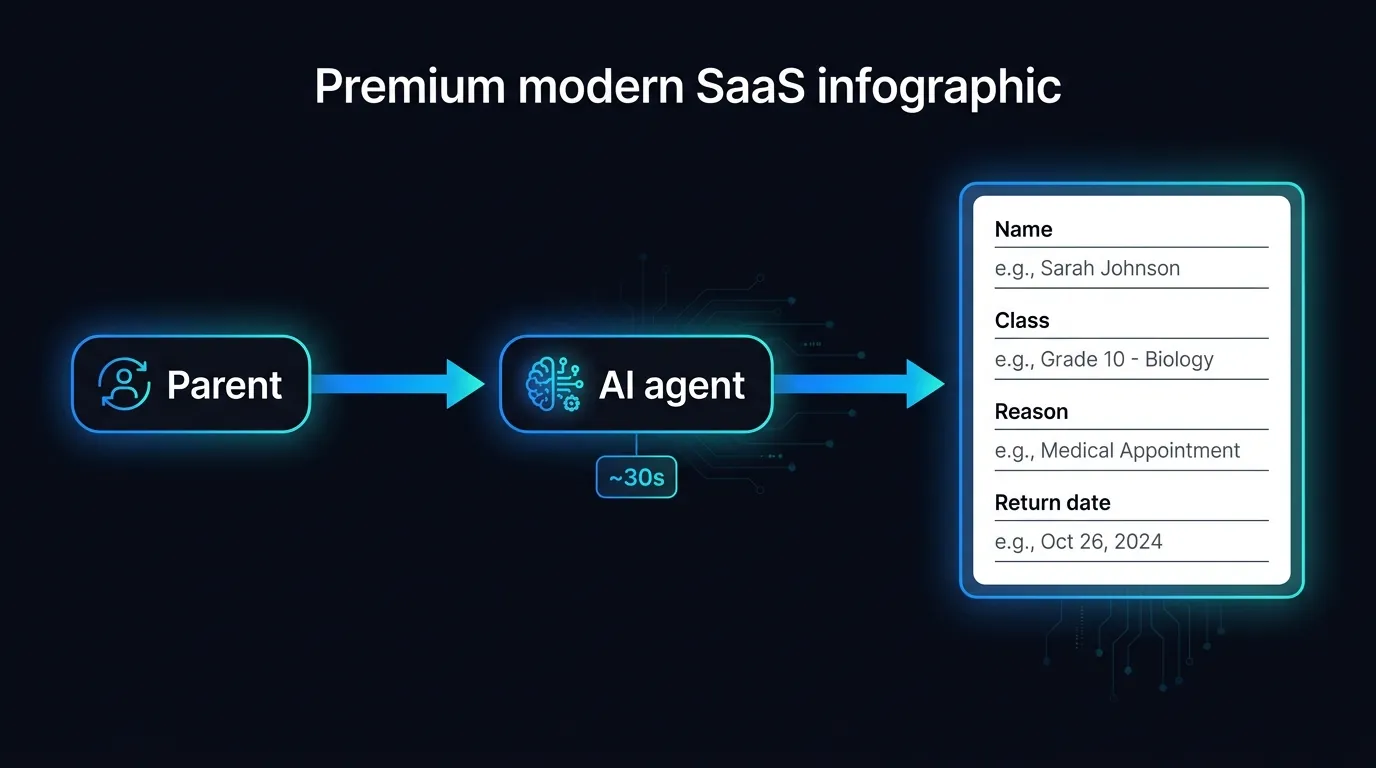
One absence call, captured and written to the roll in about 30 seconds.
How does it handle enrolment and general enquiries?
The agent answers enrolment and general questions from your own information, then books a callback or tour when a human touch is needed. It handles term dates, uniform shops, bus routes, and zone questions instantly. For enrolment it captures the family details and books the next available meeting.
Most school calls are not emergencies. They are the same 20 questions asked 200 times a term. The agent answers those from your handbook in your school's words. When a prospective family wants a tour, it offers real slots and books one. We cover that booking flow for NZ and AU receptionists, and it works the same way for schools.
How does it keep student and family data private?
Student and family data is governed by the NZ Privacy Act 2020 and the AU Privacy Act 1988. Your portal, transcripts, and structured call records sit on our Sydney servers. Live audio is processed offshore during the call, then the record returns to Sydney. We never claim every byte stays in-country.
That honest split matters for a school. You are handling minors' information. Access is controlled, transcripts are searchable by your staff only, and every caller is told they are speaking with an AI. For the full compliance picture, including OPC and OAIC expectations, read our Privacy Act 2020 compliance guide.
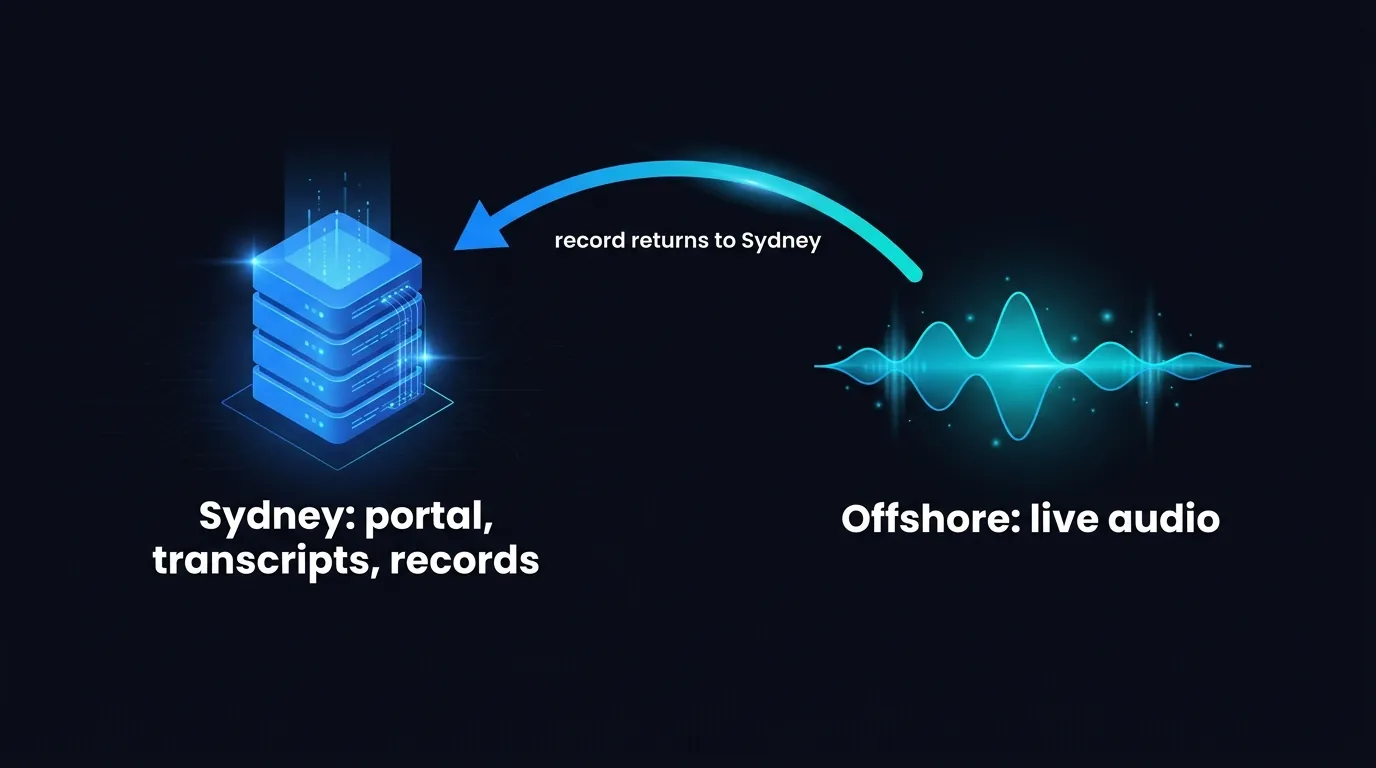
The honest split: records and transcripts in Sydney, live audio processed offshore.
When should a call go to a staff member?
A call goes to a staff member when it is urgent, sensitive, or outside the agent's scope. Welfare concerns, a distressed parent, a medical emergency, anything flagged as safeguarding. The agent recognises these and transfers or escalates fast. It does not try to handle a crisis.
This is the point we make often. The agent removes the repetitive volume so your people have time for the calls that need a human. A worried parent should reach a person, not a queue. We wrote a whole piece on why voice AI still needs humans, and a school is a clear example.
What does it cost a NZ or AU school?
The agent costs about 80 cents a minute in NZD or AUD, billed by the second, with no salary or holiday pay attached. A 30-second absence call is about 40 cents. A 200-call morning costs roughly $80. There is no per-seat fee for handling eight lines at once.
Compare that to staffing. A part-time receptionist runs $28 to $35 an hour before KiwiSaver or super, ACC, and holiday pay. The agent does not need a second hire for peak load. It scales to the morning spike and idles the rest of the day, and you only pay for the seconds it talks.
Cost the morning out for your school.
See how the Waboom AI voice agent answers your absence rush for about $80 a morning, no extra hire.
Frequently Asked Questions
Does the agent tell parents it is an AI?
Yes. Every call opens with a clear disclosure that the caller is speaking with an AI assistant. This is built into the greeting and cannot be skipped. It meets the transparency expectations under the NZ Privacy Act 2020 and the AU Privacy Act 1988. It also sets the right tone for a school front office.
Can it write absences into our student management system?
Yes. The agent captures the absence in a structured format and writes it into your record system in one pass. Student name, year or room, reason, and expected return date land cleanly. Your roll-marking at 9am stops being a scramble through voicemail and sticky notes.
What happens to a welfare or emergency call?
The agent escalates it to a staff member immediately. Welfare concerns, distressed parents, and medical issues are out of scope by design. The agent recognises sensitive calls and transfers them to a real person. It handles the repetitive volume so your staff have time for the calls that matter.
How much does a busy morning actually cost?
A morning of 200 absence calls at about 30 seconds each costs roughly $80. Calls are billed by the second at about 80 cents a minute in NZD or AUD. There is no per-line charge, so answering eight calls at once costs the same per call as answering one.
Where is our student data stored?
Your portal, transcripts, and structured call records sit on our Sydney servers. Live audio is processed offshore during the call, then the record returns to Sydney. We never claim all data stays in-country. Access is restricted to your authorised staff, and the storage split is documented in our Privacy Act guide.
Does it replace our front-office person?
No. It removes the repetitive call volume so your front-office person can do the work only a human can. Welfare calls, walk-ins, and judgement calls stay with your staff. The agent answers the 200 absence calls so one person is not drowning between 8:15am and 8:45am.
For the full security picture, read how Waboom secures voice AI.
Leonardo Garcia-Curtis
Founder & CEO at Waboom AI. Building voice AI agents that convert.
Ready to Build Your AI Voice Agent?
Let's discuss how Waboom AI can help automate your customer conversations.
Book a Free Demo

