
Most AI voice agents are frozen the day they go live. You write the script once. You launch it.
From then on it drifts out of step with how your customers actually talk. Nobody notices until the results sag.
We think that is backwards. An agent that handles hundreds of real conversations should learn from every one of them.
So we built ours to do that. The agent you launch should be the worst one you ever run. Every call after it makes the next one sharper.
Why do most AI voice agents get worse over time?
Because they are static. Customers ask a new question the script cannot answer, a product changes, an objection starts landing that the agent fumbles every time.
The only fix is a human noticing, digging through transcripts, and rewriting the prompt by hand. Almost nobody does that consistently.
So the tool you were proud of at launch is the same tool 6 months later, minus the relevance.
How does an agent learn from its own calls?
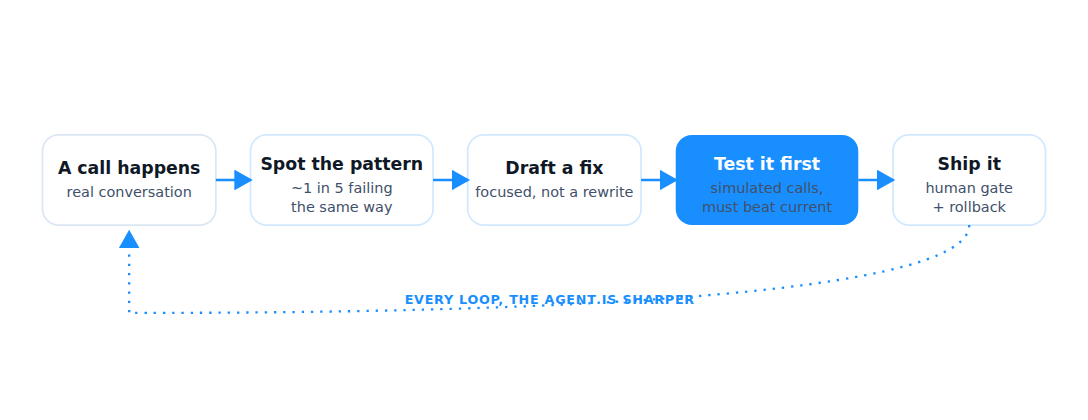
Our platform watches the outcomes of your calls, not just the recordings. It tracks how often your agent succeeds, how your callers feel by the end, and which questions keep tripping it up.
That is the signal.
It waits until it has seen at least 100 calls, so it acts on a real pattern, not one bad conversation. When roughly 1 in 5 of your calls goes wrong the same way, it drafts a fix.
The fix is focused. Not a rewrite on a hunch. A targeted change to the one part your calls show is weak.
How do you stop it breaking the agent?
This is where most self improving AI ideas fall over. A change that sounds good can quietly make your agent worse, so nothing ships on faith.
Before any fix reaches one of your callers, the platform tests it. Our engine plays the customer while the draft agent answers, then grades the call against a set of gold standard scenarios.
If the fix does not clearly beat what your agent already runs, the platform throws it out. Only a change that measurably improves it moves forward.
Then there is a human gate, and you choose the mode per agent. In the safe default, the platform proposes the change and a person approves it before it goes live.
Trust it further and you can let it apply the change itself. It rolls back automatically if anything slips, and alerts you so you always know.
Either way it is rate limited. It improves in careful steps, not lurches.
What does "smarter every call" mean for the business?
It means the asset appreciates instead of depreciating. The objection it fumbled last month becomes the objection it handles cleanly this month.
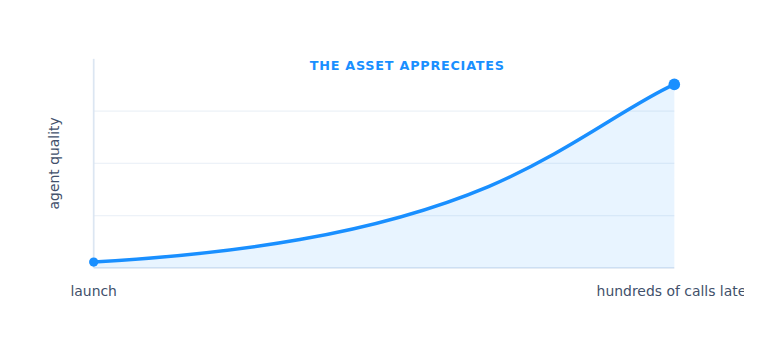
You are not buying a script that decays. You are buying an agent that turns its own worst calls into its next improvement. Over a few hundred calls, that is the difference between a tool and a teammate.
It is the same platform behind our AI sales agent and every AI voice agent we build.
Is this live for every Waboom agent today?
We will be straight with you. The self improving layer is something we have built and tested hard.
We are rolling it out deliberately, not flipping it on everywhere at once. Anything that changes how your agent speaks to your customers earns its place carefully, behind the testing and the human gate above.
The direction is not in doubt. This is where our platform is going: agents that get better on their own, safely, with you in control.
If you want to be early on it, that is a conversation worth having.
Frequently asked questions
Does the agent change its own script without anyone knowing?
Only if you let it. The default mode proposes a change and waits for a person to approve it. The automatic mode is opt in per agent, and even then every change is logged, reversible, and flagged to you.
How does it know a change is actually an improvement?
It tests the change before it ships. The proposed script runs through simulated calls graded against gold standard scenarios. It only moves forward if it clearly beats the current version.
What does it learn from?
Its own calls: success rates, how callers feel, and the questions that keep tripping it up. It looks for a pattern across at least 100 calls, not one bad conversation, so it fixes real recurring weaknesses.
Will this replace the person who manages the agent?
No. It removes the grind of reading transcripts and hand editing prompts. It puts a tested, reversible improvement in front of that person to approve. The human still decides.
Want an agent that improves itself instead of ageing?
We are rolling this out across our NZ and AU voice agents, with you in control of every change.
Leonardo Garcia-Curtis
Founder & CEO at Waboom AI. Building voice AI agents that convert.
Ready to Build Your AI Voice Agent?
Let's discuss how Waboom AI can help automate your customer conversations.
Book a Free Demo

