
An AI voice agent for dentists answers every call to your practice, day or night. It books new patients, reschedules cancellations, runs recall reminders and triages after-hours emergencies. It picks up on the first ring while your nurse stays chairside. No voicemail. No missed new patient.
The phone is the leak in most dental practices. Calls land at lunch, after hours and in the mid-morning rush, and your one front desk person cannot reach them all. This guide shows how an AI voice agent built for dental practices covers those calls without pulling a nurse off a patient.

The agent picks up the lines your front desk cannot reach.
What does an AI voice agent do for a dental practice?
It runs your phones. The agent answers in a natural voice, books appointments straight into your calendar, handles reschedules, chases recalls and screens after-hours pain calls. It works 24 hours a day. A missed call to a dental practice is often a $300 first visit walking to the practice down the road.
Most practices lose calls in three windows. Lunch, when the front desk is at the cafe. After 5pm, when the lights are off. And the busy mid-morning rush, when two patients are at the counter and three lines ring at once. The agent covers all three. It never goes to voicemail.
The agent tells callers it is an AI. People are fine with it once they get an answer instead of a beep. It speaks plainly, confirms the booking and texts a confirmation. The whole thing feels like a competent receptionist who never has a day off.
Why can a dental front desk not keep up with the phone?
Because one person cannot greet patients, process payments and answer four ringing lines at the same time. A part-time receptionist in New Zealand or Australia costs about 28 to 35 dollars an hour before KiwiSaver, super, ACC and holiday pay. They still have to sleep.
Picture a Tuesday at 9am. The waiting room has six people. The hygienist is running late. The eftpos machine is being slow. And the phone rings four times in ten minutes. Three of those callers hang up. One was a new patient with a cracked filling who just called the next clinic.
That is the leak. It is not a staff failure. It is maths. You cannot staff for the peaks without paying for the quiet hours too. The agent fills the gap. It takes the overflow when the desk is buried and the whole load when the desk is closed.
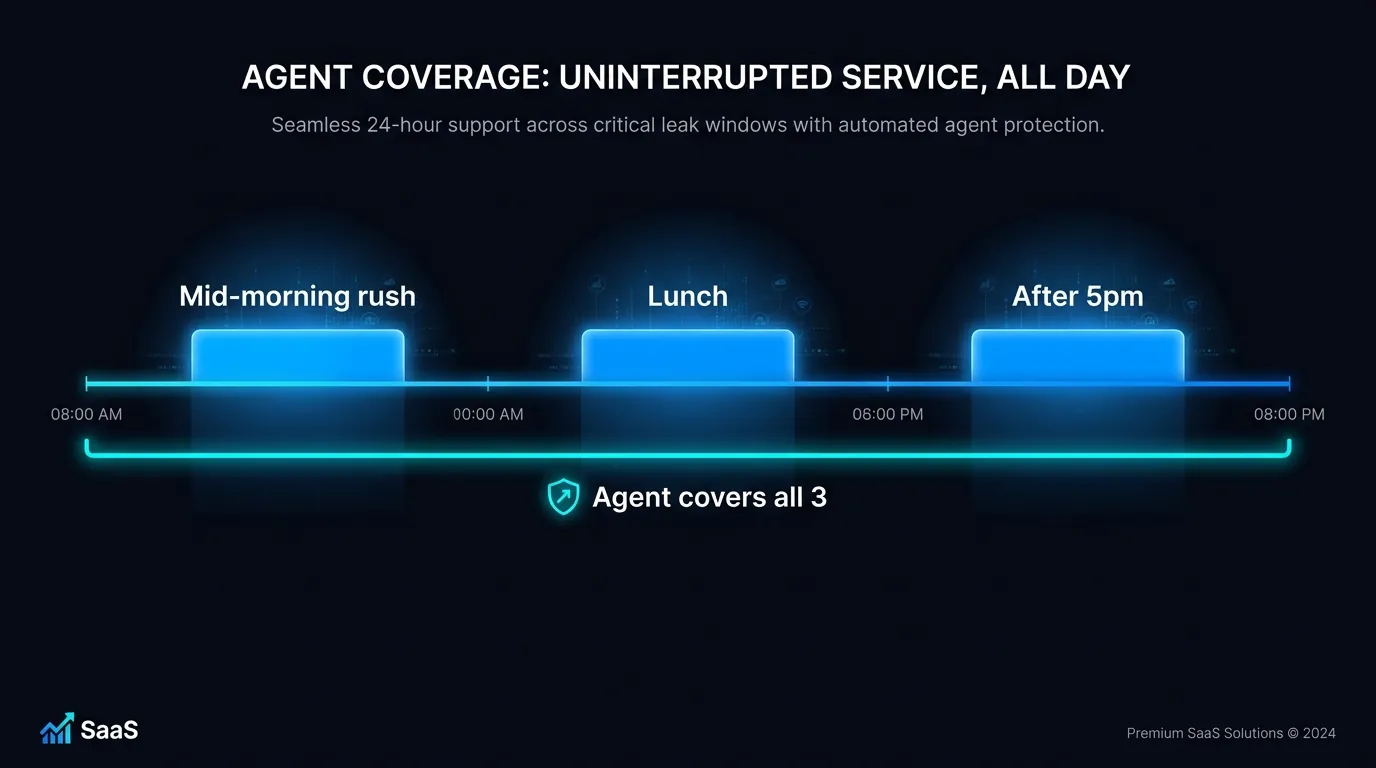
Three windows where calls leak, all covered by one agent.
Tired of the front desk drowning at 9am?
See how our AI voice agent for dental practices takes the overflow so your team stays with the patient in the chair.
How does it handle bookings, reschedules and recalls?
It books, moves and confirms appointments directly in your practice calendar. A caller asks for a check-up, the agent offers real open slots, locks it in and sends a text confirmation. Reschedules work the same way. Recalls go out as outbound calls to patients overdue for a clean.
For bookings the agent knows your appointment types. A 30 minute hygiene visit. A 60 minute new patient exam. An emergency slot held each morning. It matches the caller to the right length and the right provider. No double bookings. No 20 minute clean booked into a 10 minute gap.
Recalls are where the money hides. Most practices have hundreds of patients overdue for a six month clean. Calling them all by hand never happens. The agent runs the list as an outbound campaign. A 200 dial campaign costs roughly 100 dollars and fills a week of quiet chairs.
On outbound, expect 47 to 65 percent of dials to connect. Around 20 to 25 percent become a real one minute conversation. The rest get a voicemail or a follow-up text. You wake up to a calendar with eight recalls rebooked, billed by the second at about 80 cents a minute. More on the booking flow in our guide to appointment booking with an AI receptionist.
How does it triage an after-hours dental emergency?
It asks a few set questions and decides if the caller needs to be seen tonight. Then it either books an emergency slot or routes the call to your on-call dentist. A toothache that can wait gets the first morning slot. A knocked-out tooth gets escalated straight away.
The script is yours. You decide the triage rules. Facial swelling, trouble breathing or uncontrolled bleeding, the agent tells the caller to go to the emergency department and flags it to you. A lost crown or a dull ache, it books the morning. Real pain at 11pm, it calls your mobile.
This is the bit that saves your evenings. You are not answering the practice line at dinner. You only get the calls that truly need you. Everything else is handled or booked. Our guide on the after-hours receptionist setup covers the night routing in detail.
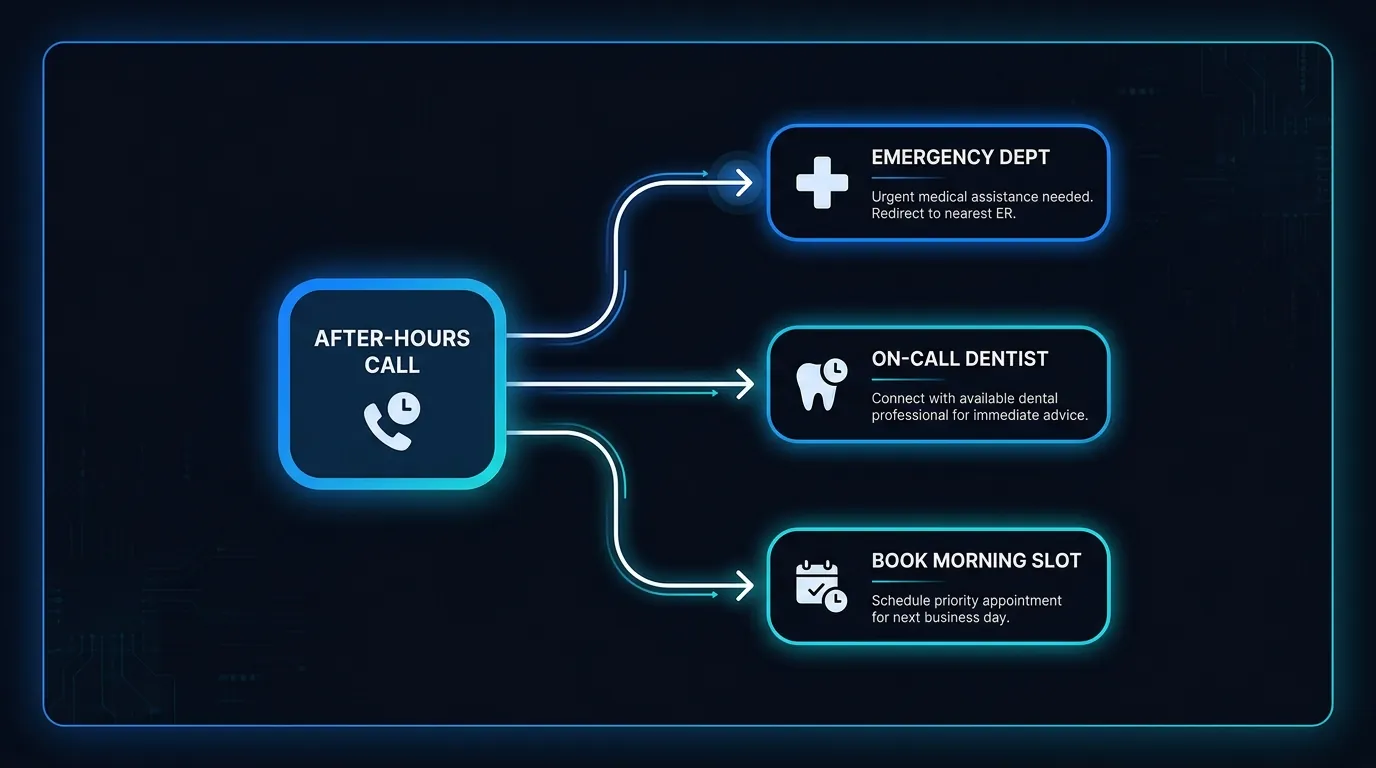
Your triage rules decide what reaches you at 11pm and what waits for morning.
How does it keep patient data private?
Your portal, transcripts and call records sit on servers in Sydney. The live audio of the call is processed offshore for the few seconds it takes to understand speech. That is the honest split. We never claim every byte stays in one country, because it does not.
For a dental practice handling health information, this matters. In New Zealand you are bound by the Privacy Act 2020 and answerable to the Office of the Privacy Commissioner. In Australia you are under the Privacy Act 1988, the 13 Australian Privacy Principles and the OAIC. The same rules apply whether a human or an agent takes the call.
The agent discloses it is an AI on every call. Callers know. You hold the records. We do not sell or reuse your patient data. For the full breakdown, read our piece on what the Privacy Act 2020 means for an AI voice agent.
When should a call reach the practice?
When a human is genuinely needed. A clinical question only the dentist can answer. A distressed patient. A complaint. A media call. You set the rules and the agent warm transfers or takes a message with full context. Everything routine it just handles.
The agent is not trying to be your dentist. It is trying to be your front desk on the calls a front desk handles. Bookings, reschedules, recalls, hours, directions, costs. The grey calls it passes up with a clean summary so your team picks up mid-thread, not from zero. We wrote about that human handoff in why voice AI agents still need humans.
You can dial the threshold up or down. Some practices want every new patient to reach a human after booking. Others want the agent to handle the lot and only escalate emergencies. Your call. The agent does what you tell it. The same pattern works for any health front desk, as our medical clinic guide shows.
What does it cost a NZ or AU dental practice?
Far less than a receptionist. You pay about 80 cents a minute, billed by the second, in NZD or AUD. An average answered booking call runs about 30 seconds, so roughly 40 cents. A longer chat of one to two minutes lands around one to two dollars. No wages, no super, no sick days.
Run the numbers against a real desk. A part-time receptionist at 28 to 35 dollars an hour, plus on-costs, covers maybe 40 hours a week. The agent covers all 168 hours for a fraction of that. A Sydney sales agent we ran booked 141 qualified leads in 90 days at 32.74 dollars each.
The recall maths is the clincher. A 200 dial recall campaign costs about 100 dollars and rebooks a stack of overdue cleans. Each rebooked clean is 150 dollars plus on the chair. The agent pays for itself before lunch on day one. We break the full pricing down in our cost guide for an AI receptionist.
Stop letting the phone walk patients next door.
Put a 24/7 inbound voice agent on your lines and keep the new patients you are already paying to attract.
To get the agent live, you point your practice number at it. We cover that in our guide to forwarding calls to an AI receptionist. Most practices are answering every call within a day.
Frequently Asked Questions
Does the AI voice agent tell patients it is not a human?
Yes. The agent discloses it is an AI at the start of every call. We have found patients are comfortable with it once they get a fast, clear answer. Disclosure is the honest and compliant thing to do under both NZ and AU privacy law, and it builds trust rather than eroding it.
Can it book straight into our existing dental calendar?
Yes. The agent reads your real availability and writes bookings, reschedules and cancellations directly. It knows your appointment types and lengths, so a hygiene visit never lands in a new patient slot. The caller gets a text confirmation within seconds, and your front desk sees the booking appear in real time.
What happens with a genuine after-hours emergency?
The agent runs your triage script. Serious red flags like facial swelling or trouble breathing get directed to the emergency department and flagged to you. Real dental pain gets escalated to your on-call dentist or booked into the first morning emergency slot. Routine issues are simply booked for the next day.
Is our patient data safe and compliant?
Your portal, transcripts and records sit on Sydney servers. Live call audio is processed offshore for seconds during the call. You stay the data holder. We comply with the NZ Privacy Act 2020 and the AU Privacy Act 1988 with its 13 Australian Privacy Principles. We never sell or reuse your patient information.
How much does it actually cost per month?
There is no fixed monthly wage. You pay about 80 cents a minute, billed by the second. A typical booking call of 30 seconds costs around 40 cents. Most small practices spend far less than a part-time receptionist who costs 28 to 35 dollars an hour before KiwiSaver, super, ACC and holiday pay.
Will it replace our receptionist?
No. It handles the phone load your front desk cannot reach, the overflow at peak and the whole load after hours. Your team stays for the in person care, the clinical judgement and the calls that need a human. The agent removes the ringing phone so your people focus on the patient in the chair.
See the answering service built for healthcare for the full picture.
Leonardo Garcia-Curtis
Founder & CEO at Waboom AI. Building voice AI agents that convert.
Ready to Build Your AI Voice Agent?
Let's discuss how Waboom AI can help automate your customer conversations.
Book a Free Demo

