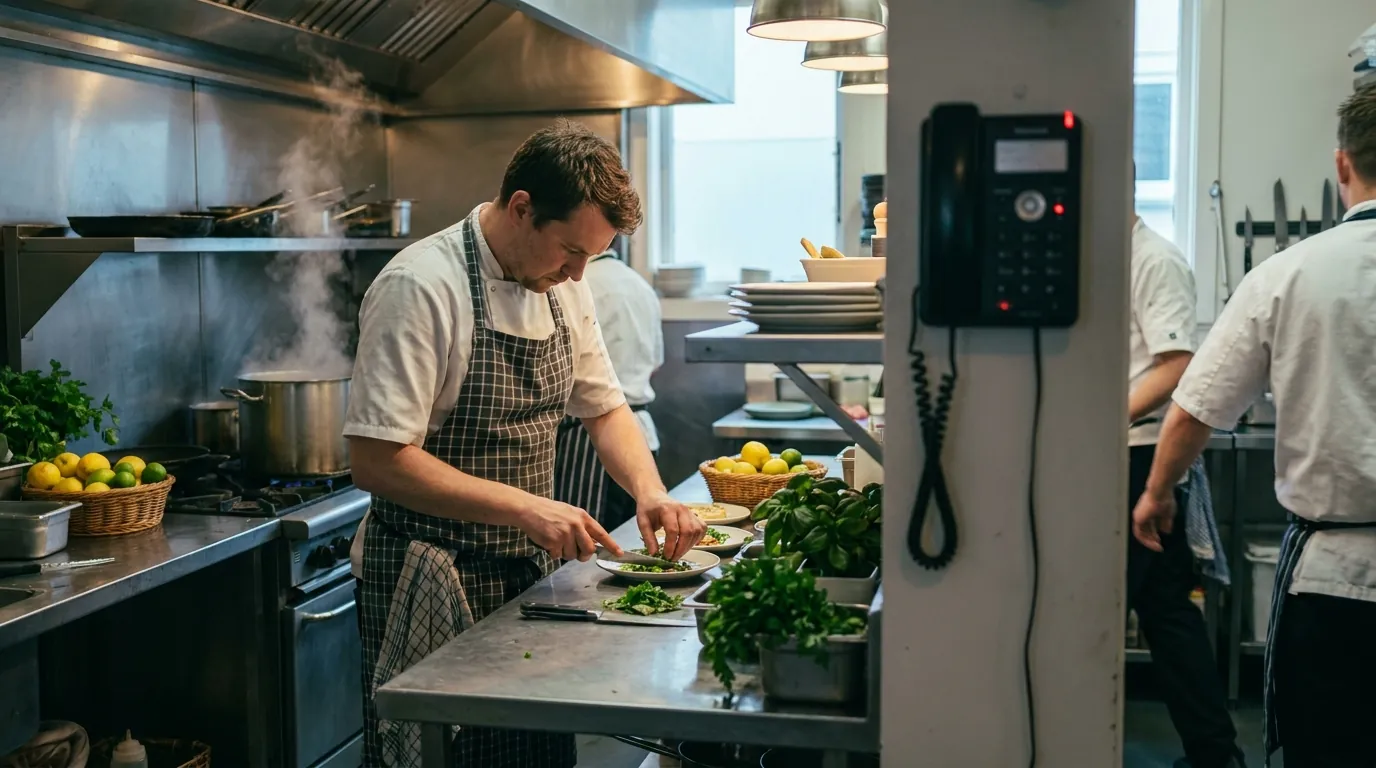
A 70-seat restaurant in central Wellington. The owner-operator (let's call him Ben) takes the bookings phone himself. He's also the head chef. From 9am to 11am on a Saturday morning, he's deep in mise en place: butchering protein, prepping sauces, breaking down the produce delivery. The phone goes to voicemail.
Saturday lunch is the restaurant's biggest single service of the week. It's also when half the bookings come in.
The pattern
Ben pulled three months of his phone log into a spreadsheet. The pattern was bleak.
Saturday morning bookings calls (9am-11am): 28 to 34 a week. Of those, around 21 hit voicemail because he was in prep. He returned about 18 of them between 11am and 1pm (kitchen open). Of the 18 returned, 6 to 7 booked. 11 to 12 had moved on, and 3 had already booked elsewhere.
Net loss per week: 11 to 12 Saturday-lunch reservations. Average table of 4 covers, average spend of $80 per person, two-hour average dwell. Per Saturday loss: roughly $3,500 to $3,840 in revenue.
Per month: $14,000 to $15,360. Just from a 2-hour Saturday morning window.
What he actually tried first
Three things, none of which worked for him:
Hiring a part-time bookings person. Cost was $25 to $30 an hour. To cover the 9am to 11am window plus shoulders, that was $90 to $120 a week, or roughly $400 a month. Plus he couldn't keep the role filled. turnover was constant.
Calls forwarded to his mobile. He couldn't talk on the phone with bloody hands while breaking down a side of beef. Reservations were either rushed and inaccurate or got cut off.
A booking widget on the website. Helped a bit, but his demographic (mid-40s and up, regulars, group bookings) still preferred to call. The website widget covered maybe 15% of weekend volume.
What he did instead
Moved the reservations line to an AI voice agent for the 9am-11am Saturday window only. In-hours (lunch service onward) stayed with him.
Setup was a single 45-minute call with us where we mapped the reservation script, confirmed his calendar (a Google Calendar with a 70-seat capacity rule), and tested the voice. The agent's only job was to take a reservation: name, party size, time, dietary requirements, contact number. Anything outside that scope (private events, complaints, suppliers) went to a "we'll call you back at 11am" message and a SMS to Ben's phone.
Voice was a Wellington-tuned Kiwi female. The opening line was deliberately blunt: "Kia ora, you've reached [Restaurant]'s reservations. The kitchen is in prep at the moment, but I can take your booking right now."
What happened
Month one: 91 Saturday-morning bookings calls answered. Of those:
Lost-bookings-to-voicemail: down from 11-12 a week to under 1 a week. Recovered roughly 40 weekend bookings a month at the average $640-table value, that's $25,600 in incremental monthly revenue.
Cost: 91 calls × ~70-second average × $0.80/min = around $85 a month in AI usage.
What it changed about the kitchen
Ben says the bigger effect wasn't the bookings number, it was his focus. He stopped checking voicemail every 15 minutes between knife cuts. The mise was tighter. The 12pm service started cleaner.
"I used to feel like I was failing the front of house from the kitchen, and failing the kitchen from the front of house. The agent took the front of house off my plate during prep. I just cook now."
What to copy
Three takeaways for any owner-operator restaurant:
1. Identify the worst window first. Don't deploy AI for 24/7 reservations on day one. Find the 1-2 hour window where you're hemorrhaging the most bookings, and start there. Almost always it's prep windows or busy service.
2. Limit the script. AI agents work best with one job. "Take reservations" is one job. "Take reservations + handle complaints + book private events + answer takeaway questions + supplier calls" is five jobs and a worse outcome.
3. Connect to the calendar in real time. A booking that doesn't land in the system before lunch service is a phantom booking. The AI must write to the same source of truth your front of house uses.
We covered the broader after-hours economics in our after-hours pillar.
Frequently asked questions
Won't customers feel snubbed when they get an AI instead of the owner?
The script is upfront about it. The opener is: "Kia ora, you've reached us. The kitchen is in prep at the moment, but I can take your booking right now." Most callers prefer that to "leave a message and we'll call you back." Calls drop, voicemail gets ignored, and the booking is lost. AI takes the booking immediately.
What about regulars who specifically want to talk to the owner?
The agent is trained to recognise repeat callers (matched by phone number) and offer to either book them in or take a message for the owner. Most regulars are calling to book a regular table at a regular time. The owner sees the booking land and can ring them personally if they want, on his terms.
How does the AI handle dietary requirements?
The script captures dietaries as a structured field on the booking ("any allergies or dietary requirements we should know about?"). The data lands in the booking system the same way a manual booking would. The kitchen prepares accordingly.
Can the AI handle group bookings or private events?
For routine group bookings (up to 10), yes. the agent books direct. For private events (function room, set menu, large groups), the agent captures the enquiry details and either schedules a callback or transfers to the owner during service hours.
What's the cost vs hiring a part-time bookings person?
A part-time bookings person at $25 to $30/hour for a 2-hour Saturday morning window plus shoulders runs about $400/month, plus turnover and rostering hassle. AI usage at $0.80/min for the same window comes in under $100/month. The harder math: AI doesn't call in sick.
Restaurant phone burning out a co-owner?
A targeted 2-hour AI deployment over a prep window is often the highest-ROI AI project a restaurant can run. Start with the worst window.
Leonardo Garcia-Curtis
Founder & CEO at Waboom AI. Building voice AI agents that convert.
Ready to Build Your AI Voice Agent?
Let's discuss how Waboom AI can help automate your customer conversations.
Book a Free Demo