
Do you need to custom-train an AI voice agent?
No. For almost every NZ or AU small business, a custom trained voice agent is the wrong tool. You change the wording, the prices, the hours, all the time. A trained model freezes that knowledge in place. We prompt a frontier language model instead, so a change goes live in minutes, not weeks.
Here is the scene. A plumber in Hamilton wants the agent to mention a new weekend call-out fee.
With training, that means gathering examples, retraining, testing, redeploying. With prompting, we edit one line and the next caller hears it. Same day. No retrain.
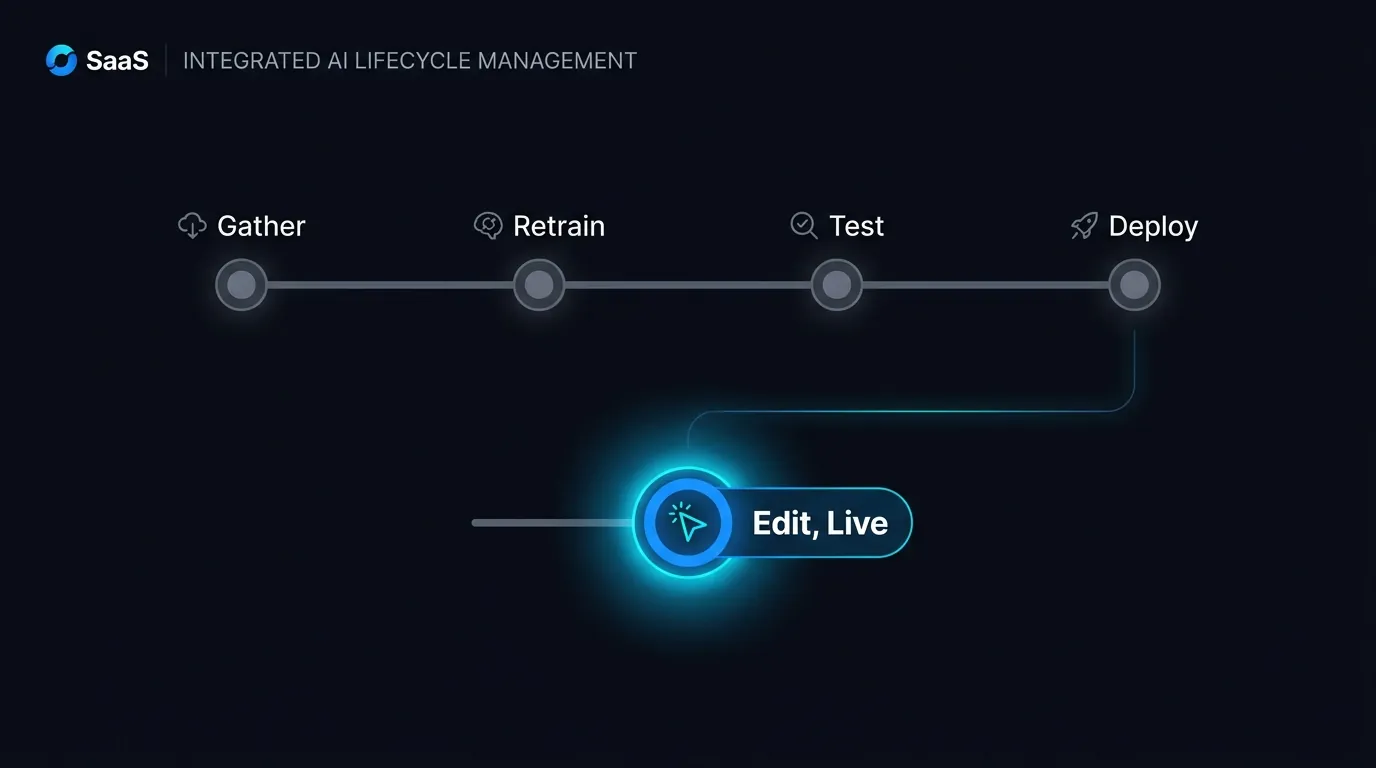
Training means a retrain cycle. Prompting means one edit, live the same day.
What is the difference between prompting and training a voice agent?
Training builds a custom model from your data over days or weeks. Prompting gives a ready frontier model clear instructions and your live information at call time. Training bakes knowledge in. Prompting keeps it loose and editable. For a small business that changes prices and hours often, prompting wins on speed and cost.
Think of training like printing a brochure. Once it is printed, fixing a typo means a whole new print run. Prompting is more like a whiteboard. You wipe one number and write the new one.
A trained voice model also needs thousands of clean, labelled examples. Most small businesses do not have hundreds of recorded calls sitting in a folder. They have a price list, a few FAQs, and a booking calendar. Prompting works with exactly that.
For the full picture of what happens on a single call, read how an AI voice agent works on a call.
Why does prompting win for a small business?
Prompting wins because it is faster to change, cheaper to run, and sounds local out of the box. There is no retrain cycle, no waiting on a data science team. You get the same frontier model that already speaks natural English, then we point it at your live information. Updates land the same day.
The economics back this up. A prompted agent bills about 80c per minute in NZD or AUD, charged by the second. An average answered call runs about 30 seconds, so roughly 40c. A one to two minute call is about one to two dollars. There is no upfront training spend to recover before the first call pays for itself.
Compare that to a part-time receptionist at about 28 to 35 dollars an hour before KiwiSaver or super, ACC and holiday pay. The agent answers every call, never takes a smoko, and you only pay for talk time.
We have the receipts. A Sydney agent produced 141 vendor leads in 90 days at 32.74 dollars per seller. A Christchurch developer booked property viewings at 7.12 dollars each. Neither needed a custom-trained voice model. Both ran on prompting plus live data.
DIY teams often reach for training because it sounds more serious. It usually backfires. We wrote about that in why DIY voice agents fail. The hard part is never the model. It is the live information and the call flow.
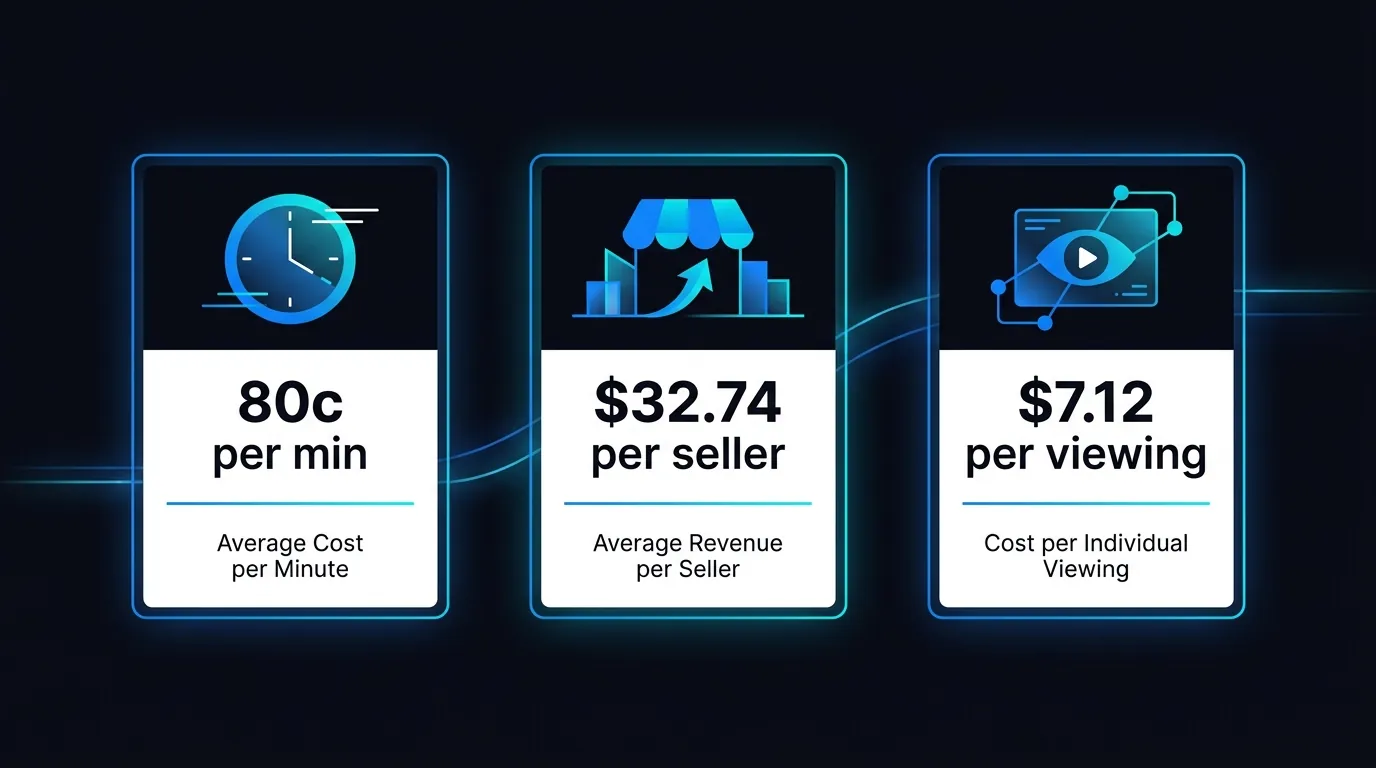
Real numbers from live agents: 32.74 dollars per seller, 7.12 dollars per viewing.
Want the agent live before your next price change?
See how our AI voice agents run on prompting plus your live data, no retrain ever.
How fast can you change what the agent says?
Same day, usually within minutes. Because the agent reads your live information at call time, a price change or a new policy is one edit. No retrain, no redeploy queue. You can update the agent in the morning and the lunchtime caller hears the new answer.
Picture a dentist in Auckland who adds a Saturday clinic. With a trained model, that is a project. With prompting, we update the hours and the booking rules in one place. Done before the first Saturday booking comes in.
This speed matters more than people think. Prices move. Promotions start and end. A frozen model is wrong the moment something changes. Read how we keep the knowledge base fresh in our piece on knowledge base update speed.
Does a prompted agent sound local enough?
Yes. A frontier model already speaks natural NZ and AU English. We layer a local persona on top through prompting, so it says car park not parking lot, and rates not property taxes. No accent training run required. It sounds local out of the box, then we tune the wording.
The trick is the persona, not the model. We give the agent a name, a tone, and local phrasing. It greets a Wellington caller the way a good front-desk person would. We go deep on this in our guide to a localised NZ persona.
Callers do not care how the model was built. They care that the agent understands them, gets the suburb right, and books the job. A well-prompted agent does all three on the first call. And it discloses it is an AI, so nobody feels tricked.
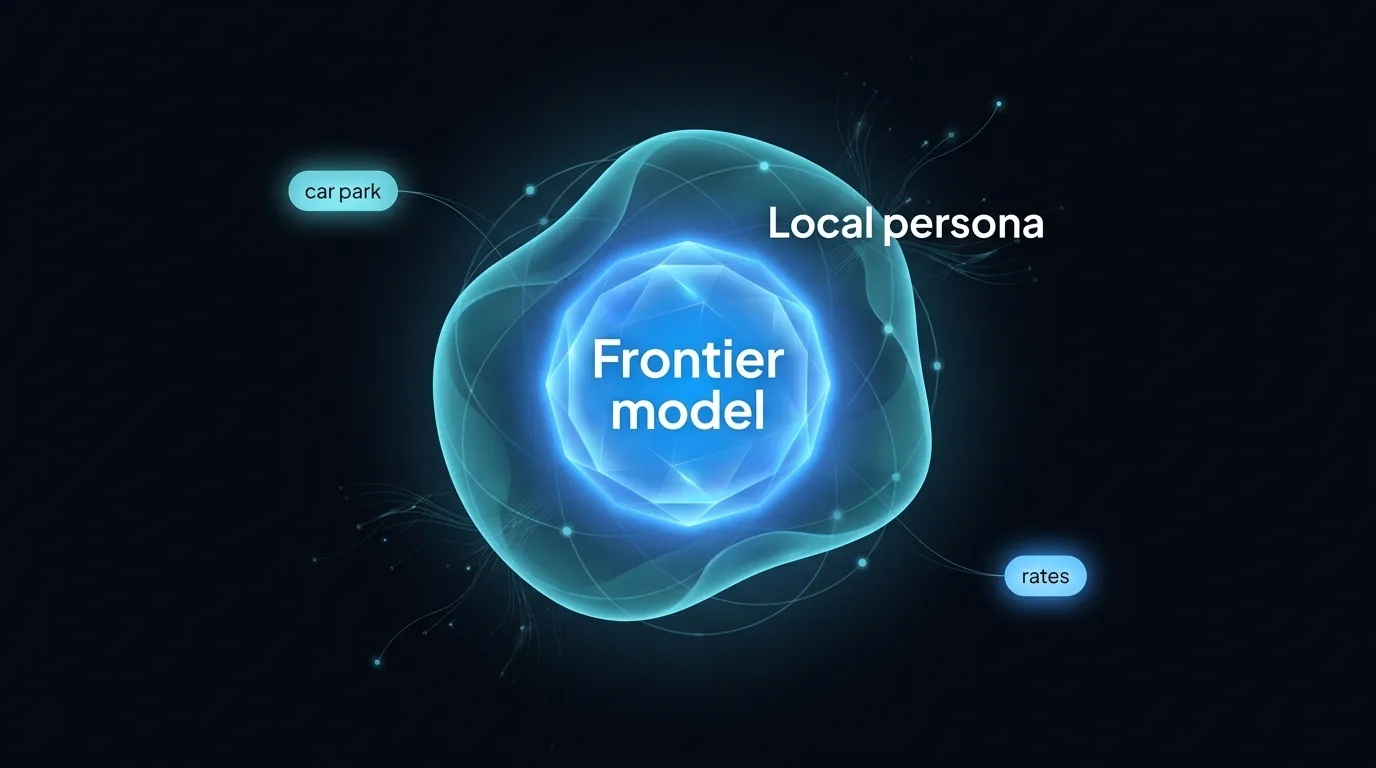
A local persona sits on top of the model: car park, rates, the right suburb.
When would custom training ever make sense?
Rarely, and only at large scale. Training can pay off when you have millions of calls, a narrow repeated task, and a data science team to maintain it. For a NZ or AU small business, that almost never describes the situation. The cost and the retrain cycle outweigh any gain.
Even big operators usually start with prompting. It is faster to test, cheaper to change, and good enough for the vast majority of calls. They only consider training once a single narrow flow runs millions of times and a tiny accuracy lift is worth a fortune.
If a vendor tells a five-person trades business it needs a custom-trained voice model, be careful. That is usually a way to sell a longer, pricier project. The honest answer for most businesses is prompt, ship, and iterate.
How do you keep a prompted agent accurate?
We ground it in your live information and constrain what it can claim. The agent reads from a maintained knowledge base, not from memory, so it quotes real prices and real hours. We add guardrails so it never invents an answer. When it does not know, it says so and offers a callback.
Accuracy is a discipline, not a one-off. We keep the knowledge base current, test the call flows, and review transcripts. We wrote a full guide on stopping the agent from making things up, because a confident wrong answer is worse than no answer.
This is where prompting shows its edge again. If a transcript shows a weak answer, we fix the prompt or the knowledge base that day. A trained model would need another retrain. If you care about response speed, here is our take on voice AI latency.
Ready to skip the retrain trap?
See how our AI voice agents work, all built on prompting plus your live data.
Frequently Asked Questions
Is a prompted agent less capable than a custom trained voice agent?
No. For small business call handling, a well-prompted frontier model matches or beats a trained one. It answers FAQs, books jobs, and qualifies leads. Training only helps at huge scale on one narrow task. For a NZ or AU business that changes prices and hours, prompting is both more capable and far easier to keep correct.
How long does it take to launch a prompted voice agent?
Days, not weeks. There is no retrain cycle to wait on. We load your prices, hours, and FAQs, build the call flow, and test it. Most agents are answering real calls within a week. Changes after launch land the same day, often in minutes.
Where does my call data live?
Your portal, transcripts, and structured records sit on our Sydney servers. Live audio is processed offshore under documented arrangements with our voice infrastructure partner. We do not claim all data stays in Australia. You can ask us to delete records in 10 minutes.
Do you have to disclose that the agent is an AI?
Yes, and we always do. The agent tells callers it is an AI assistant on every call. This keeps you onside with the NZ Privacy Act 2020 and the OPC. It also covers the AU Privacy Act 1988 and its 13 Australian Privacy Principles, overseen by the OAIC.
What happens to prices when I change them?
You tell us, or update the knowledge base, and the next caller hears the new price. Because the agent reads live information at call time, there is no retrain. This is the core reason prompting beats a custom trained voice agent for any business whose prices move.
What if the agent does not know an answer?
It says so and offers a callback or a human handover. We constrain the agent so it never guesses. A confident wrong answer costs you trust and money. An honest I will get someone to call you back keeps the lead warm and the caller calm.
Leonardo Garcia-Curtis
Founder & CEO at Waboom AI. Building voice AI agents that convert.
Ready to Build Your AI Voice Agent?
Let's discuss how Waboom AI can help automate your customer conversations.
Book a Free Demo

