
Can an AI voice agent take a card payment safely?
Yes, when the card number never reaches the agent. A PCI compliant AI voice agent collects payment with keypad entry or a warm transfer to a secure line. The 16 digits stay out of the AI's context. They stay out of the transcript too. The caller pays, you get the result, and nobody stores raw card data.
Picture a Hamilton plumbing firm. A customer rings at 7pm to pay a 480 dollar invoice. The agent confirms the amount, then says it will collect the card by keypad.
The customer types the number on their phone. The agent never hears it, never sees it, never writes it down. That call lasted about 90 seconds, cost about 1.20 dollars at roughly 80c a minute, and cleared the payment with no staff member touching a card number after hours.
This is the same trust posture we apply across our secure AI voice agent platform. Keep the dangerous data out, and the rest of the call stays simple.
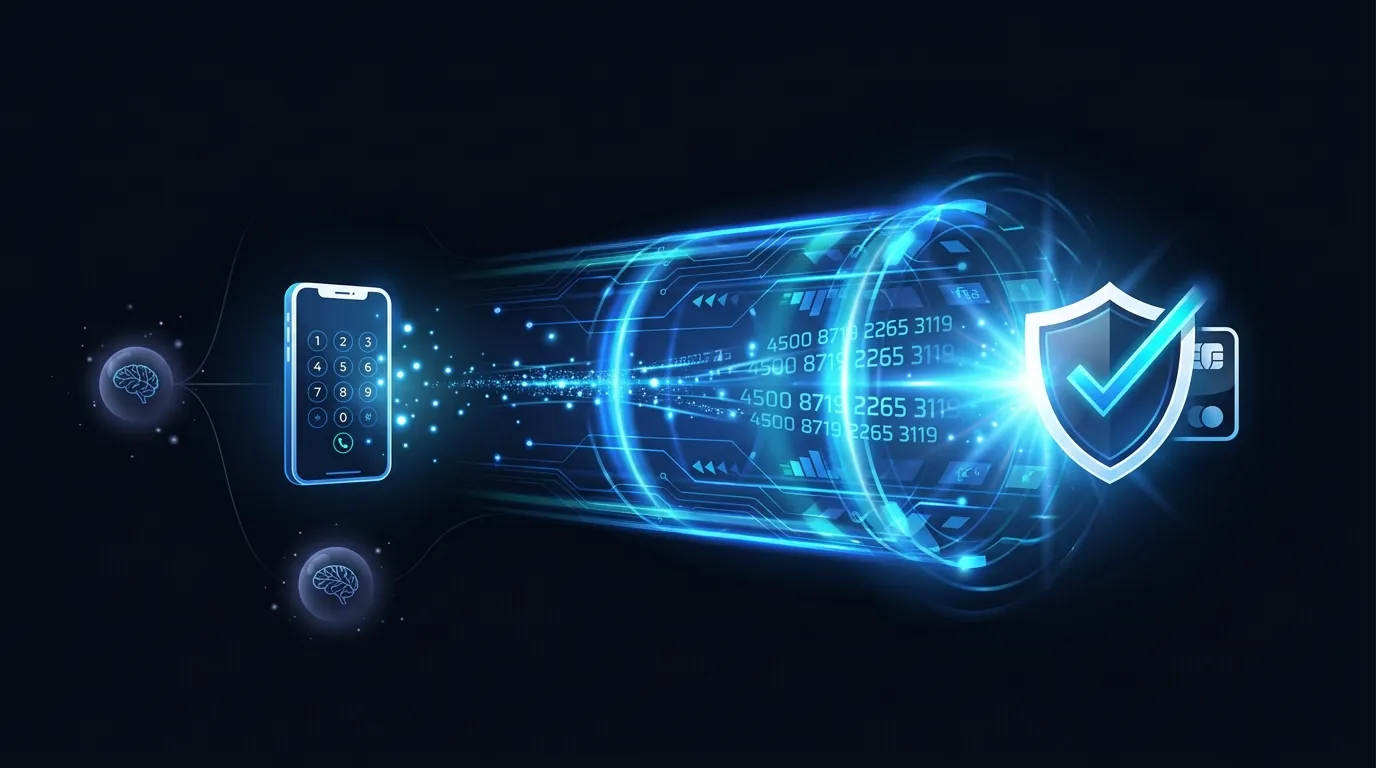
The card number travels straight from the caller's keypad to the processor, never through the agent.
Why is reading a card number to a bot a risk?
Because spoken card numbers get recorded, transcribed and stored. Every word an agent hears can land in a transcript and an audio file. If those 16 digits sit in your records, you have pulled live card data into systems never built to guard it. That is the exact thing PCI rules exist to stop.
A spoken number is the worst case. The audio captures it. The transcript captures it. Logs capture it.
Now three copies of live card data live in places your team can read. That is a breach waiting to happen. It also drags far more of your business into PCI scope than you ever want, which is why we keep the number out by default.
How does keypad capture keep the number out of the transcript?
Keypad capture routes the digits straight to the payment processor, not the agent. The caller taps the number on their phone keypad. Those tones go directly to a secure payment gateway. The agent only ever learns one thing back, approved or declined.
Think of it like a tunnel. The card number travels inside the tunnel from phone to processor. The agent stands outside the tunnel the whole time and cannot read what passes through.
So the transcript shows a payment step, then a result. It never shows a card number, because the agent never had one. This is the same discipline we use for other sensitive fields, covered in our work on PII redaction for voice transcripts.
The recording follows the same rule. The keypad moment is not narrated, so there is nothing sensitive to capture. You get a clean record of the call and a paid invoice.
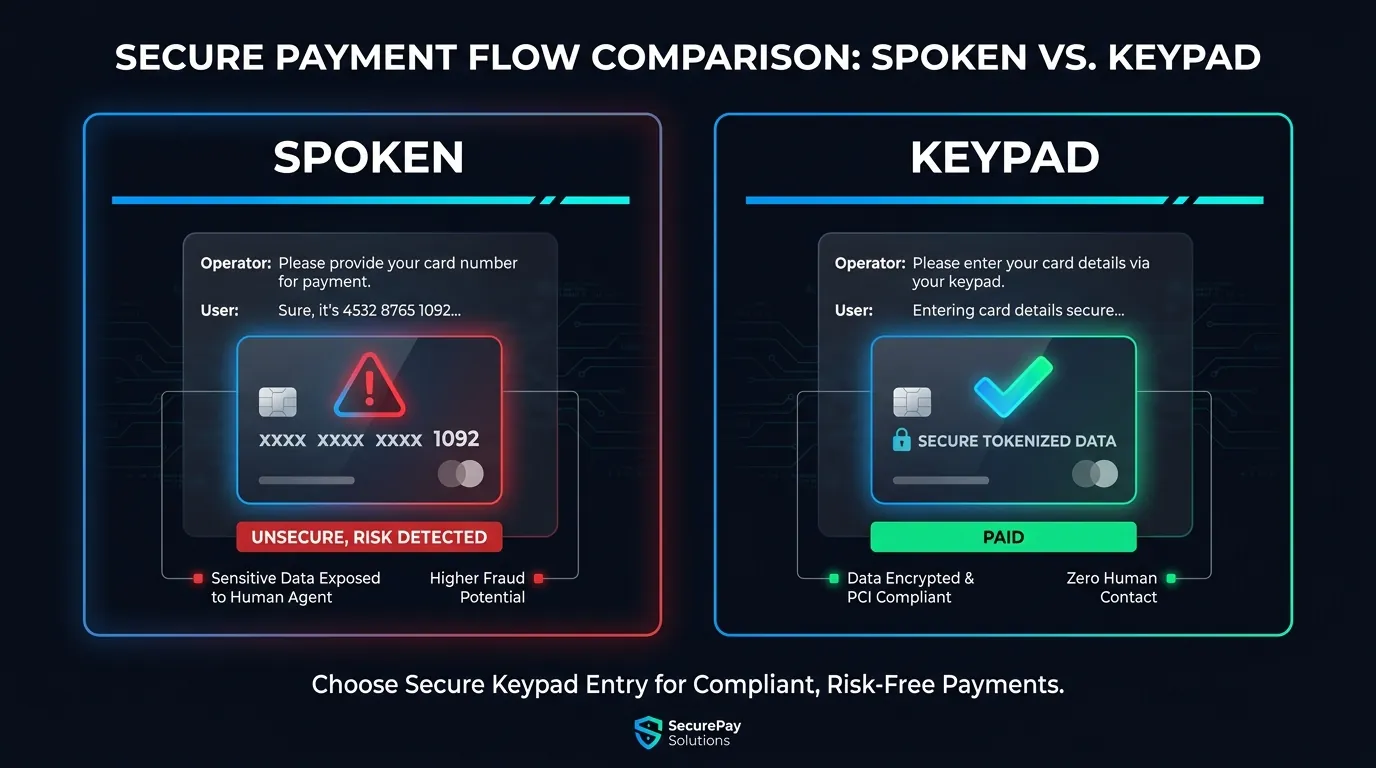
Spoken digits land in the transcript and recording; keypad capture leaves both clean.
When should a payment call transfer to a human or secure line?
Transfer when the payment is complex, disputed or high value. For a simple invoice, keypad capture is enough. For a payment plan, a refund or a confused caller, a warm transfer to a trained person or a secure line is the safer path. The handover carries the full call context, so the caller never repeats themselves.
A Tauranga dental practice does this well. Routine co-payments go through keypad. Anything over 2000 dollars, or any dispute, gets a warm transfer to the office manager.
That transfer keeps the context intact. The human picks up knowing the patient, the amount and the reason. We cover how that handover works in our piece on agent to agent transfer with full context.
The rule is simple. Easy and low value stays automated. Hard or high value goes to a person. You decide the threshold, and the agent enforces it on every call without fail.
Want payment calls that never expose a card number?
See how our secure voice agent platform keeps sensitive data out of the transcript by design.
What does PCI-aware actually mean for a small business?
PCI-aware means your payment flow is designed so card data never lands where it should not. You are not promising a giant audit. You are making sure raw card numbers stay out of your transcripts, recordings and logs. For most NZ and AU small firms, that is the practical bar that keeps you out of trouble.
PCI DSS is the card industry's security standard. The heavy version applies to businesses storing or processing huge volumes of card data. Most small firms never want to be there.
The smart move is to keep card data out of your hands entirely. Keypad capture and secure transfer do that, which is why we treat zero retention as the default for secure voice agents.
So PCI-aware for you means three things. Card numbers never enter the agent's context. Nothing sensitive sits in the transcript. The processor handles the dangerous part. That is a posture you can explain to any customer in one sentence.
How does this fit the Privacy Act and the APPs?
It fits because card numbers are sensitive personal information, and keeping them out of your records is exactly what both laws expect. New Zealand's Privacy Act 2020, overseen by the Office of the Privacy Commissioner, requires you to protect personal information. Australia's Privacy Act 1988, with the 13 Australian Privacy Principles and the OAIC, sets the same duty of care.
Both regimes care about what you collect and how you guard it. A card number you never store is a card number you can never leak.
If something does go wrong elsewhere, both countries run breach reporting through the Notifiable Data Breaches scheme. Keeping payment data out of scope shrinks your exposure. Your portal, transcripts and structured records sit on our Sydney servers, while live audio is processed offshore under documented arrangements with our voice infrastructure partner.
Every call discloses that the caller is speaking with an AI. That honesty is part of the same trust posture. We go deeper on the NZ rules in our Privacy Act 2020 compliance guide and on the location question in our data residency explainer.
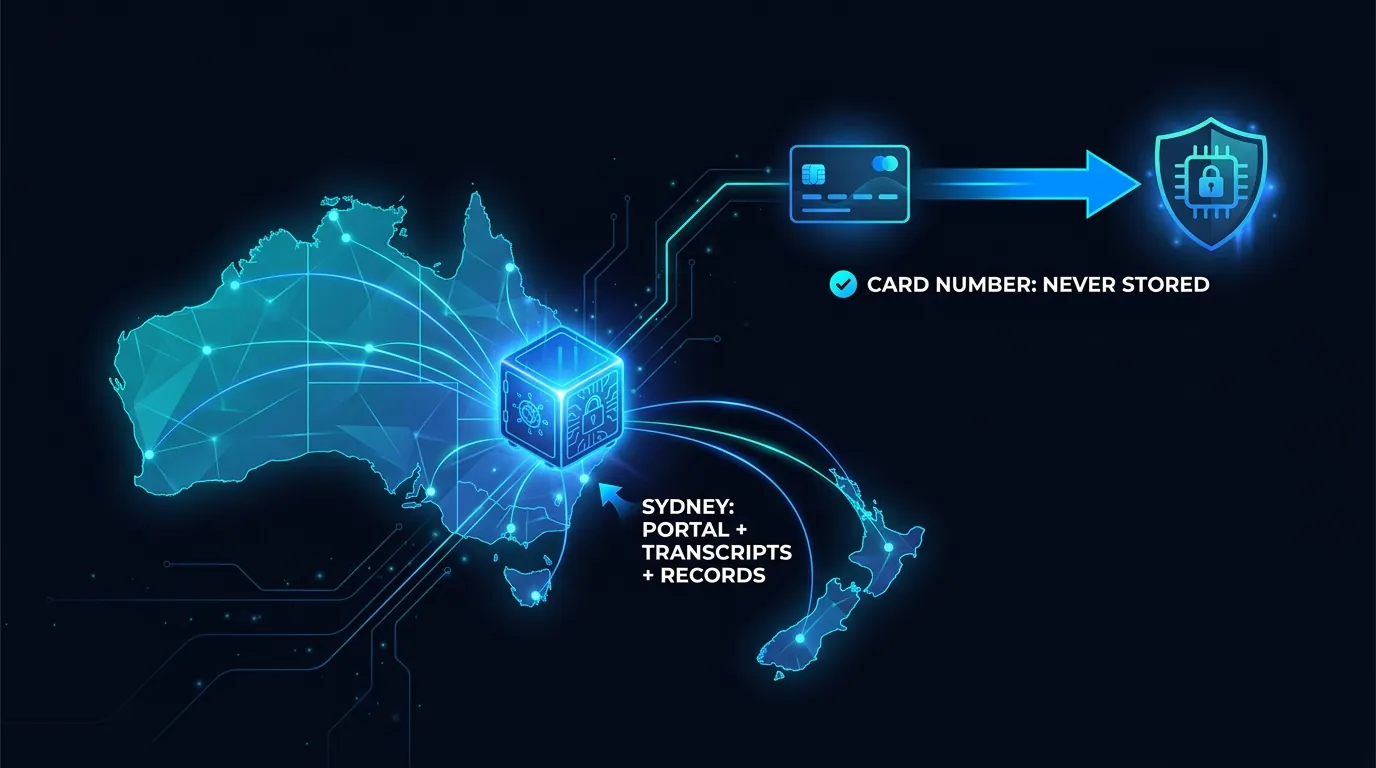
Records sit in Sydney; card numbers route straight to the processor and are never stored by us.
What should you ask a vendor about payments?
Ask whether the card number ever reaches the AI. If the answer is anything other than no, walk away. The right vendor keeps digits out of the agent's context, out of the transcript and out of the recording. They should explain keypad capture and warm transfer in plain English.
Here is your checklist for any payment-capable voice agent.
If a vendor dodges these, that is your answer. A real PCI compliant AI voice agent welcomes every one of these questions. You can see the full payment and compliance setup on our AI voice agents overview.
Ready to take payments without the risk?
Book a walkthrough of our secure AI voice agent platform and we will map your payment flow with you.
Frequently Asked Questions
Does the AI ever hear my customer's card number?
No. With keypad capture the digits travel from the caller's phone straight to the payment processor. The agent is outside that path the entire time. It only receives an approved or declined result. The number never enters the agent's context, the transcript or the recording, so there is nothing sensitive to leak later.
Can the agent process a refund or payment plan?
It can start the conversation, but complex cases warm transfer to a person or a secure line. Routine, low value payments run on keypad capture. Refunds, disputes and payment plans hand over with full context, so your customer never repeats their details. You set the dollar threshold where automation stops and a human takes the call.
Is this actually PCI compliant?
It is PCI-aware by design. The agent keeps raw card data out of your transcripts, recordings and logs, which is the practical bar most NZ and AU small businesses need. The dangerous part of the payment is handled by your processor. We help you explain this posture to customers and to your own compliance team.
Where is my payment-related data stored?
Your portal, transcripts and structured call records sit on our Sydney servers. Live audio is processed offshore under documented arrangements with our voice infrastructure partner. Card numbers themselves are never stored by us, because keypad capture sends them straight to the processor. You can delete a customer's records in 10 minutes on request.
Do callers know they are talking to an AI?
Yes. Every call discloses that the caller is speaking with an AI agent. This is part of how we meet New Zealand's Privacy Act 2020 and Australia's Privacy Act 1988 with the 13 Australian Privacy Principles. Honesty on the line is the foundation of the trust posture that makes payment handling safe.
How much does a payment call cost to run?
About 80c a minute, billed by the second. A typical payment call runs 1 to 2 minutes, so about 1 to 2 dollars. Compare that to a part-time receptionist at 28 to 35 dollars an hour before KiwiSaver or super, ACC and holiday pay. The agent handles after-hours payments at a fraction of the cost.
Leonardo Garcia-Curtis
Founder & CEO at Waboom AI. Building voice AI agents that convert.
Ready to Build Your AI Voice Agent?
Let's discuss how Waboom AI can help automate your customer conversations.
Book a Free Demo

