
Your accountant takes 40 calls a week. Each one holds a name, a phone number, a problem worth money. Now picture that conversation feeding a giant model you never signed up for. That is the fear most NZ and AU owners cannot name. So we put a no-model-training guarantee in writing.
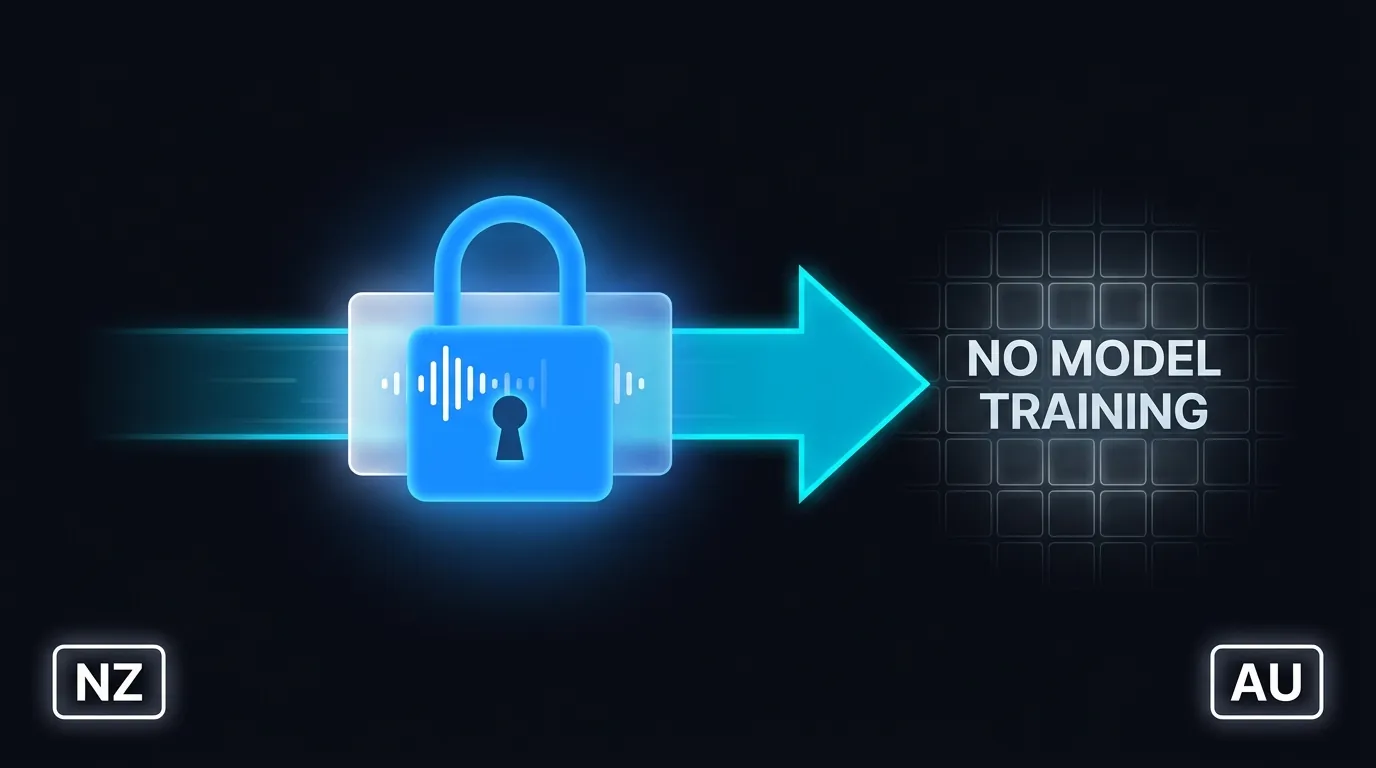
Your call data is a business asset, not training fuel for someone else's model.
Does an AI voice agent train on your call data?
It can, unless someone stops it. Plenty of consumer AI tools reserve the right to learn from what you feed them. We do the opposite. Your call data is never used to train any model, ours or anyone else's, and we put that in writing.
The default for most consumer AI is to improve the product using your inputs. That sounds harmless until your inputs are a caller's medical history. Or a buyer's offer on a house.
The data that runs through your agent is your business asset. It should not quietly become training fuel for a model serving your competitor next door.
We treat every call as your property from the first second. The transcript belongs to you. The recording belongs to you. Neither one trains anything.
What does a no-model-training guarantee actually mean?
It means three concrete promises. Your call data never enters a training set. No human reviews your calls to improve a model. And you can delete the lot in 10 minutes.
A guarantee is only worth the page it is written on. Most owners hear privacy talk and tune out. So let me make it concrete.
A receptionist agent for a Christchurch clinic handles maybe 30 calls a day. That is 30 names, 30 reasons for calling, 30 phone numbers. A no-model-training guarantee means none of that leaves your control to teach a machine.
Here is what the guarantee covers in plain terms.
The guarantee also names our sub-processors. You know exactly who is in the chain before a single call connects. That is the part generic tools refuse to give you.
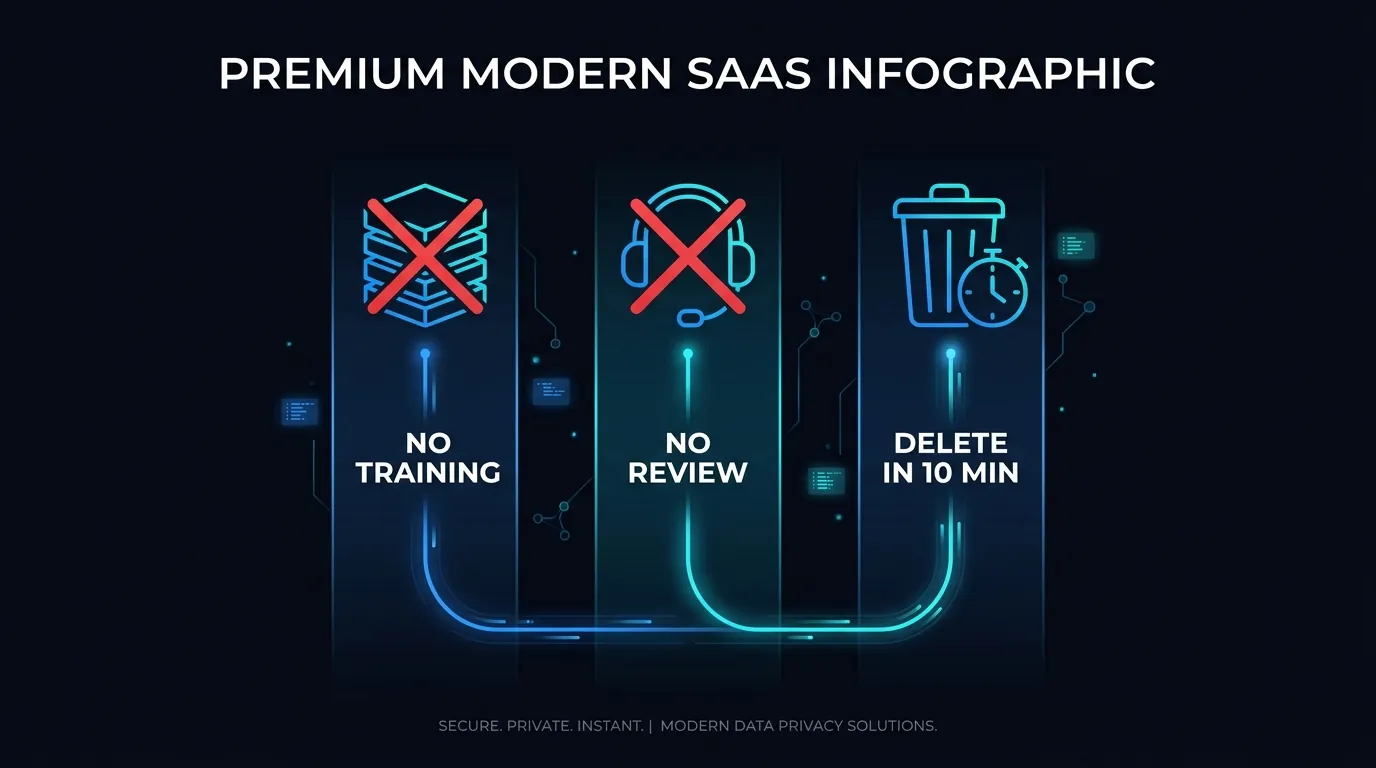
The three promises that turn a privacy claim into a contract you can hold us to.
How does this map to the Privacy Act 2020 and the Australian Privacy Principles?
Directly. NZ's Privacy Act 2020 makes you accountable for personal information you collect, even when a supplier handles it. Australia's Privacy Act 1988 and its 13 Australian Privacy Principles do the same. A no-model-training guarantee is how you stay on the right side of both.
Under the Privacy Act 2020, the Office of the Privacy Commissioner expects you to control how personal information is used. If a caller's details get repurposed for model training, that is a use they never agreed to. The OPC takes a dim view of surprise uses.
In Australia, the APPs are stricter on secondary use. APP 6 limits using information for anything beyond the reason you collected it. Training a model is a textbook secondary use.
The Office of the Australian Information Commissioner enforces this. A serious breach goes through the Notifiable Data Breaches scheme.
Our written guarantee closes that gap. We collect a call to serve the caller, and we do not repurpose it. That keeps your collection notice honest on both sides of the Tasman.
Every call also discloses the AI up front. The agent tells callers it is an AI assistant. That single sentence keeps your consent clean under both regimes.
Want the compliance picture before you sign?
See exactly how we handle call data on our AI voice agent security hub.
Where does your data go, and who can touch it?
Your structured records stay in Sydney. Transcripts, call logs and the data you actually search live on our Sydney servers. The live audio is processed offshore by our voice infrastructure partner under documented arrangements. We are honest about that split.
Nobody pretends all data sits in one country. The audio of a live call has to be processed somewhere fast, and that happens offshore. The moment it becomes a record you can read and search, it lives in Sydney.
That is the honest residency split, and we spell it out.
Access is tight. Your team sees your data. We hold documented arrangements with our voice infrastructure partner that bar them from training on it. No mystery third parties get a look.
We cover the full picture in our guide to data residency for NZ and AU and in our breakdown of zero-retention secure call data.
What should you get in writing from a vendor?
Four things. A no-model-training clause. A named list of sub-processors. A deletion commitment with a stated timeframe. And the residency split for where records sit versus where audio is processed.
If a supplier dodges any one of these, walk. Most owners sign a sales contract and never see the data terms.
Ask for them before you pay. A real AI voice agent provider hands these over without flinching.
Here is the checklist we hand clients.
We walk through the rules in our note on the Privacy Act 2020 for AI voice agents and our wider voice AI privacy guide.
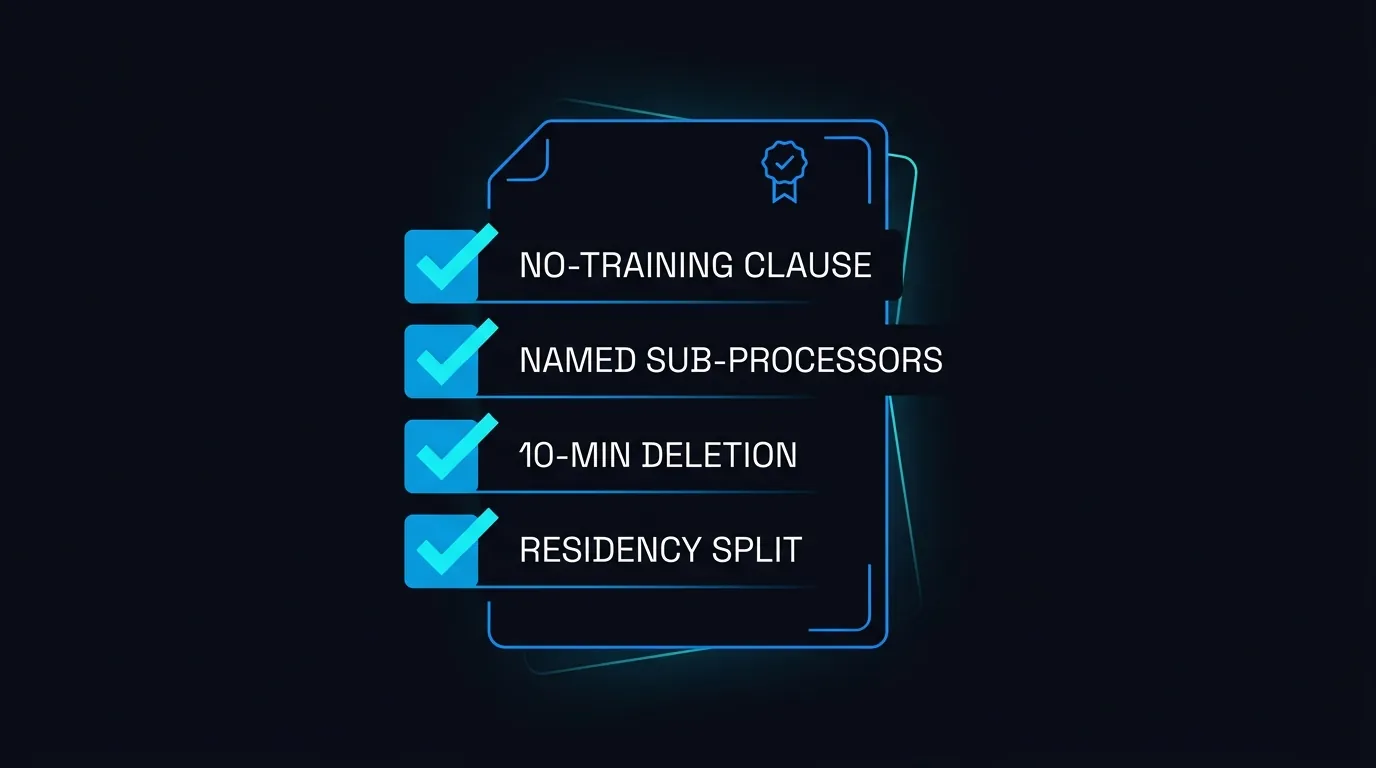
The four data clauses to demand in writing before you pay a single invoice.
Why do generic AI tools fail this test?
Because their business model is your data. Free and cheap consumer AI tools fund themselves by learning from inputs. That is the trade.
For a clinic or a law firm, that trade is a compliance landmine. A generic chatbot bolted onto a phone line gives you no residency control and no deletion clock. It also gives you no named sub-processors.
You cannot tell a caller where their information went, because you do not know.
There is also the redaction problem. Generic tools rarely strip out sensitive details before storage. We redact personally identifiable information from records by default, which we cover in our PII redaction guide. A generic tool stores the raw lot.
So the cheap option is not cheap. One breach notification to the OAIC or the OPC costs more than years of a proper platform. The AI voice agent no model training guarantee is the difference between a tool and a partner.
How do you verify the guarantee?
You test it. Ask us to delete a test call, then confirm it is gone. Request the named sub-processor list and check it matches the contract. Run a real call and read the disclosure script.
A guarantee you cannot verify is just marketing. We expect clients to check.
Book a test call, give the agent a fake name and number, then ask us to wipe it. You will see the record vanish inside 10 minutes.
We also publish our security posture rather than hiding it. The full picture sits on our AI voice agent security hub, and you can see the wider product on our AI voice agents overview. Verification is built into how we work.
The numbers stay sane too. An answered call averages about 30 seconds, roughly 40 cents. A one to two minute call runs about one to two dollars. None of that data trains a model. You pay for the call and you keep the asset.
Get the guarantee in writing.
Read how we protect every call on our AI voice agent security hub, then ask us for the contract terms.
Frequently Asked Questions
Does Waboom AI use my call recordings to train models?
No. Your call recordings and transcripts are never added to any model's training data, ours or a third party's. We put that in writing as a no-model-training guarantee. No engineer reviews your calls to tune a product either. The data is your asset from the first second, and you can delete it in 10 minutes.
Where is my call data stored under your residency model?
Your structured records, transcripts and call logs live on our Sydney servers. Live audio is processed offshore by our voice infrastructure partner under documented arrangements. We never claim all data stays in Australia. The honest split is records in Sydney, live audio processed offshore, with both covered in our data residency guide.
Does this meet the Privacy Act 2020 and Australian Privacy Principles?
It is built for both. NZ's Privacy Act 2020 and the Office of the Privacy Commissioner expect you to control how information is used. Australia's Privacy Act 1988 and the 13 APPs limit secondary use under APP 6, enforced by the OAIC. Our no-training guarantee keeps you compliant on both sides of the Tasman.
Can I delete a caller's data, and how fast?
Yes, in 10 minutes. You ask, and we remove the transcript and recording from our systems. This is an authorised deletion commitment with a stated timeframe, not a vague promise. We recommend you test it. Book a call, then ask us to wipe it, and watch the record disappear.
What sub-processors are involved in a call?
A named, documented list you receive before any call connects. Live audio runs through our voice infrastructure partner under documented arrangements that bar training on your data. There are no mystery third parties. Generic AI tools refuse to name their chain, which is exactly why they fail a serious compliance review.
Do callers know they are talking to an AI?
Yes, every time. The agent tells callers it is an AI assistant at the start of the call. That single disclosure keeps your consent clean under both the NZ Privacy Act 2020 and the Australian Privacy Principles. It also builds trust. Callers respond better when nobody is pretending to be human.
Leonardo Garcia-Curtis
Founder & CEO at Waboom AI. Building voice AI agents that convert.
Ready to Build Your AI Voice Agent?
Let's discuss how Waboom AI can help automate your customer conversations.
Book a Free Demo

