Waboom AI Handles Call-Recording Consent Across Every Australian State and New Zealand
One opening line satisfies all eight Australian jurisdictions plus New Zealand. On inbound calls it plays by default; on outbound campaigns it runs when your jurisdiction or your policy needs it. You don't write the script. You don't manage state-by-state variants.
TL;DR
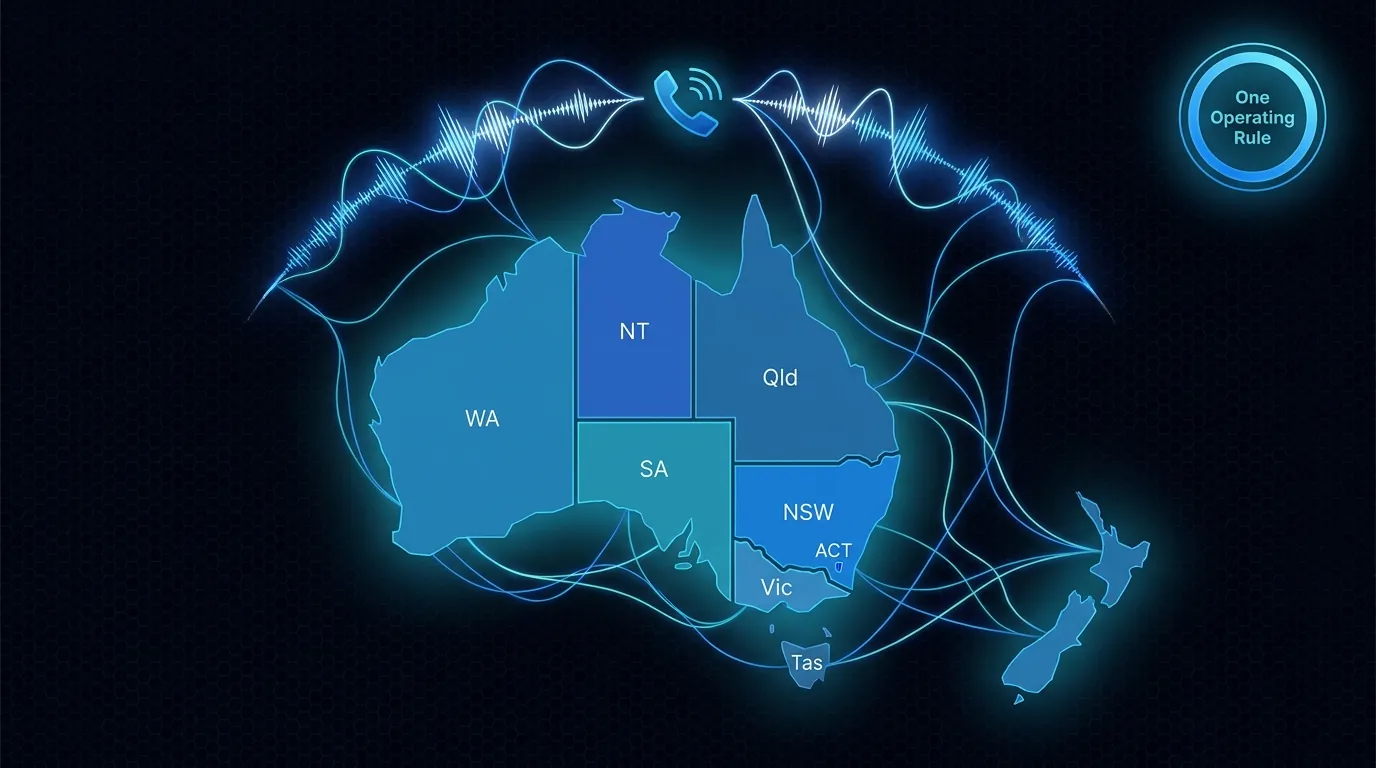
One opening line satisfies all eight Australian jurisdictions plus New Zealand. NSW, WA, SA, Tas and ACT are all-party consent. Vic, Qld and NT are one-party. New Zealand allows party recording with disclosure for the collection-notice rule.
On inbound calls, our agents open with a recording disclosure by default. On outbound campaigns, the same disclosure runs when your jurisdiction or your policy needs it. Either way, every agent is prompted to confirm recording on the spot if a caller asks. You don't write the script. You don't manage state-by-state variants. You don't pick which jurisdictions your campaigns can run in.
Here's the table that proves it.
Is it legal for a Waboom AI agent to record a call in Australia?
Yes, in every state. Our agent is a party to the call, and we disclose the recording at the start. That satisfies the all-party group (NSW, WA, SA, Tas, ACT) through informed consent at the opening line, and over-complies politely in the one-party group (Vic, Qld, NT) at no cost to the conversation. The wider picture of how dumb AI platforms get you fined is why we build this into the floor, not the upsell.
The federal answer
The Telecommunications (Interception and Access) Act 1979 (Cth) governs interception. A party to the conversation recording its own call is not "interception" under section 6. Federal law doesn't bind our agent in this scenario.
The state answer (this is where it gets interesting)
State Surveillance Devices Acts bind concurrently with the federal regime. Five Australian jurisdictions require all-party consent for recording a private conversation. Three accept one-party. The table below has every row your compliance officer needs.
Why our disclosure approach handles every state at once
Disclosure at the start of the call does three things at once. Satisfies the all-party states through informed consent. Harmlessly over-complies in the one-party states. Covers your collection-notice obligation under Australian privacy law, which says you have to tell individuals when you start collecting their data.
The Australian state-by-state table
This is your reference table. One row per jurisdiction. Verified against the current versions of each Surveillance Devices Act as in force in 2026.
| Jurisdiction | Governing Act | Consent regime | How a Waboom AI agent handles it |
|---|---|---|---|
| NSW | Surveillance Devices Act 2007 (NSW) s 7 | Consent of each principal party required, effectively all-party | Disclose recording at start. Implied consent if the call continues. We don't rely on Section 7(3)(b)(i) "lawful interest" exception. |
| Vic | Surveillance Devices Act 1999 (Vic) s 6 | One-party. A party to the conversation can record. | Lawful as a party. We disclose anyway for the federal collection-notice rule. |
| Qld | Invasion of Privacy Act 1971 (Qld) s 43 | One-party. Party recording is not an offence. Publication is separately restricted. | Recording lawful. Downstream sharing scoped to your account only. |
| WA | Surveillance Devices Act 1998 (WA) s 5 | All-party. Recording a private conversation without consent of each party is an offence. | Express disclosure at the start of the call. Implied consent on continuation. |
| SA | Surveillance Devices Act 2016 (SA) s 4 | Effectively all-party. Party-recording allowed if reasonably necessary to protect a lawful interest, or with consent. | Disclosure plus consent on continuation. |
| Tas | Listening Devices Act 1991 (Tas) | All-party for private conversations. A party may record with consent of each principal party. | Disclosure plus consent on continuation. |
| ACT | Listening Devices Act 1992 (ACT) | All-party rule for private conversations. | Disclosure plus consent on continuation. |
| NT | Surveillance Devices Act 2007 (NT) | One-party. Recording by a party is permitted. | Lawful as a party. We disclose anyway for the federal collection-notice rule. |
Three jurisdictions (Vic, Qld, NT) are one-party. Five (NSW, WA, SA, Tas, ACT) are all-party in practice. One opening line covers both columns. It plays by default on inbound calls and runs on outbound when your jurisdiction or your policy needs it.
What about the federal Telecommunications (Interception and Access) Act 1979?
It doesn't bind our agent. The agent is a party to the call by design. Section 6 defines interception as recording a communication "in its passage over a telecommunications system" without the knowledge of the person making the communication. A party to the call has knowledge by definition, so our agent sits outside the prohibition. The Act targets third-party wiretapping, and Australian courts have read it that way consistently since the Act's introduction.
The interaction between federal and state law
Federal law sets the wiretapping floor. State law sets the consent regime for party recording. Waboom AI complies with both by handling the state-level disclosure rule on every call, since federal law isn't engaged in the first place.

Is it legal for Waboom AI to record a phone call in New Zealand?
Yes. Our agent is a party to the call. New Zealand law allows party recording, with disclosure separately required under the Privacy Act 2020 collection-notice rule. The clear exception sits in the Crimes Act 1961. We handle both rules with the same opening line.
The exception in the criminal code
The general offence covers intentional interception of a private communication by an interception device, with up to two years' imprisonment. There's a clear exception for a party to the communication. It's unambiguous and applies to our agent on every call.
Why "party to the conversation" makes recording lawful
A Waboom AI agent making or receiving the call is a party to the call. The party exception applies. Criminal liability is off the table.
The Privacy Act 2020 disclosure rule, handled by default
Anyone collecting personal information has to make the individual aware of the collection. A recording is collection. Our opening line covers the privacy side of the ledger at the same time as the criminal side.
What's the one operating rule that works everywhere?
Disclose recording at the start of the call, regardless of state, regardless of country. One line of audio satisfies five Australian Surveillance Devices Acts, three one-party regimes, and the federal collection-notice rules in both Australia and New Zealand. Five compliance objectives, one sentence. On inbound calls it plays by default; on outbound campaigns it runs when your jurisdiction or your policy needs it, and every agent is prompted to confirm recording on the spot if a caller asks.
Want your recording-disclosure copy as a template?
We'll send you the exact opening line our agents use, plus the variants for your healthcare, finance, and outbound campaigns.
Get your templateHow our agents handle the opening on every call
The disclosure happens before any conversational content. The caller has the option to hang up. Continued engagement counts as implied consent in every jurisdiction that uses that doctrine.
What our agent actually says
"Hi, you've reached Smith Real Estate. I'm Mia, an AI assistant. This call may be recorded for quality and accuracy."
That's the canonical opener. Industry-specific variants swap "accuracy" for "clinical accuracy" in healthcare or "training and compliance" in finance. Why a localised NZ or AU persona matters for the line that comes right after.

Opening disclosure configured in the Waboom AI portal: Agent Settings > Behaviour. The default opener satisfies AU Surveillance Devices Acts, NZ Crimes Act s 216B, and AU Telecommunications Act caller-ID identification in a single line.
Why this also satisfies the federal collection-notice rules
Both Australia and New Zealand require you to notify the individual at or before collection. Audio disclosure at call start handles both. No separate written notice is required when the call is the collection moment.

How does Waboom AI catch a "stop calling me" moment without your team listening to every call?
Three layers, all on by default. A real-time do-not-call detector on every conversation. A CSV uploader that cross-checks every new list against your existing DNC list before any call queues. Agents trained to answer the source-of-data questions a prospect will fire back when they pick up.
Automatic do-not-call detection on every conversation
Every Waboom AI conversation runs through 24 do-not-call trigger phrases in real time: "stop calling", "do not call", "remove me", "take me off", "leave me alone", "unsubscribe", "opt out", and 17 variants. Any match auto-flags the number on your DNC list. No human intervention.
Your team doesn't have to read every transcript to catch the "stop calling me" moment. The agent catches it. The portal stores it. The next campaign respects it.
CSV re-upload safeguard against accidental DNC violations
The CSV uploader checks every new contact list against your existing DNC list at upload time. A prospect who asked to be removed last quarter can't get called again by mistake next quarter. Flagged matches surface before any call queues.
Agents that answer source-of-data questions live (IPP 3A)
Under New Zealand's IPP 3A (live 1 May 2026), you must tell prospects where their data came from. Waboom AI agents are configured to answer "how did you get my information?", "why are you calling?", and "who is this on behalf of?" live during the call, reading the source field from your CRM. The disclosure script is tunable per campaign without dropping the legal floor.
What do we log about every call, and for how long?
Call metadata, transcripts, and structured fields by default for 30 days, configurable from 1 to 730 days per agent. Sydney servers hold the portal piece (your transcripts, structured call data, audit logs, contact lists). The voice runtime runs on a SOC 2 Type II audited platform we built Waboom AI on top of, the same enterprise-grade foundation used by financial services, healthcare, and government clients worldwide. That foundation is what delivers sub-second response on the call. When a deletion request arrives, a single action completes across every layer in under 10 minutes. Full mechanics sit at the security pillar.
Frequently Asked Questions
Is your AI voice agent built to satisfy 8 jurisdictions on day one?
Talk to us about your rollout.
Get in touchRelated reading
Sources
- Surveillance Devices Act 2007 (NSW), legislation.nsw.gov.au
- Surveillance Devices Act 1999 (Vic), legislation.vic.gov.au
- Telecommunications (Interception and Access) Act 1979 (Cth), legislation.gov.au
- Crimes Act 1961 s 216B (NZ), legislation.govt.nz