
"Call me back later" is where most sales pipelines quietly leak. The caller means it.
Your rep writes it on a sticky note, or trusts their memory, or logs it in a CRM nobody reopens. Two weeks on, the note is gone. So is the deal.
Every business owner has that graveyard. The pile of people who said "yeah, give me a call back" and never heard from anyone again.
We built our voice agents to close that loop. Every single "call me back" gets handled, with the context of the first call intact.
Here is how it works.
What actually happens to a "call me back" today?
In most sales teams, nothing reliable. A busy week buries the callback, and the lead goes cold.
Not because the pitch was wrong. Because the second call never happened, or came 3 weeks too late with none of the original context.
The fix is not "try harder to remember". It is to take the remembering off your team, so every callback actually happens.
Who gets a person, and who does the agent handle?
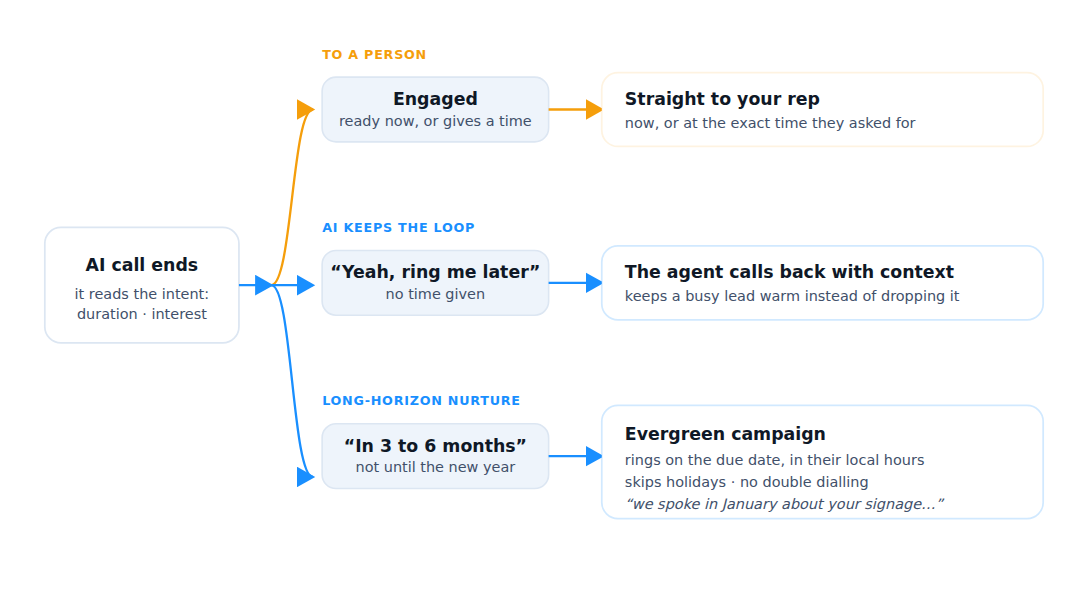
Not every callback is equal, so they do not all land in the same place. When an outbound agent finishes a call, it reads the intent and routes from there.
Someone engaged, ready to talk now or with a time in mind, goes straight to your rep. A person calls them, right away or at the exact time they asked for.
Your team spends its day on the leads actually raising a hand. Not chasing the maybes.
A vague "yeah, ring me back later", with no time attached, is where leads usually die. The agent takes that one itself.
It rings back with the full context of the last call, so a busy but interested lead stays warm. The callback just happens. It is the same routing behind our AI sales agent.
What about "call me in three months"?
This is the one every system drops. A caller says "I'm interested, but not until the new financial year", and they may as well have hung up. Three months is longer than any reminder survives.
So we built a standing nurture campaign that sits alongside your live one. Ask to be rung back in a few months and you route into it automatically, tagged with the date and what you wanted. Nobody types a thing.
On that date, the agent rings. It opens with the real thread: "Hi, we spoke in January about your signage, you asked me to check in around now."
It calls inside their local business hours, not yours. An Auckland lead never gets a call at 6am, a Perth lead never at dinner. It skips public holidays and holds a cooldown, so nobody is double dialled.
The lead you would have lost to the calendar rings back at the moment they said they would be ready.
Why does the context matter more than the callback?
A callback with no memory is a cold call wearing a name tag. "Hi, I'm calling from" and the person has already checked out.
A callback that opens with "we spoke in January about your signage" is a different conversation. It respects their time. It proves someone listened.
It picks the thread back up instead of starting a new one. That is the gap between a follow up that converts and one that gets hung up on. It is the part a human under pressure almost always loses.
This is the loop every sales team has been missing
For years, the honest answer to "what happens to the call me back leads" has been a shrug. Now every one of them has a home, and it pairs with the way our agents already handle inbound lead qualification and outbound calling.
Nothing falls through. Not the driving one, not the six month one, not the one your best rep forgot on a Friday.
This is the loop every sales team has wanted and almost nobody has had. The follow up finally runs itself, on the context of what was already said.
Frequently asked questions
What decides whether a callback goes to a person or the agent?
The agent reads the last call. Someone ready to talk now, or who names a specific time, goes straight to your rep. A vague "ring me later" with no time is handled by the agent, which calls back with context. A "call me in months" routes into the nurture campaign.
How does the agent know what to say on the callback?
It carries the context of the previous call. On a short callback it opens with "returning your call as you asked". On a long nurture callback it opens with what you last spoke about and when, so it never starts cold.
What stops the agent calling someone back at a bad time?
Nurture callbacks fire inside the contact's own local business hours. They skip public holidays and hold a cooldown, so nobody is double dialled. A caller who asked for March gets rung in March, during their working day, not yours.
Is this only for outbound sales?
It fits any team that runs callbacks: inbound receptionist overflow, outbound sales, lead qualification. Anywhere a caller says "not now, later", the same routing applies.
Ready to close the loop on every "call me back"?
See what your follow up looks like when it runs itself, on the context of every call, across NZ and AU.
Leonardo Garcia-Curtis
Founder & CEO at Waboom AI. Building voice AI agents that convert.
Ready to Build Your AI Voice Agent?
Let's discuss how Waboom AI can help automate your customer conversations.
Book a Free Demo

