
5 min read · Operator perspective · Last updated 29 May 2026
Picture a stand at EMEX. A big screen behind me showing a live machine dashboard. A microphone in my hand. And an AI voice agent that, mid sentence, reaches into the real numbers off a CNC cell, works out something is wrong, and logs a maintenance ticket while the crowd watches.
That was our three days at EMEX 2026. No slides about some far-off future. A working thing, running live, in front of people who make parts for a living. The looks on their faces are the whole reason I'm writing this.
What EMEX actually is
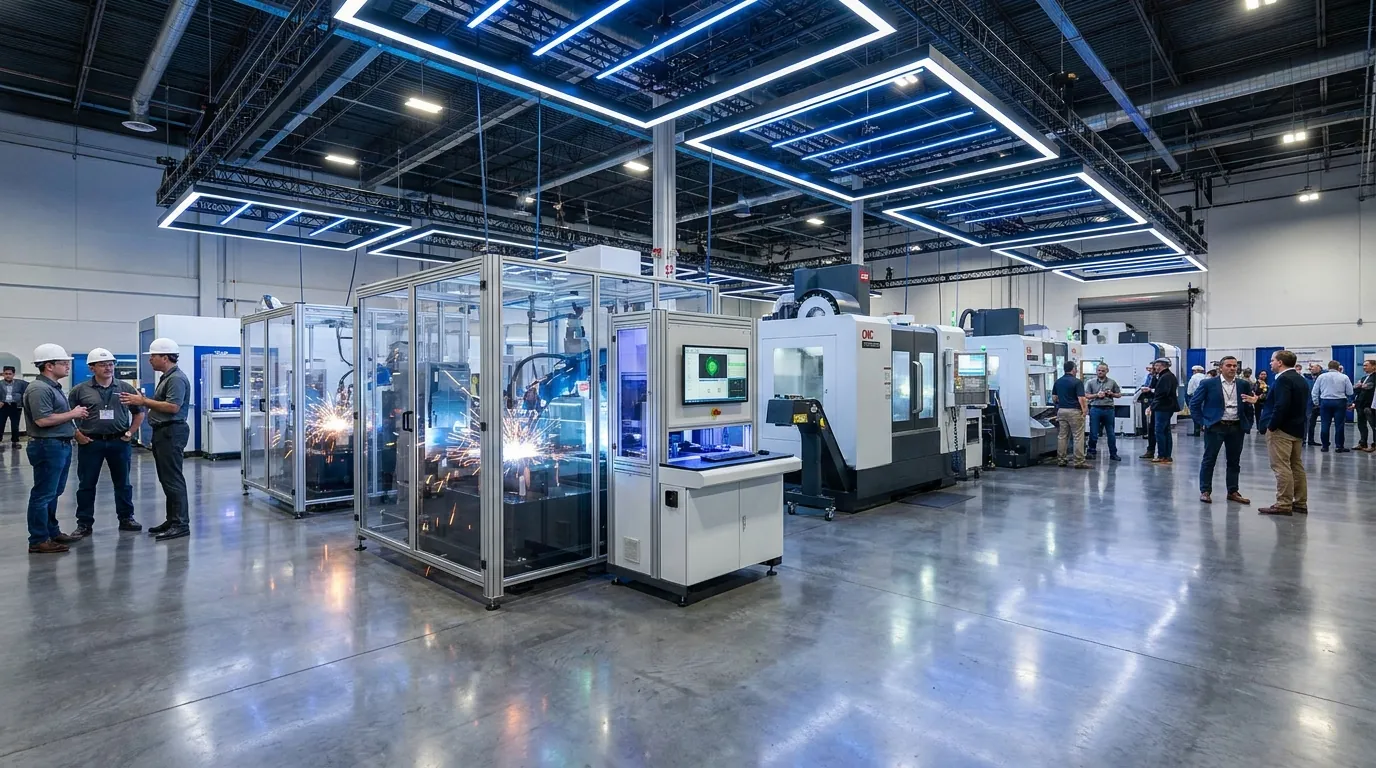
EMEX is New Zealand's leading trade event for engineering, manufacturing and technology. Three days at the Auckland Showgrounds, Tuesday 26 to Thursday 28 May, and the floor is wall to wall with the real stuff. Welding robots, CNC machines, automation, measurement, the lot. Around 250 stands.
Wednesday is the peak. The aisles were packed by mid morning and stayed that way. Tuesday warms up, Thursday winds down, but the middle day is where the whole industry shows up at once. If you build things in this country, EMEX is the room you want to be in.
We had the floor as a guest speaker
We didn't just stand at a booth. We had a speaking slot, a talk called Hands-Free AI for the Factory Floor, and we used it to answer one question. What can an AI agent actually do on a factory floor today, not in five years?
Here is the honest read of the room. People are dabbling. They've typed into ChatGPT once or twice. They've seen a demo somewhere. But most of the engineers and plant managers I spoke to still don't know what's genuinely possible. We're in the dabbling era. That's not a criticism. It's exactly where you'd expect a whole industry to sit a year into all this.
So instead of telling them, we showed them.
The agent read the fictional factory floor we set up while I talked to it
We built a live demo for this. It's a real time view of a CNC production cell, an aluminium bracket line, with every machine reporting output rate, spindle temperature, vibration, reject rate and more. The numbers refresh every three seconds.
Here is the part that landed. I never touched a keyboard. I stood there, hands free, and just talked to the agent the way I'd talk to a colleague. Every time I asked it something, it made a function call in the background to fetch the live data, then answered out loud. How is this machine doing? It called for the numbers, read them back, and told the crowd in plain English what looked healthy and what didn't. No typing. No hunting through screens. A conversation.
Then it went past a lookup. The agent spotted a machine producing less than it should, and it didn't just flag it. It called another function and raised a maintenance ticket on the spot, while I was still mid sentence. So I asked a simple operator question. Had anything changed on that machine recently? It checked the record. Eighteen minutes earlier, someone had swapped some parts. That someone was Bob.
From a question to a root cause in seconds
The ticket didn't just say "machine slow". It said output had dropped, parts were changed 18 minutes ago by Bob, go and talk to Bob. That's the difference between an alert and an answer.
That's the moment the room shifted. It's one thing to hear that AI can help your operations. It's another to watch an agent hold a conversation, make real function calls into live machine data, reason about a likely cause, name the person, and log the ticket itself, all hands free and all in about the time it takes to ask the question.
This is how businesses are going to run
Strip the demo back and here's the shape of it. A person talks. The agent listens, works out what data it needs, calls for it, reasons over what comes back, and takes the action. Read the dashboard. Raise the ticket. Update the record. Nobody driving a mouse.
That's the future we were really showing. Not a chatbot sitting in a corner of a website. An AI voice agent that sits across your tools, holds a normal conversation, and does the work a person would do if they had a spare pair of hands and instant recall of every number on the floor. The phone version answers your customers. The floor version answers your team. Same engine, pointed at different jobs.
We're closer to this than most people at EMEX realised. The function calling, the live data, the ticket, all of it ran on the same Claude Code build we teach in a day. None of it was smoke. It was the actual thing, doing actual work, hands free, in front of a few hundred witnesses.
Why the booth stayed busy for three days
People didn't drift past. They stopped, watched the whole thing, then asked the same question over and over. How do I build that? Three days of it. It was one of the busiest conversations we've ever had, and almost none of it was theory. It was about agents doing real work against real data.
That tells me something. The appetite is way ahead of the understanding. People can feel that this matters. They just haven't been shown a version that clicks. Show them one that does, and they lean right in.
What everyone actually wanted to learn: Claude Code
One name kept coming up. Claude Code. Over and over, the follow up wasn't "can you build this for me", it was "can you teach me to build this". Engineers are builders by nature. The second they saw an agent calling functions against live data, they wanted their hands on the tools.
That's exactly what our Claude Code workshop is for. A practical day where you build AI workflows that do real work, the same way we built the agent on that stage. If you caught us at EMEX, that's your next step.
We came home sure of one thing. The dabbling era ends the moment someone sees what's actually possible. At EMEX, a few hundred people just did.
Frequently Asked Questions
What is EMEX?
EMEX is New Zealand's leading trade event for the engineering, manufacturing and technology industries. It runs over three days at the Auckland Showgrounds, 26 to 28 May 2026, with around 250 stands of robots, CNC machines, automation and measurement gear. Wednesday is the busiest day.
Can an AI voice agent really read live machine data?
Yes. In our EMEX demo the agent called straight into a live CNC dashboard, pulled current output, temperature, vibration and reject figures, and explained in plain English what each machine was doing. In a real deployment that data comes from your MES, ERP or maintenance system rather than a demo feed.
What happened in the live EMEX demo?
While I talked to the agent on stage, it read a machine that was underproducing and raised a maintenance ticket. When I asked whether anything had changed, it found that parts had been swapped 18 minutes earlier by a named operator and put that on the ticket. The crowd watched an agent go from a question to a likely root cause to a logged action in seconds.
How do I learn to build AI agents like this?
Start with our Claude Code workshop. It's a hands-on day where you build working AI workflows yourself, the same approach behind the agent we demoed at EMEX. You don't need a heavy coding background.
Missed us at EMEX? Come and build your own
We run a hands-on Claude Code workshop where you build the kind of agent we demoed on stage.
Leonardo Garcia-Curtis
Founder & CEO at Waboom AI. Building voice AI agents that convert.
Want your team to actually use these tools?
Waboom AI runs hands-on AI training and Claude workshops for teams across New Zealand and Australia.
Explore AI Team Training

