Nathalie Moolenschot, GM of Marketing and eCommerce at Animates, posted something this week worth sitting with. She rang her local bistro to book dinner. The phone was answered by an AI assistant called Sadie. Took the details, sent a confirmation by SMS, did the job. Exactly what you'd expect in 2026.
Most of the chatter on Nathalie's post focused on a clever detail: a typing sound the AI played while capturing the booking, and a faint ambient restaurant noise underneath the call. Smart design choices, no doubt. But honestly, that's not the headline.
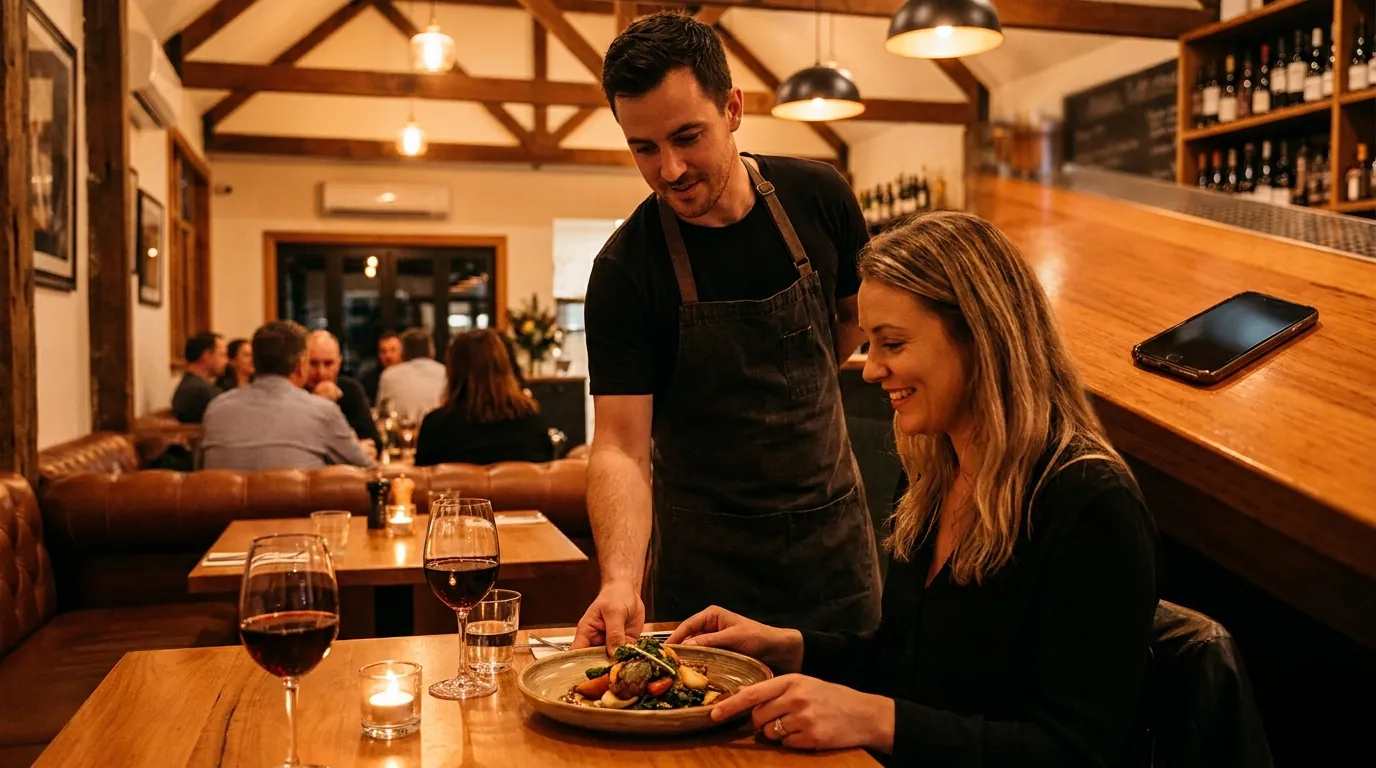
The headline is what wasn't on the call. The owner. The kitchen team. The waitstaff. None of them stopped what they were doing to take a phone booking. None of them got pulled out of a moment with a customer at table six to deal with a confirmation.
Sadie took the booking. The humans at the bistro got to keep being humans where it counted.
(Sadie isn't ours, by the way. Fabric Cafe Bistro is using a different platform and we don't know which one. The point of this post isn't who made the agent. It's what the agent freed up.)
Nobody reviews the phone call
Think about the last restaurant you reviewed. You wrote about the food. The wine. Whether the service was attentive without being annoying. Whether the table next to you was too loud. Whether the waiter remembered you were there to celebrate something.
You didn't review the phone call.
Phone calls are hygiene. If they go well, you don't notice. If they go badly, you notice once and never come back. There is no upside to a brilliantly answered phone call. The most a perfect phone interaction can do is not damage the rest of the experience.
The food, the floor, the table, the second visit. That's where the review comes from. That's where the moat is.
For years small business owners have spent half their day in the wrong half of that ledger. Stuck on the phone for general enquiries. Booking changes. Confirmation calls. "What time do you open on Sunday." "Do you have gluten-free options." "Do I need to book." Every one of those calls pulled them out of the part of the business that actually creates the memory.
That's what the AI changes. Not by being clever. By being repetitive.
What moves the needle vs what eats the day
Make a list of every phone interaction your business has in a typical week. Now sort it into two columns.
Repetitive (the AI should do this):
Needle-moving (the human should do this):
Look at the two columns. Owners and managers spend most of their day in the first one. Most of the second one happens in the gaps between calls.
That's the operational pattern AI voice agents are correcting. Not by replacing the human. By taking column one off the human's plate so column two gets the attention it actually deserves.
What this looks like in NZ deployments
We've been running this pattern across 30 NZ businesses on our platform, and the pattern is consistent across industries.
Hospitality. A 40-room Auckland boutique hotel stopped bouncing after-hours calls to voicemail. Reception staff stopped spending their first 40 minutes each morning calling back voicemails. Bookings up 47%, but the bigger change was that reception went from playing catch-up to actually being attentive when guests checked in at 7am.
Restaurants. A 70-seat Wellington restaurant had its owner-chef trying to take Saturday-morning bookings between knife cuts during prep. He moved that 9am-11am window to AI. The bookings stopped leaking. But what he actually said about the change: "I just cook now."
Trades. A solo Auckland mobile mechanic was missing 42% of weekend enquiries because he couldn't take calls while under a vehicle. We covered the deployment here. AI handled the booking and the standard quote ranges. He kept the work that needed his hands.
Healthcare. A Hamilton home-care service had its admin team handling a constant stream of inbound enquiries. The team was administratively overwhelmed and clinically under-utilised. AI took the front layer. The administrators got time back. The clinicians got better-qualified intakes.
The pattern is identical across all four. The AI does the thing that was eating the day. The human does the thing the customer actually remembers and reviews.
The economic timing
We're in the tightest small-business operating environment NZ has seen in 15 years. Margins squeezed. Headcount frozen or cut. Hiring takes months and costs more than it used to.
The default response to "we have too much phone admin" used to be "hire another part-timer." That option is gone or expensive for most operators in 2026. Voice AI fits because the per-minute cost is roughly $0.80 NZD, the typical inbound call costs about $0.40, and the unit math beats a $25/hour part-time receptionist on most volumes. Full pricing breakdown here.
But the real story isn't cost. It's that the cost-saving option also happens to be the experience-improving option. The owner gets out of the phone admin. The customers get a faster, more consistent first interaction. The reviews get better, because the human time goes to the moments that actually generate them.
Two wins from one decision. Rare in this category.
What it looks like to do this well
Three things separate the operators who get this right from the ones who don't.
1. Pick the worst window first. Don't deploy AI for 24/7 inbound on day one. Find the 2-hour window where the phone is hurting you most (kitchen prep on a Saturday, weekday after-hours, lunchtime) and start there. Smaller risk, faster validation, the ROI maths is brutal in your favour at the worst window.
2. Match the AI's job to one column. The AI should do repetitive things very well. Booking, FAQs, triage, reminders. It should not do the things in column two. When in doubt about which column a call falls into, the AI should transfer with context, not improvise. Every "let me put you through to one of my colleagues, just a moment" is better than a confused half-answer.
3. Use the time you save for column two. This sounds obvious but most operators we work with don't actively redirect the recovered time. The AI saves you 90 minutes a day. If you fill that 90 minutes with more admin, you've missed the point. Spend it on the floor, in the kitchen, with the high-value customer, on the second visit follow-up.
The shift
The bistro story isn't really about the typing sound. It's about a quiet pattern that's becoming impossible to ignore. More NZ operators are figuring out that the phone is the wrong place for the human, and the floor is the right one. AI gets the call. The owner gets the customer. The reviews get the in-person experience.
Nobody reviews the phone call. They review what the owner was free to do because the phone was no longer running their day.
Frequently asked questions
Doesn't AI taking calls feel impersonal?
It feels less personal than the owner answering. It feels more personal than voicemail, hold music, an outsourced call centre, or a stressed staff member trying to take a booking while delivering plates. The realistic comparison isn't "AI vs owner". it's "AI vs whatever you're falling back on when the owner is busy doing the job that creates the experience."
What if a customer asks the AI something it can't answer?
The agent transfers with context. "Let me put you through to one of my colleagues, just a moment." It does not improvise, guess, or make things up. The transfer carries a 30-second summary of what was already said, so the human doesn't start from scratch. Silent transfers are a worse experience than a labelled, short hold.
How do I know which calls should go to AI vs humans?
Sort your weekly call log into two columns: repetitive (booking, hours, FAQs, confirmations, reminders) and needle-moving (complaints, complex quotes, high-value referrals, customer recovery, in-person service). AI handles column one, humans handle column two. If unsure about a specific call type, default to human until you've watched the AI handle ten of them well.
Will the AI make my staff redundant?
Not in any of the 30 NZ deployments we've shipped. The pattern is consistently "the team gets to do the work the team is best at." Staff stay employed, but their day shifts away from phone admin and toward the work that actually creates customer relationships. We covered four real examples in the article above.
What's a sensible first deployment?
Pick the worst window, not the busiest. Find the 2-hour stretch where your phone is hurting you most (kitchen prep on a Saturday, weekday after-hours, lunchtime overflow) and start there. Lower stakes, faster validation, the ROI maths is brutal in your favour at the worst window. Expand once you've validated the experience is right.
Sick of the phone running your day?
A 30-day trial covers a typical worst-window deployment. We'll point the AI at one specific phone problem (after-hours, lunchtime, prep window, overflow) and you'll see the recovered time inside week one.
Listen to voices · ROI calculator · AI virtual receptionist · Talk to us
See AI voice agents for hospitality for venues and restaurants.
Leonardo Garcia-Curtis
Founder & CEO at Waboom AI. Building voice AI agents that convert.
Ready to Build Your AI Voice Agent?
Let's discuss how Waboom AI can help automate your customer conversations.
Book a Free Demo