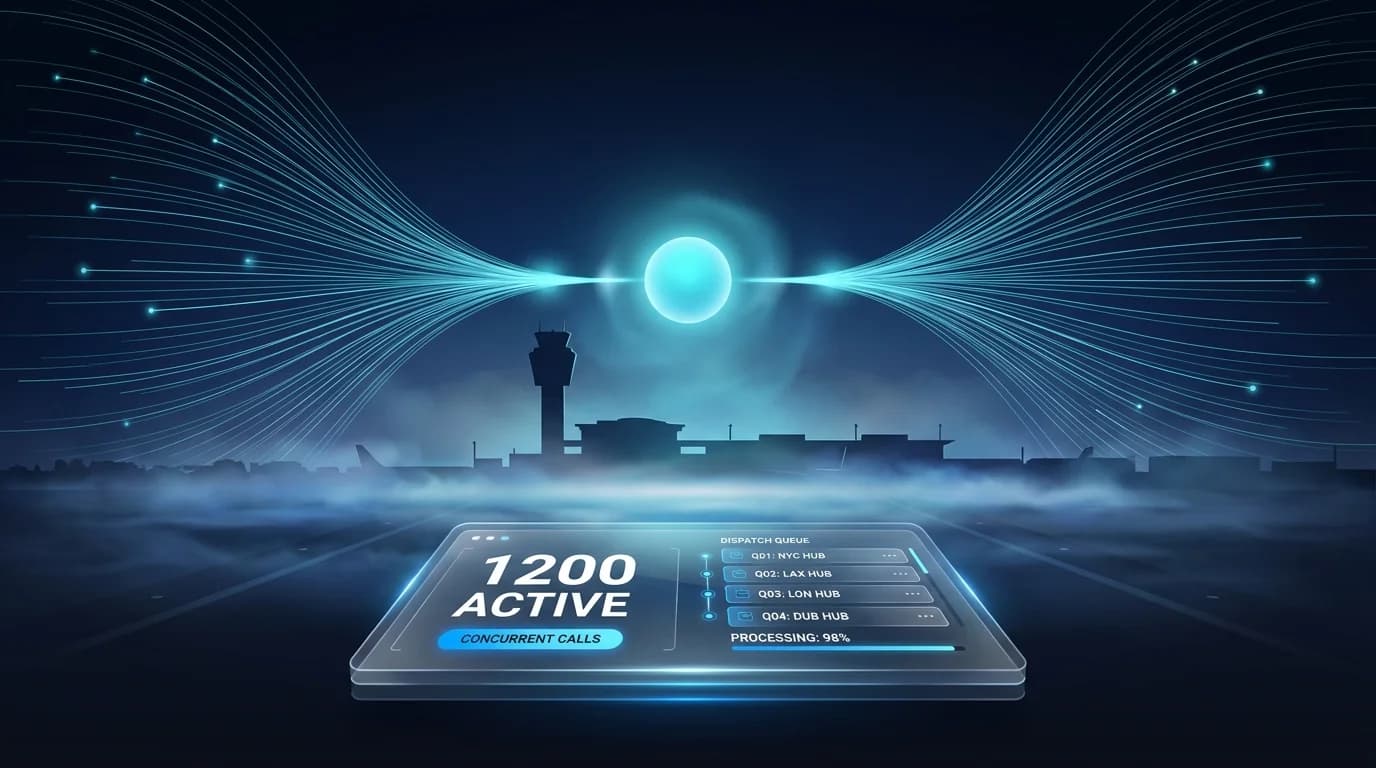
It's 6:42am on a Tuesday in winter. Auckland Airport is fogged in. 70 flights cancelled before morning coffee.
Air New Zealand's contact centre lights up. Every line, all at once.
The call queue hits 1,200 in the first 20 minutes. Average hold time stretches to 47 minutes by 8am. Travellers start tweeting screenshots of the hold music timer. Local media picks it up by 9.
Your team caps at one call a minute. The queue caps at infinity.
By the time a human picks up call 1,200, the customer has already booked an Uber, missed a meeting, and rebooked themselves on Skyscanner.
You couldn't have hired enough humans to fix this. You were never going to.
But your voice agent could have eaten the queue.
The pattern: humans are linear, agents are parallel
This is Playbook 3 from the voice agent column we have been running.
Five playbooks beyond the AI receptionist. This one's the most-misunderstood by operators in your space.
The receptionist handles the predictable trickle. The trickle's easy.
Spike-load is different. Three flavours of phone load that humans cannot scale through:
The long single call. One hold-the-line task that takes 45 minutes per call.
The dropped escalation. The call your human handoff didn't answer.
The mass-spike event. 70 flights cancelled, 1,200 callers in 20 minutes.
Three flavours. One pattern.
Same agent. Same minute pricing. Same 800ms first-token reply.
The agent is parallel. Your humans are linear. That's the whole story.
Flavour 1: The 45-minute hold-time killer
Your team's worst call is the one nobody ever gets to make.
The dental clinic admin who needs to ring the insurer to verify a patient's cover. The physio chasing nib for pre-auth. The mortgage broker on hold with the lender for the third time this week.
Each call is 30 to 60 minutes. Most of it is hold music. The actual transactional minute is the last 90 seconds.
Your team won't do it. They'll find a thousand other tasks. The patient sits in your waiting room because nobody confirmed cover.
Your team's nightmare? A US dental chain called West Coast Dental put this exact call on AI. The voice agent dials the insurer. Sits on hold for 45 minutes.
Navigates the IVR. Verifies cover. Writes the result back into your practice management system.
10,000 of those calls a month. Five staff members back to billable work.
Want the Hamilton specialist clinic version? Same flow.
Tane the practice manager has a list of 30 patients booked for next week. Each one needs Southern Cross or nib pre-auth. Tane used to do these on Friday afternoons, getting through 8 of them before he gave up at 5pm.
Now the agent runs your queue overnight. Tane wakes up Monday morning. All 30 verified. Two flagged for human follow-up because the policy doesn't cover the procedure code.
Tane calls those two patients first thing. By 9am he's resolved both. Surgery list locked. Nobody's left wondering at the front desk.
(The patients don't know AI made the verification call. They don't care. They just know their procedure happened.)
Flavour 2: The clawback when human handoff drops
Sometimes your voice agent does need to escalate to a human. Then the human doesn't pick up.
You've now got the worst of both worlds. The customer thinks they were promised a human. They got dropped.
A US auto group called Toma built a "clawback" mechanism. If the human escalation isn't picked up in 30 seconds, the agent retrieves the call. Books the appointment anyway. Files the human-pickup ticket as a follow-up.
That mechanism saved 22,000 calls in 90 days at one 16-dealership group. 40% reduction in BDC team workload.
We've shipped a variation of this. We documented the mechanic in agent-to-agent transfer with full context preservation.
Want the Wellington version? An auto group service drive.
Customer rings on a Thursday morning about a recall on their Honda. Voice agent qualifies the issue. Confirms the customer's preferred service date.
The agent escalates to the service manager for the booking confirmation. Service manager's on another call.
30 seconds tick by. Your agent doesn't drop the customer.
It says, "Hey, looks like the service team's on another call. Let me lock that booking in for you now and they'll ring you back to confirm. Same Thursday at 2pm work?"
Customer says yes. Booking locked in DMS. Service manager gets a follow-up ticket with the customer's number and the booking reference.
Without the clawback, that call goes to voicemail. The customer rings the dealership two suburbs over. You lost the service for a $40 oil change and a $4,000 transmission repair the technician would have spotted.
(Most operators don't realise how much revenue they're losing to handoff drops. It hides in the gap between "customer rang" and "customer never rang back".)
Flavour 3: The mass-spike event
Back to AKL fog day. 1,200 callers in 20 minutes. Your team caps at one call a minute.
A European airline put 100% of its disruption-day rebookings on AI voice agents. When 70 flights cancel at once, humans cap at one call a minute. The agent runs ten thousand simultaneously.
Want the Air NZ version? Air NZ has already announced its OpenAI partnership. This is the obvious next move for them.
(I'd put a coffee on it shipping before the 2027 winter cycle, not after.)
The mechanic on a fog day:
Your agent answers every call within two seconds, regardless of queue. No hold music. No "your call is important to us" voicemail loop.
Each call on your line follows the same flow.
Identify the booking by phone number lookup. Present three rebook options based on fare class and availability. Execute the change in your PMS.
Send the new boarding pass via SMS. Log a courtesy code for ground crew if the customer needs it.
A normal day handles 50 calls per agent shift. Storm day handles ten thousand calls per agent shift. Same agent. Same minute pricing.
Here's the part operators miss. The mass-spike pattern isn't only for airlines.
Want the Wellington insurance broker version? Storm damage across the city.
200 customers ringing about claims in the first hour. Your team of three is drowning.
The agent picks up every call. Captures the claim details. Books the assessor visit. Sends the customer a reference number and a 24-hour callback promise.
Your team comes in at 9am. The queue's already triaged. They start on the high-priority claims first.
Same trick for an SMB after a marketing campaign goes viral. Same trick for a clinic after a vaccination booking opens at 8am. Anywhere you can predict the spike, the agent can eat the queue.
What every spike-load setup needs
Three things. None of them are exotic.
Concurrent call capacity. Your phone provider needs to handle the simultaneous load.
Most NZ providers cap free tiers at 10 to 20 concurrent. Storm-day work needs 200+. Pre-purchase the capacity.
A predictable script per flavour. Hold-time calls follow a strict IVR walk.
Clawback calls follow a "soothing fallback" pattern. Mass-spike calls follow a "qualify and triage" pattern. Don't reuse the same script.
A clean back-end write. The agent's only useful if its outcome lands in the system your humans look at next. Practice management system, dealership management system, claims platform. Wire the write before you wire the agent.
Honest moment: when spike-load setups blow up
Me: "What's the worst spike-load failure you've shipped?"
Builder: "Storm event. Concurrent cap was 50. Customer base hit us with 280 calls in five minutes. The agent dropped 230 of them on a busy tone."
Me: "How did you fix it?"
Builder: "Pre-paid the concurrent cap up to 500 before the next predictable storm event. Costs $400 a month sitting idle. Worth every cent on the day you need it."
The pattern: predict the spike, pre-pay the capacity. Most operators only buy capacity after they've already lost the customers.
(Pre-paying capacity is the boring part. The spike is the dramatic part. The boring part is what makes the dramatic part go right.)
Your spike-load checklist
Five questions before you ship:
Then two more:
If you can answer all five, you're ready to ship.
If you can't, the next storm day is where you'll lose 230 customers to a busy tone. Pre-pay the capacity now.
Pick the spike that already costs you customers
Three flavours. One pattern. The agent is parallel.
Same engine that picks up your missed call at 9pm. Same minute pricing. Different trick.
The competitors who deploy this in your space are quietly absorbing your spike-day customers. The ones who didn't get through to your team yesterday are already booked with theirs today.
Pick the spike pattern that already costs you customers. Wire the agent. Run 60 calls in a sandbox before the next storm event. Playbook 5 will cover why.
Then watch the next AKL fog day land without your queue blowing out.
Far out, that's a long article. Pick one spike pattern. Ship one experiment.
Want help wiring your spike-load setup before your next predictable storm? Spend 25 minutes with me. We'll name your spike, size your concurrent capacity, and pick the flavour that bleeds the most.
Book a slot here and check our pricing first.
See this service for the full detail.
Leonardo Garcia-Curtis
Founder & CEO at Waboom AI. Building voice AI agents that convert.
Ready to Build Your AI Voice Agent?
Let's discuss how Waboom AI can help automate your customer conversations.
Book a Free Demo